
Renting an office in a city you want to rank in almost never buys a second location Google ranking, and it can cost you the profile you already have. Google’s own guidelines say a rented mailing address “isn’t eligible for a Business Profile” and that a service business travelling to customers is allowed one profile. A real branch with your sign on the door, your own staff inside it and its own service area is a different thing, and it is allowed.
What’s in this guide
- The short answer on a second location Google ranking
- What Google counts as a location
- The rented mailing address is the one clear no
- Coworking is not a loophole, it is a longer checklist
- Why the building’s receptionist is not your staff
- What actually drives a second location Google ranking
- The verification video is where most of these plans die
- What a second location that qualifies looks like
- What it costs if Google decides you were wrong
- The quieter risk: editing the address you already have
- Employee homes, a friend’s shop and the storage unit
- The service area you already have
- What the office costs before any ranking shows up
- Where this stops being a marketing question
- Numbers you should not believe about local ranking
- The ten minute test to run before you sign anything
- What to do on Monday instead
- Questions trades owners ask about a second location Google ranking
- Sources
The short answer on a second location Google ranking
If the office is real, you qualify. If it is an address you pay for, you do not. Google’s guidelines put it in one sentence: a rented physical mailing address your business does not operate out of “isn’t eligible for a Business Profile”. There is no version of that arrangement that becomes eligible because the address is hidden, because a receptionist signs for your mail, or because your accountant lists it on a state filing.
What is allowed is narrower than the sales pitch and wider than most owners assume. Google permits one profile for a service business that travels to customers, and one profile per location when you genuinely have more than one location with its own staff and its own service area. The question is never whether you can have a second pin. It is whether the second pin has a crew behind it.
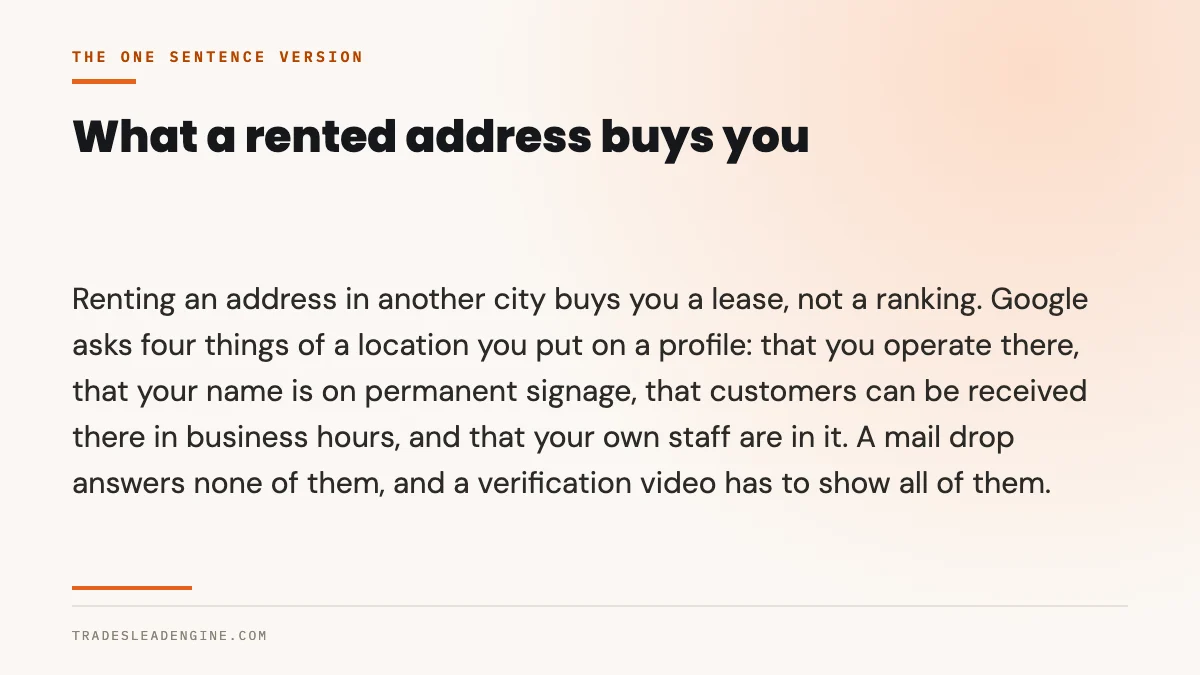
Renting an address in another city buys you a lease, not a ranking. Google asks four things of a location you put on a profile: that you operate there, that your name is on permanent signage, that customers can be received there in business hours, and that your own staff are in it. A mail drop answers none of them, and a verification video has to show all of them.
What a rented address actually proves, drawn to scale
Top: how many of Google’s four stated conditions each kind of address satisfies, at 130 pixels per condition. Bottom: how long Google’s position on rented offices has been on the public record, at 0.22 pixels per day between two fixed dates.
What Google counts as a location
Start with eligibility, because everything else follows from it. Google’s guidelines open by describing two kinds of business that can have a profile at all, and a trades business is usually the second one.
If your business either has a physical location that customers can visit, or travels to customers where they are, you can create a Business Profile on Google.
Google Business Profile Help, Guidelines for representing your business on Google
Notice what the second half does not say. It does not say you can have a profile wherever you travel. It says travelling to customers is a reason you are eligible, and the guidelines then cap the result: a business with no storefront that travels to customers “you’re allowed one service-area Business Profile”. One. The pin goes where the business is based, and the service area describes where the trucks go.
The address rules are blunt about what an address is for. “Use a precise, accurate address and/or service area to describe your business location. P.O. boxes or mailboxes located at remote locations aren’t acceptable. Create your Business Profile for your actual, real-world location.” A profile is a claim about a place that exists, not a marker you place where you would like the work to come from.
There is also a standing instruction most owners have never read, and it is the one that kills the “just add another pin” plan outright: “Do not create more than one page for each location of your business, either in a single account or multiple accounts.” Two accounts is not a workaround. It is the example Google gives of the thing not to do.
The rented mailing address is the one clear no
Most of local search is judgement. This part is not. If you pay for an address and do not work from it, the address cannot carry a profile, and Google says so in one sentence with no conditions attached.
If your business rents a physical mailing address but doesn’t operate out of that location, also known as a virtual office, that location isn’t eligible for a Business Profile.
Google Business Profile Help, Guidelines for representing your business on Google
The test in that sentence is “operate out of”. Not own, not rent, not receive post at. The reason the rule reads that way is that a profile sends a person to a door, and Google is protecting the searcher who drives to the door rather than the owner who paid for it. Joy Hawkins of Sterling Sky, who has taken more of these cases to Google than almost anyone, calls it “very cut and dry”, and her September 2026 re-read of the guidelines reaches the same answer the page did nine years ago.
Two paragraphs apart, the guidelines say a virtual office “isn’t eligible for a Business Profile” and that service-area businesses “can’t list a ‘virtual’ office unless that office is staffed during business hours”. Read alone, the second line sounds like permission with a condition. It is the line vendors quote. In practice it is the same rule stated from the other end, because an office staffed by your own people during business hours is no longer a virtual office. If somebody shows you that sentence as the reason your plan is fine, ask who exactly is going to sit in the room all day.
Coworking is not a loophole, it is a longer checklist
Shared offices look like the gap in the rule, and they are the next thing suggested once the mail drop is ruled out. Google addresses them directly, with three conditions in one sentence.
Businesses can’t list an office at a co-working space unless that office maintains clear signage, receives customers at the location during business hours, and is staffed during business hours by your business staff.
Google Business Profile Help, Guidelines for representing your business on Google
Read those as a shopping list rather than a policy. Clear signage means your business name on the space, which most shared offices will not let you fix to a wall. Receiving customers during business hours means a homeowner can walk in and be dealt with. Staffed by your business staff means somebody on your payroll, in that room, during the hours published on the profile.
A plumbing company with four trucks does not have a spare person to sit in a shared office in another city. That is not a criticism, it is arithmetic, and it is the honest reason the coworking route almost never survives contact with a real schedule. If you can genuinely staff it, the route is open and legitimate. If you are already thinking about who you could ask to cover it, you have your answer.
Signage matters separately, for any location you show publicly: “Businesses showing their address on Google should maintain permanent fixed signage of their business name at the address.” Permanent and fixed rules out a printed sheet taped inside a glass door for the week the verification video is filmed.
Why the building’s receptionist is not your staff
Every serviced office sells a person at a desk, and that person is the single most common reason owners believe they qualify. Somebody is there, in business hours, and will greet a visitor who asks for you. That reads like staffing until you ask who pays them.
Hawkins answers it in two sentences in her comment thread: “Paying a virtual office to have a receptionist doesn’t make it staffed. The staff would need to be employed by the actual business.” Her article also reproduces the proof Google has asked for in these cases, including that “Virtual office employees are NOT considered to be the merchant’s employees” and that the phone number “must be a direct line to the business”.
That is a practitioner’s account rather than a help page, and it is labelled as one here. But it matches the wording on Google’s own page, which says “your business staff” and not “staff at the location”, and the distinction is the whole thing. A shared receptionist can take a message. They cannot represent your company to a customer who wants a quote on a repipe.
What actually drives a second location Google ranking
The plan rests on a theory about distance, so it is worth reading what Google currently publishes about it. The wording changed at some point before this was written, and the current version is more specific than the one most local SEO articles quote.
Local results are mainly based on relevance, distance, and popularity.
Google Business Profile Help, Tips to improve your local ranking on Google
Distance now reads: “Distance refers to how far each business is from the customer who’s searching. If a customer doesn’t share where they are, Google uses what it knows about their location.” Measured from the customer, not from the words they typed. An eligible address in the middle of the city helps when somebody standing in that city searches, which is exactly why a genuine branch is worth something and exactly why an ineligible one is worth nothing.
The other two factors are where a trades business can actually win, and neither needs a lease. Relevance “is how well a Business Profile matches what someone is searching for”, which is categories, services and the words on the profile. Popularity, which the same page then calls Prominence, is “based on info like how many websites link to your business and how many reviews you have”. That is reviews, links and reputation, and it travels with you into every town you serve.
Google says plainly that “More reviews and positive ratings can help your business’s local ranking”. A hundred reviews mentioning the towns you actually work in cost nothing but the asking, and they move the factor Google names, in every city at once. A rented office moves one factor, in one city, only if the office is eligible. Our guide on how many Google reviews you need to rank covers the arithmetic.
One caution on that page: the summary sentence says “popularity” while the heading below it says “Prominence” and defines the same thing. Google rewrote this page and left both words in it. Nothing turns on which word you use, but it is a reminder that a help page you quoted last year may not say the same thing today, and that a URL still resolving tells you nothing about the sentence you took from it.
There is also a line on the same page that should end every conversation with anyone selling a shortcut: “There’s no way to request or pay for a better local ranking on Google. We do our best to keep the search algorithm details confidential to make the ranking system as fair as possible for everyone.”
The verification video is where most of these plans die
Suppose you sign the lease anyway. The profile still has to be verified, and you do not get to choose how. “Verification methods are automatically determined by Google and can’t be changed”, and the options depend “on your business type, public info, region, or business hours”. Google’s own recommendation, where it is offered, is the video.
Video verification is the part nobody factors in, because it asks you to film the three things a rented address cannot show. For a storefront or hybrid listing, the video must show the location, show the business exists, and show you manage it.
Show proof that your business exists: Include your storefront, showroom, or business signage. Make sure your business name is clearly printed on a permanent fixture, like a signboard, wall, or window. The name shown in your video must match the name on your Business Profile.
Google Business Profile Help, Verify your business with a video recording
Then the third test: “Show proof of management: Prove that you manage or represent the business. Record things only an employee can access, like opening a cash register, kitchen, storage room, or using a point-of-sale system.” In a shared building you have access to a desk and a door code the same as everyone else on the floor. There is nothing to open that is yours.
The review takes “up to 5 business days”, and a failed attempt is not fatal, since Google tells you why and lets you submit another. But you will be submitting another video of the same room, and the room is the problem. Meanwhile the clock on the lease is running.
For a service-area business the video requirements are built around a truck and a trade, not a lobby. Google asks you to “Show the professional tools, equipment, or products you use for work”, which “can include specialized machinery, your workspace, business cards, or branded apparel”, and to prove management by “unlocking a van that has your business branding” or showing “a business permit, invoice, or utility bill”. If you run from home, “you can record landmarks and signs in your immediate neighborhood to verify the address”. Every contractor already owns everything on that list.
What a second location that qualifies looks like
None of this means a growing company cannot have two pins. It means the second pin follows the business rather than leading it. Google’s guidelines state the condition in one sentence, and it is worth reading slowly.
If you have different locations for your service business, with separate service areas and separate staff at each location, you’re allowed one profile for each location.
Google Business Profile Help, Guidelines for representing your business on Google
Two conditions, both of them about the real world. Separate staff means a crew based there, not the same two technicians driving over from the first yard. Separate service areas means the two profiles do not cover the same towns, which also means the second location has to serve somewhere the first one does not. Sterling Sky’s guide on multiple listings states the same pair as the test: “You have different staff servicing the different areas” and “The service areas don’t overlap”.
Put those together and the plan stops being a marketing decision. A second qualifying location means a lease, a sign, a crew, their own area, and a direct phone line. That is an expansion. If the business is ready for one, the profile is the easy part. If it is not, no address solves it.
A warehouse or yard you actually use counts, which surprises owners who assume they need a shopfront. Hawkins answers that case directly in her comments: if you rent or own the space and use it for the business, “I see no reason why you can’t use it. That’s not a virtual office.” The point is occupation, not retail footfall.
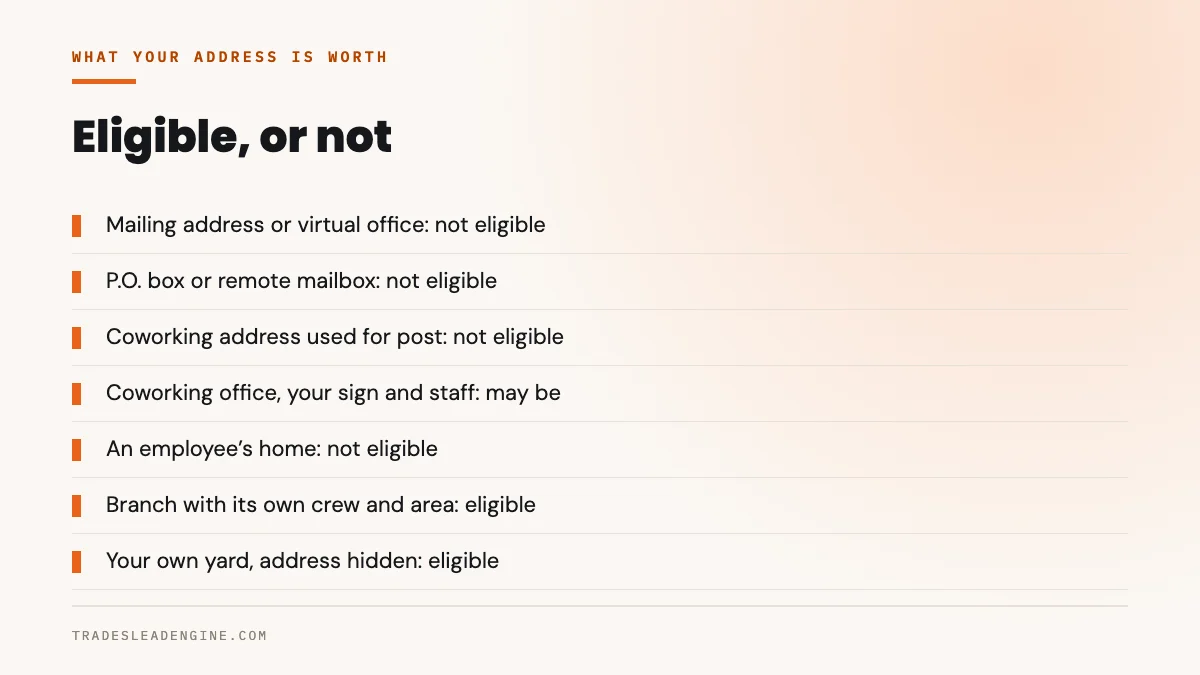
| What you are paying for | Eligible for a profile | What Google requires | Realistic outcome |
|---|---|---|---|
| Mailing address or virtual office | No | Nothing will make it eligible while you do not operate there | Verification fails, or the profile is suspended later |
| P.O. box or remote mailbox | No | Named as not acceptable in the address guidelines | Rejected |
| Coworking address used for post and the odd meeting | No | Signage, walk in hours and your own staff, none of which apply | Verification fails on the signage and management tests |
| Coworking office with your sign, your staff and walk in hours | Possibly | All three co-working conditions, permanently | Works if you can truly staff it every published hour |
| An employee’s home | No | Authority to represent the location, which you do not have | Suspension risk, plus a mess when they leave |
| Second branch with its own crew and its own area | Yes | Separate staff and non overlapping service areas | One profile per location, as the guidelines allow |
| Your own home or yard, address hidden | Yes | Hide the address and set a service area | One service-area profile, which is what you already have |
What it costs if Google decides you were wrong
The downside is not that the new profile disappears. It is that the penalty is applied to the account, and the account holds the profile your phone actually rings from.
Your account may be restricted when you violate our policy. As a result of an account restriction, the Business Profiles you manage are suspended and you won’t be able to create or claim other profiles.
Google Business Profile Help, Fix suspended or disabled profiles
The removal page is blunter still. If Google removes a profile, “The public can’t go to the profile” and “The owner and managers can’t act on the profile”. If it removes the owner’s Google Account, “We remove all the locations owned by that user”. One ineligible pin, filed to chase one city, sits in the same account as the listing that has your reviews on it.
Two more details worth knowing before you gamble. “Appeals can only be submitted once”, so there is no iterating your way out with three attempts. And “Do not create a new Business Profile for the same business” while you are appealing, which is the instinctive reaction and makes the situation worse. Our guide on what to do when your Business Profile is suspended walks the process.
Sterling Sky’s own framing of the risk, from the same article: an address that is not eligible is “one of the most common reasons” profiles get suspended, and for a service-area business caught using a virtual office, Hawkins writes that the result “would be a hard suspension which means their listing would get removed entirely”.
Not sure whether your profile is set up the way Google expects
The free Lead Engine Scorecard checks your site and your local presence the way a cautious homeowner and an AI assistant both check them: speed, conversion blockers, trust signals, rankings and whether you are being cited in AI answers at all. No sales call required.
Get the free Scorecard
Questions first? leads@tradesleadengine.com · (726) 224-4920 · see what local SEO actually involves
The quieter risk: editing the address you already have
There is a version of this plan that feels safer than adding a profile, which is moving the existing one. Change the address on the listing you already have to the new office, keep one profile, stay inside the one-location rule. It is the worst option on the table.
Sterling Sky notes the mechanism in one line: “updating the address on a service area business listing often causes a GBP suspension”. Editing the core field on a verified profile is exactly the kind of change that sends it back for review, and the profile under review is the one with your reviews, your photographs and your call history attached.
If the business has genuinely moved, you still have to do it, and it is worth doing deliberately rather than on a Friday afternoon. If the business has not moved and the edit is a ranking experiment, you are risking a working asset to test a theory the guidelines already answer.
Employee homes, a friend’s shop and the storage unit
Once the office idea is dead, three substitutes usually appear. All three have been asked and answered.
Your technician’s house in the next town
Sterling Sky’s answer is that when this has come up at industry events, “Google has always said no”, because “The guidelines say not to use a location that you don’t have the authority to represent. Employees are not owners and might not always work for your company.” The practical half of that is the part owners underestimate: when the technician leaves, their home address is attached to your business across a dozen directories.
A friendly business that will let you use their address
This can work only in the form where it stops being a favour. Sterling Sky’s answer to a similar case is that it could qualify “as long as it’s their staff (not the other law firm’s staff) that works there” and there is proper signage. In other words, you are renting part of a building, putting your sign on it and putting your own person in it, which is the coworking checklist again.
A storage unit or yard you really do use
This is the one that often survives. Asked about renting depot space in each city for crews to work out of, with no customers visiting, Hawkins’ answer was that such locations “would most likely qualify” and that Google can confirm a specific case. Occupation is the thing being tested, so a space you genuinely operate from is in a different category from a space you merely rent an address at.
Nothing here is legal advice and we are not your lawyer. Two parts of this decision are genuinely outside a marketer’s competence: whether your lease permits the signage Google requires, and what a second place of business does to your tax and filing position. Both are covered further down, and the answer in both cases is to ask the professional whose name is on the advice.
The service area you already have
Before you buy coverage, check what you are already entitled to claim. One profile carries a service area, and the published limits are more generous than most contractor profiles use.
Google allows up to 20 service areas on a profile, and says “The boundaries of your overall area shouldn’t be more than about 2 hours of driving time from where your business is based”. The guidelines add a note the service area page leaves out: “For some businesses, larger service areas may be appropriate.” Two hours of Texas driving from one yard is a lot of towns, and most profiles we look at list three or four areas.
Two mechanical details. If you set your area as a radius years ago, “you can’t edit it” and will have to re-specify it by city or postal code instead, which is a ten minute job nobody has done. And if you do not see customers at your address, “remove your address from your Business Profile”, which is the setting covered in our guide on hiding your address on a Business Profile.
The honest limit is that a service area tells Google where you will go. It does not plant you in the middle of a city for someone searching from there, which is why owners keep reaching for a second address. The answer to that gap is pages and reputation, not property, and we covered the page side in whether to build a page for every city you serve and the ranking side in why you do not show up on Google Maps in every city.
What the office costs before any ranking shows up
The marketing case for the office is always framed against the rent. The real bill is longer, and every line of it is spent before a single call arrives.
There is the rent itself, which commenters on Sterling Sky’s article put at $225 a month for a city centre serviced office and $400 for a small one. Those are two owners’ own figures rather than published research, so treat them as the shape of the number rather than the number. Then the signage, which has to be permanent and fixed, and which a landlord may simply refuse.
Then the staffing, which is the real cost and the one that cannot be bought cheaply. A published set of opening hours with nobody behind them is a promise to every homeowner who drives over, and the profile is where they got the hours. Then the phone line, since Google’s casework asks for “a direct line to the business” at that location, which means another number to answer and another number to track.
Weigh all of that against the alternative uses of the same money, because that is the actual decision. Reviews, a site that converts, and answering the phone are all cheaper per lead than a lease and all work in every town. Our guide on what a contractor website costs in Texas gives a sense of the comparison, and how long local SEO takes sets the honest timeline.
Where this stops being a marketing question
A second place of business is a tax and compliance event, not just a map pin, and this is the part that gets skipped because it is boring. It is also the part with deadlines attached.
In Texas, the equipment and inventory you put in a location are taxable where they sit, and the location’s appraisal district wants to hear about them. Comal Appraisal District states the general rule plainly: “If you own a business, you are required to report personal property that is used in your business to your appraisal district”, and “Texas requires a business to pay property taxes to each taxing unit based on the market value of the inventory and assets it owns or uses in the production of income.” The rendition deadline is April 15.
So putting a van, a stock of fittings and a desk in another county can create a filing obligation in that county. Whether it does in your case, and what it does to your local sales tax position, is a question for your accountant, and the right time to ask is before you sign rather than in April.
The licensing side is separate again. If your trade is licensed, your advertising obligations follow you to every new address and every new number, which we set out in our guide on putting your license number on your website in Texas. A new location means new printed material, and new printed material means the same rules apply to it.
For the accountant: does a leased location in another county create a rendition or local tax obligation for us, and what is the deadline. For the attorney or the landlord: does the lease allow permanent fixed signage carrying our business name, since Google requires it for any address shown publicly. Both answers are short, both are cheap, and both arrive before the lease rather than after.
Numbers you should not believe about local ranking
Pitches for extra locations tend to arrive wrapped in statistics, and the statistics in this niche are largely invented. Four that circulate constantly and trace to no openable source: that “42% of clicks go to the local pack”, that “consistent listings make you 40% more likely to rank”, that “optimising your listing lifts direction requests by 2,717%”, and that businesses with more than fifty reviews are “266% more likely to appear in the local pack”. Several trace back to statistics pages that attribute themselves to HomeAdvisor, Angi or IBISWorld and cite nothing.
A second category is softer and deserves a fairer treatment. “97% of consumers search online for local businesses” and “46% of all Google searches are local” may once have been real research. Neither has a source you can open today. Rather than calling them fabrications, ask the person quoting them for the link before you agree to anything priced against them.
It would be a useful number and we cannot find one. Nobody publishes how many trades businesses rent addresses to chase rankings, how many get caught, or what proportion of suspensions it causes. Where a number here is real, it came from Google’s own pages or from a named practitioner’s published casework, and it is attributed to whichever it was. An article that told you “68% of contractors have tried this” would be making it up.
What does exist is Google’s own documentation, and it is better evidence than any borrowed figure. The guidelines, the service area limits, the verification requirements and the suspension consequences are all published, free, and quoted above with links. That is the whole case, and it does not need a percentage.
The ten minute test to run before you sign anything
Four questions. If any answer is no, the address will not carry a profile, and no amount of optimisation changes that.
1. Will your business operate out of that room
Not visit it. Operate out of it. If the honest answer is that somebody will collect post and use the meeting room twice a quarter, the guidelines have already settled it.
2. Can you fix a permanent sign with your name on it
Ask the landlord in writing, before signing. Google asks for “permanent fixed signage” at any address shown publicly, and the verification video wants your name “clearly printed on a permanent fixture, like a signboard, wall, or window”.
3. Who is in the room during your published hours
Name them. If the name belongs to the building’s staff rather than your payroll, that is not staffing for this purpose. If you cannot name anyone, do not publish hours you cannot keep.
4. Is there anything there only your employee can open
This is the verification question. The video has to show you accessing something that is yours, in that space. A shared desk and a door code are not that.
Ask them to show you the sentence in Google’s guidelines that permits it. Ask who will be in the office during the published hours. Ask what happens to your existing profile if the new one is found ineligible. And ask them to put the answer to the third question in writing. A vendor who will not write it down has told you what they think the risk is.
What to do on Monday instead
The money for the office, spent on the things Google actually names, in roughly this order.
Open your profile and re-specify your service area by city rather than radius, up to the 20 Google allows, out to a sensible fraction of the two hour boundary. Check that your address is hidden if customers do not come to you. Confirm the categories are right, which is the relevance lever and is covered in our guide on choosing Business Profile categories.
Then the two factors that are not geographic. Ask every customer for a review, which is the popularity lever Google names, and make sure the ones you have are not quietly vanishing, which we covered in why your Google reviews disappear. Then build one genuinely useful page per town you actually work in, with real jobs and real photographs on it.
Then check who holds the keys. If an agency or a former marketer controls the profile, that matters more than any new pin, and our guide on getting your Business Profile back from your old marketing company covers it. While you are in there, look at your competitors’ names, since a padded business name is the other thing owners see and assume they have to copy, which we handled in why your competitor has keywords in their Google business name.
Finally, the honest growth answer. If a city is worth a location, open one properly: a lease, a sign, a crew based there and its own service area. Google allows one profile per location on exactly those terms, and at that point you are not gaming a map, you are a two branch company that happens to be correctly listed.
Want to know what is actually holding your rankings back in the next town
The free Lead Engine Scorecard looks at the things Google names: your profile, your categories, your reviews, your site speed and whether AI assistants cite you at all. It takes a couple of minutes and it is cheaper than a lease.
Get the free Scorecard
Questions first? leads@tradesleadengine.com · (726) 224-4920 · see what local SEO actually involves
Questions trades owners ask about a second location Google ranking
Can I rent an office in another city to show up there?
Only if you will genuinely operate out of it. Google’s guidelines say a rented physical mailing address a business does not operate out of, “also known as a virtual office”, is not eligible for a Business Profile. If the office will have your permanent sign on it, your own staff inside it during your published hours, and customers able to walk in, it is not a virtual office and it can be listed. If it will not, renting it buys you a lease and a suspension risk.
What if I hide the address so nobody can see it?
Hiding the address does not change eligibility. The guidelines treat the location itself as ineligible, not the display of it, and the profile still has to be verified against that address. Google asks service-area businesses to hide the address of the place they actually operate from, which for most contractors is a home or a yard. Hiding an address you do not operate from is a different thing, and it is the arrangement the rule was written about.
Does a coworking space count as a location?
It can, on three conditions stated in one sentence. Google says businesses cannot list an office at a co-working space “unless that office maintains clear signage, receives customers at the location during business hours, and is staffed during business hours by your business staff”. All three, permanently. Most shared offices will not allow fixed signage, and most small trades businesses cannot spare somebody to sit in one, so in practice the route is open but rarely usable.
The office has a receptionist. Is that staffed?
Not for this purpose. Google’s wording is “your business staff”, and the casework Sterling Sky reproduces states that “Virtual office employees are NOT considered to be the merchant’s employees”. A receptionist employed by the building can take a message, which is not the same as your company receiving a customer. Joy Hawkins puts it directly: paying a virtual office to have a receptionist does not make it staffed.
Can I use an employee’s home address in the town I want to rank in?
No. Sterling Sky reports that when this has been raised at industry events, Google has always said no, because the guidelines say not to use a location you do not have the authority to represent, and an employee is not an owner. There is a practical problem too. When that employee leaves, their home address is attached to your business across every directory that copied it, and changing the address on a verified profile often triggers a suspension of its own.
Will a virtual office get my Google Business Profile suspended?
It can, and the consequence lands wider than the new profile. Google’s help pages say an account restriction suspends every Business Profile you manage and stops you creating or claiming others, and that removing an owner’s Google Account removes all the locations owned by that user. Appeals “can only be submitted once”. So the realistic downside is not losing a listing you just made, it is risking the one your phone rings from.
How many cities can one profile cover?
Up to 20 service areas, with the overall boundary not more than “about 2 hours of driving time” from where the business is based, and the guidelines add that larger areas may be appropriate for some businesses. Most contractor profiles list a handful, so there is usually free coverage sitting unused. A service area tells Google where you will travel. It does not place you inside a city for someone searching from the middle of it.
When am I genuinely allowed a second Business Profile?
When you have a second location with separate staff and a separate service area. Google’s guidelines say that if you have different locations for your service business, “with separate service areas and separate staff at each location, you’re allowed one profile for each location”. A warehouse or depot you really operate from can qualify even with no customers visiting. The test is occupation and staffing, not retail footfall, and it is a question about the business rather than about the marketing.
Sources
- Guidelines for representing your business on Google, Google Business Profile Help. Eligibility, the address rules including P.O. boxes, the virtual office sentence, the three co-working conditions, permanent fixed signage, one profile per location, the one service-area profile rule, the separate staff and separate service areas condition, the two hour boundary, and the instruction to hide a residential address. Read 3 November 2026.
- Manage your service areas for service-area and hybrid businesses, Google Business Profile Help. The 20 service area limit, the two hour driving boundary, the note that an old radius area cannot be edited, and the instruction to remove the address if customers are not served there.
- Tips to improve your local ranking on Google, Google Business Profile Help. Relevance, distance and popularity, the definition of distance as the gap to the customer who is searching, the reviews and links factor, and the statement that there is no way to request or pay for a better local ranking.
- Fix suspended or disabled profiles, Google Business Profile Help. Account restriction suspending every profile you manage, what removal means for owners and managers, removal of all locations owned by an account, the single appeal, and the instruction not to create a replacement profile.
- Verify your business on Google, Google Business Profile Help. Verification methods being determined by Google and not changeable, the factors that decide which options appear, and the recommendation to use video where it is offered.
- Verify your business with a video recording, Google Business Profile Help. The storefront definition, the three things a video must show, the permanent fixture signage requirement, the proof of management test, the service-area equivalents including tools, branded vans and permits, and the five business day review.
- Google Business Profile Virtual Office Guidelines: Are They Allowed?, Joy Hawkins, Sterling Sky, 24 September 2026. The reproduced 2017 statement from Google’s policy team, the receptionist point, the three proof requirements Google has asked for, the eligibility comparison, and the published comment thread including a general contractor’s marketer asking this exact question. A practitioner account, labelled as such.
- When Can Service-Based Businesses Have Multiple Google My Business Listings?, Joy Hawkins, Sterling Sky. Ineligible addresses as a leading cause of suspension, the different staff and non overlapping areas test, the answer on employees’ home addresses, and the warning that editing the address on a service-area listing often causes a suspension.
- Business Personal Property and Renditions, Comal Appraisal District. The requirement to report business personal property to the appraisal district, taxation by each taxing unit on assets used in the production of income, and the 15 April rendition deadline. Quoted for the general Texas rule, not as advice on your situation.