
Every service-area contractor eventually runs the same experiment. You sit in your truck in a town you work in constantly, you search your own trade plus that town, and you’re not in the map pack. So you search from your shop and you’re second. Same business, same reviews, same everything — twenty miles apart.
The usual explanation you’ll get is that you need “more SEO.” That’s not an explanation, and it’s usually not the fix. The real reason is structural, and once you understand it, the list of things worth paying for in a local SEO program gets a lot shorter and a lot more specific.
Google Maps was built around places customers go to. Restaurants. Dealerships. Dentists. You are a business that goes to the customer, which means the single most heavily weighted input Google has — where you physically are — is the one thing about your business that doesn’t matter to the job. As the local agency LeadsNearby put it bluntly, map results “were not set up for service area businesses.”
That’s the bad news, and anyone selling you a guarantee of top-three placement in nine Texas cities is either lying or about to get your profile suspended. The good news is that the map pack is only one of three places a contractor can win a city, and the other two are fully under your control.
What’s in this guide
- The short answer, before the detail
- Proximity: the factor you can’t buy your way around
- What actually decides who ranks in a given city
- Why this hits Texas contractors harder than anyone
- The five things that genuinely move the needle
- Four “fixes” that will get you suspended
- A 90-day plan for one new city
- Questions contractors actually ask
The short answer, before the detail
Google ranks local results on three factors it names publicly: relevance, distance, and prominence. Distance means distance from where the person is searching — not from the edge of your service area, and not from the city you’d like to rank in.
You get one Google Business Profile for your whole service area. You cannot create a second profile for Katy, or New Braunfels, or Plano. Doing so is the single fastest way to get your real profile suspended. So in the map pack specifically, a contractor 30 miles out is competing against contractors who are two miles from the searcher, and losing on a factor that has nothing to do with skill.
What you can win, in any city, without physically being there:
- Organic results — the blue links under the map. Location-specific pages rank here, and there’s no proximity ceiling.
- The wider map radius — proximity weighting is strongest in dense urban cores and loosens considerably in low-competition suburbs and rural areas. A lot of Texas is the second kind.
- AI answers and Google’s AI Overviews, which pull from a broader source set than the map pack does and weight reviews, citations and page content differently.
If a city is 90 minutes away and you have no address there, no one can put you in its map pack reliably. What a good local SEO program does is win the organic results for that city, expand how far your pin carries, and make sure that when someone in that city does see you, you convert. Anyone promising more than that hasn’t read Google’s own documentation.
Proximity: the factor you can’t buy your way around
Google’s own support documentation for local ranking is unusually direct about two things. First, the three factors:
Local results are based primarily on relevance, distance, and prominence.
Google Business Profile Help — Improve your local ranking on Google
And second, the line that should end every conversation with a vendor who offers a shortcut:
There’s no way to request or pay for a better local ranking on Google.
Google Business Profile Help
Distance isn’t a tiebreaker. In Whitespark’s 2026 Local Search Ranking Factors study — an annual survey of 47 local search practitioners that’s the closest thing this field has to a consensus document — proximity of your address to the point of search ranks as the #2 individual factor for map pack placement, and “physical address in the city of search” ranks #4.
Here’s what that actually looks like in practice. The curve below isn’t from a single published dataset — it’s the pattern every service-area business sees in rank-tracking grids, and it’s why your position collapses so suddenly rather than fading gradually.
Why your ranking falls off a cliff, not a ramp
Typical map-pack visibility for one service-area business as the searcher moves away from its address. Dense urban cores decay fastest.
This is why two contractors with identical marketing budgets get wildly different results from the same work. One is in Cedar Park competing against 40 HVAC companies inside a 10-mile radius. The other is in Fredericksburg competing against six. Proximity weighting isn’t a fixed penalty — it tightens as competitive density rises.
What actually decides who ranks in a given city
The same Whitespark panel estimates how much each category of signal contributes to map pack placement. This is the most useful chart in local SEO, because it tells you where not to spend money.
What drives map pack placement
Estimated weight by signal category, Whitespark Local Search Ranking Factors 2026 (47 practitioners surveyed).
Two things jump out. Your Google Business Profile and your reviews together account for roughly half of map pack placement. And your website — the thing most contractors think of as “the SEO” — is 15%.
But flip to organic results, the blue links below the map, and the weights nearly invert: on-page content becomes the dominant factor at about a third, links come second, and your Business Profile drops to single digits. That inversion is the whole strategy for cities you can’t reach on proximity. You stop fighting for the map pack and go win the organic result instead.
Why this hits Texas contractors harder than anyone
Google’s service-area rules include a constraint most contractors have never read. Your total service area is not supposed to extend more than about two hours of driving time from where your business is based, and you can list a maximum of 20 service areas.
In a compact metro, two hours covers the entire market. In Texas, two hours from a San Antonio shop gets you to Austin and not much past it. Two hours from Fort Worth doesn’t reliably cover the east side of Dallas in traffic. Contractors here routinely run territories that are geographically larger than entire states elsewhere, and the platform’s defaults simply weren’t designed for that.
| Distance from your address | Map pack | Organic results | What to do about it |
|---|---|---|---|
| 0–10 miles | Strong — this is your core | Strong | Defend it. Reviews and profile completeness decide the top three here. |
| 10–25 miles | Contested; depends on competitive density | Strong | Real city pages plus reviews that name the suburb. Winnable with work. |
| 25–50 miles | Unlikely without an address there | Very winnable | Stop chasing the pin. Build the city page and target the blue links. |
| 50+ miles | Effectively out of reach | Winnable but slow | Organic + AI citation only, or open a real staffed location. |
Find out which cities you’re actually winning
A free Lead Engine Scorecard maps your current visibility city by city across the metros you serve — map pack, organic, and AI answers — and shows you which ones are realistic to take this year.
Get the free Scorecard
Or call (726) 224-4920 — same business day reply.
The five things that genuinely move the needle
1. Your primary category, which outranks everything else
In the Whitespark 2026 survey, primary Google Business Profile category is the #1 individual ranking factor for the map pack — ahead of proximity itself. There are roughly 4,000 categories available, you get one primary plus up to nine secondary, and most contractors pick the wrong one by being too generic.
“Contractor” is not the category. If you run air conditioning service, your primary should be the category a customer’s search maps to — HVAC contractor, air conditioning repair service, or furnace repair service — and those rank differently for different queries. Pick the primary to match your highest-margin service, then use the secondary slots for everything else you actually do. We break the choice down trade by trade in do GBP categories actually affect ranking.
2. One profile, correctly configured
You get one. Google’s guidelines state that service-area businesses “should have one profile for the central office or location with a designated service area,” and separately that you should not “create more than one page for each location of your business, either in a single account or multiple accounts.”
Two more rules that trip contractors up constantly: you cannot set your service area as a radius — Google requires named cities, postal codes or regions — and if you don’t serve customers at your address, you’re required to hide it. That second one has a real cost, which we cover in detail in our guide to hiding your address on Google Business Profile, because controlled testing has shown rankings can drop when an address is removed.
3. Reviews — enough of them, recent, and mentioning the city
Review signals are worth about 20% of map pack placement, and the Whitespark panel flagged a specific nuance for 2026: “sustained influx of reviews over time (rather than bursts)” is its own ranking factor, separate from raw count. Blasting 40 review requests the week your agency starts is actively worse than 4 a week for ten weeks.
The consumer side matters just as much. BrightLocal’s 2026 survey of 1,002 US adults found 47% won’t use a business with fewer than 20 reviews, and 74% specifically want reviews written in the last three months. A 4.9-star profile whose newest review is from 2024 is not the asset you think it is. We go deeper on the competitive math in how many reviews you actually need to beat your competitors.
4. City pages that a human would actually read
This is the organic play, and it’s where most contractors either skip the work or do it so badly it backfires. The standard failure is twenty near-identical pages with the city name swapped — which Google treats as thin, duplicated content, and which converts nobody.
Joy Hawkins of Sterling Sky, who has tested this more rigorously than almost anyone, has a rule worth taping to the wall: don’t just research statistics about a city — highlight your own statistics, gathered on the job. Her team also tried generating city pages with ChatGPT and reported it “failed pretty epically.”
What belongs on a real city page: jobs you’ve actually done there, with photos and the neighborhood named. Permit and inspection quirks specific to that jurisdiction. Equipment or system types common in that area’s housing stock. Reviews from customers in that city. Your response time to that city, stated honestly. That page can rank organically at 40 miles where your pin never will — and it’s the same page structure we use for Houston, Dallas–Fort Worth and every other metro we build out.
One more reason to do this properly: city pages built from real job detail are also what AI assistants pull from when someone asks ChatGPT or Google’s AI Mode who to call. That’s a different ranking game with different inputs, covered in how AI Overviews and ChatGPT actually pick which contractor to recommend.
5. Being open when people search
New in the 2026 factor list at #5: whether your business is open at the time of the search. That’s not a content problem, it’s an operations problem — and it connects directly to whether anyone answers the phone when the call comes in. If your hours say you’re open and nobody picks up, you’re paying for the ranking and giving away the job. That’s a separate and expensive problem, and we’ve put real numbers on it in what a missed call actually costs a Texas contractor.
Four “fixes” that will get you suspended
| The “fix” | What actually happens | Risk |
|---|---|---|
| Create a second profile at a friend’s address in the target city | Google’s guidelines prohibit more than one profile per location. Detection is routine, and enforcement often hits the original profile too. | Suspension |
| Rent a virtual office or mailbox to establish an address | Google requires a staffed location with signage that receives customers during business hours. A mailbox meets none of that. | Suspension |
| Add the city to your business name — “ABC Plumbing Austin” | Names may not include location or service information. Google states directly that unnecessary information in your business name “could result in the suspension of your Business Profile.” | Suspension |
| Spin up 30 city pages with AI and publish them | Thin duplicated content that ranks for nothing and dilutes the pages that could have worked. Sterling Sky’s own test of this approach failed. | Wasted spend |
Stop editing the profile immediately — excessive edits to critical fields are themselves a common trigger. Gather your business registration, trade licenses, and a utility bill before you start the appeal, because Google’s evidence form must be submitted within 60 minutes of opening it. Full walkthrough in our Google Business Profile reinstatement guide.
A 90-day plan for one new city
Pick one city. Not nine. The contractors who succeed at this treat each market as a project with a start and an end, rather than paying a retainer to “do SEO” across a territory.
| Window | What you do | How you know it worked |
|---|---|---|
| Days 1–14 | Run a rank grid for your core terms across the target city. Audit your primary category against the top three competitors there. Confirm the city is in your 20 service areas. | You have a baseline map showing exactly where you disappear. |
| Days 15–45 | Build one real city page with your own job photos, permit notes, and local specifics. Start a steady review ask — a handful per week, never a burst — and ask customers in that city to name the city. | The page is indexed; reviews mentioning the city start appearing. |
| Days 46–75 | Earn two or three genuinely local mentions — a chamber listing, a supplier’s contractor page, a local news or association mention. Add photos geotagged to jobs in that city. | The city page starts appearing in organic results for long-tail terms. |
| Days 76–90 | Re-run the same rank grid. Compare organic position for the city page separately from map pack position. | Organic movement on city-specific queries. If nothing has moved at all by day 90, the diagnosis was wrong — not the effort. |
Ask them one question: “For this city, are we going after the map pack or the organic results, and why?” A vendor who can’t separate the two, or who promises the map pack in a city 40 miles from your shop, is selling you something Google’s own documentation says isn’t purchasable.
Questions contractors actually ask
Can I rank in the map pack for a city where I have no address?
Sometimes, in low-competition areas, and rarely in dense ones. Proximity to the searcher is the #2 individual map pack factor in Whitespark’s 2026 study, and a competitor physically in that city has a structural advantage you cannot buy around. Treat the map pack as winnable within roughly 10–25 miles depending on density, and target organic results beyond that.
How many service areas can I add to my profile?
Twenty. Google also specifies that they must be named cities, postal codes or regions — you cannot set a radius — and that the overall area shouldn’t extend more than about two hours of driving time from your base. If you serve more than 20 towns, list the 20 that represent the most revenue, not the 20 that are furthest away.
Should I make a separate Google profile for each city I serve?
No. Google’s guidelines are explicit that a service-area business gets one profile for its whole area, and that you should not create more than one page per location. Multiple profiles is one of the most common causes of suspension, and the enforcement frequently takes down the legitimate profile alongside the duplicate.
Does adding the city to my business name help?
It’s a ranking factor and it’s a policy violation at the same time — which is why it’s so tempting and so dangerous. Keywords in the business title rank #3 in Whitespark’s factor list, but Google’s naming guidelines prohibit location and service information in the name, and state that unnecessary information “could result in the suspension of your Business Profile.” Competitors doing it are borrowing against a profile they may lose.
How long before I see results in a new city?
Expect movement on organic city-page rankings in roughly 60–90 days if the page is genuinely useful and gets a few real local links. Map pack movement in a city you’re far from may never come, and that’s not a failure of effort — it’s the platform working as designed. Ask your provider to report map and organic separately so you can tell the difference.
Do citations and directory listings still matter?
Less than the industry sells. In the 2026 factor weights, citations account for roughly 6% of map pack placement and about 7% of local organic. Consistent name, address and phone across the major aggregators is worth getting right once. Paying a monthly fee to maintain listings on 200 directories is not where the remaining 94% comes from.
Is it worth opening a real second location to rank in another metro?
It can be — but the bar is a genuinely staffed office with signage that receives customers during business hours, because that’s what Google’s guidelines require and what video verification checks for. A desk in a co-working space that nobody sits at will not survive review. If the second market is worth a real lease and a real person, the ranking follows. If it isn’t, win it organically instead.
What to do with this
The frustration is legitimate, and the explanation is not “you need more SEO.” Your pin is competing on a factor that has nothing to do with whether you’re the right company for the job, and in the map pack there is a real ceiling on how far it carries.
So split the problem. Defend the core with your profile and a steady flow of recent reviews. Take the middle ring with city pages built from work you’ve actually done. And for anything past that, stop paying for map pack promises and go win the organic result, where distance doesn’t apply and your content does.
Pick one city, run the 90 days, and measure map and organic separately. That single discipline — knowing which of the two you’re actually competing in — puts you ahead of most contractors in your market, and ahead of a fair number of the agencies selling to them.
See your city-by-city visibility, free
The Lead Engine Scorecard shows where you rank across every metro you serve — map pack, organic, and AI answers — plus the three cities most realistic to take next. No obligation, no sales call required.
Get the free Scorecard
Questions first? leads@tradesleadengine.com · (726) 224-4920
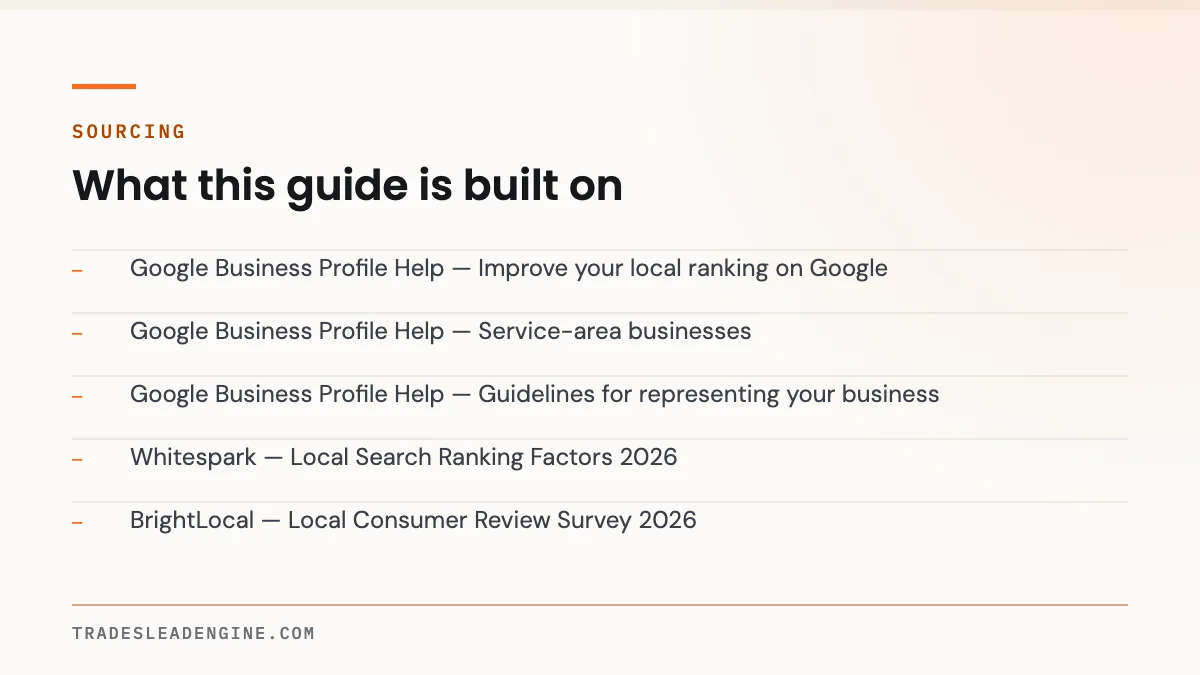
Sources
- Google Business Profile Help — Improve your local ranking on Google (relevance, distance, prominence; no paid ranking)
- Google Business Profile Help — Service-area businesses (20 service areas, no radius, ~2-hour boundary, one profile)
- Google Business Profile Help — Guidelines for representing your business (business name rules, co-working prohibition, suspension authority)
- Whitespark — Local Search Ranking Factors 2026 (47 practitioners; category, proximity, review recency and sustained-influx factors)
- BrightLocal — Local Consumer Review Survey 2026 (n=1,002 US adults, published Feb 2026)
- Sterling Sky — How to create unique and helpful service area pages
- ACHR News, August 2026 — HVAC contractor loses thousands after Google suspends Business Profile
- LeadsNearby — Why service area businesses don’t rank everywhere on Google Maps
Ranking-factor weights are practitioner estimates from a survey panel, not figures published by Google. Distance bands in this guide are directional and vary with competitive density.