
The question usually arrives the same way. Somebody knocks on the door at seven on a Saturday evening wanting a quote, because Google told them that’s where the plumbing company is. Or your wife points out that the family address is now a public pin with a review count attached to it. Or a customer shows up at a locked yard gate off a county road outside Austin expecting a showroom.
The advice you’ll get is split down the middle and delivered with total confidence either way. Half the internet says hide it, everybody does. The other half says never hide it, you’ll tank your rankings. Neither camp usually mentions that Google has a rule about this and that the rule isn’t optional.
The real situation is more awkward than either answer. Google’s policy requires you to remove your address if customers don’t come to you there. Google’s ranking system, meanwhile, weights proximity and a physical address in the city of search very heavily — and the one published controlled test of hiding an address found a severe ranking drop. Policy and performance point in opposite directions, and you have to live in the gap.
This guide covers what Google actually says about a business profile address, what Sterling Sky actually measured, how to decide which side of the line your business sits on, how service areas really work (20 of them, named places only, roughly two hours’ drive), what hiding does and doesn’t do for your privacy, and the co-working and virtual-office trap that puts contractors into suspension.
What’s in this guide
- The rule, in Google’s own words
- What happened when someone actually tested it
- So which do you do?
- How service areas actually work
- Spending your 20 slots properly
- The privacy question, answered honestly
- The co-working and virtual office trap
- Making the change without triggering a review
- Questions contractors actually ask
The rule, in Google’s own words
Google defines a service-area business with a sentence that decides this for most contractors:
A business that visits or delivers to customers directly but doesn’t serve customers at their business address.
Google Business Profile Help — Service-area businesses
And then it tells you what to do about it:
If you don’t serve customers at your business address, remove your address from your Business Profile.
Google Business Profile Help — Service-area businesses
That is not “you may.” Google’s separate page on managing your address puts the same fence up from the other direction: “You should only choose to not show your address if your business is a service-area business.” Hide it when customers don’t come to you. Show it when they do. There is no third option where you pick whichever ranks better, and it is the first thing we check on any Google Business Profile we take over.
The test is not whether you have an office, a shop, a yard, or a nice sign. It’s whether customers are actually served at that location. A plumbing supply counter with posted hours where homeowners walk in and buy a cartridge is a location that serves customers. A 3,000 square foot warehouse where the only visitors are your own techs and the parts delivery driver is not — no matter how real it is.
What happened when someone actually tested it
In October 2024, Joy Hawkins at Sterling Sky published the result of a controlled test on a real business: hide the address for a month, watch what happens, put it back, watch again. The finding was not subtle. Hiding the address produced a massive decline in rankings and a drop in calls. For one keyword the business disappeared from the local pack entirely — and came back when the address was restored.
That result fits the wider evidence. In Whitespark’s 2026 Local Search Ranking Factors survey of 47 local search practitioners, proximity of address to the search point is the #2 individual local pack factor and physical address in the city of search is #4. If removing the address from public view weakens how those signals resolve, a drop is exactly what you’d predict.
We’re citing this because it is the only published on/off test we could find, not because it settles the question. A single business over a single month can’t tell you the size of the effect on your business, in your city, in your trade. What it does establish is that the effect is real and can be severe — which is more than the “just hide it, it doesn’t matter” crowd can support with anything at all.
So the honest summary is: yes, you can hide your address. Often you must. And it may cost you map pack visibility, possibly a lot of it, and nobody can tell you in advance how much.
So which do you do?
Most contractors stop at “hide it and hope.” That is not a plan. The decision has two parts, and only the first one is actually a decision.
Part one is compliance, and it’s determined by facts about your business rather than preference. If customers are not served at your address, the address comes off. A ranking drop is recoverable. A suspension, as we covered in the Business Profile reinstatement guide, can take a profile offline for months while your competitors absorb the calls — nine months, in the case ACHR News reported in August 2026.
Part two is mitigation, and that’s where the actual work is.
| Your situation | Address | Why |
|---|---|---|
| Run the business from your house; nobody ever comes there | Hide it | Textbook service-area business. Google’s wording is that you should remove the address if you don’t serve customers there. |
| Gated yard or warehouse; techs load out, customers never visit | Hide it | Same rule. Storage and dispatch are not customer service at an address. |
| Shop with a parts counter, posted hours, and walk-in customers | Show it | You genuinely serve customers there, so the address stays — and you keep the proximity signal legitimately. |
| Showroom where remodel or solar customers view samples by appointment | Show it — if it’s real | Only if it’s staffed during your stated hours and you’d be comfortable with an unannounced visitor arriving in one. Otherwise it isn’t a customer-serving location. |
| Co-working desk or a rented mailbox | Neither | Don’t list it at all unless it meets Google’s co-working conditions in full. See below. |
| A relative’s house or an employee’s house in the city you want to rank in | Don’t | This is the classic suspension route, and enforcement often reaches the legitimate profile too. |
Two things to do the same day you hide the address. First, make sure the city your business is physically in is one of your listed service areas — hiding the address does not remove you from that city, but leaving it off your service area list can. Second, get the organic side moving, because organic results have no proximity ceiling.
A real city page for each market you care about will still be there if the map pin softens. That’s the whole play in why you don’t show up on Google Maps in every city you serve, and it becomes the priority of any local SEO program the moment you go address-hidden.
How service areas actually work
Once the address is hidden, service areas are how Google understands where you work. Three rules, all stated by Google, all of which contractors regularly get wrong.
One profile, not one per city
Google is explicit: “Service-area businesses can only have one profile for the whole area that they serve.” Not one for Houston and another for Katy. Creating the second one is among the most common causes of suspension, and it frequently takes down the original along with the duplicate.
Twenty areas, named places only
“You can set up to 20 service areas based on the cities, postal codes, or other areas you serve.” And the line that surprises people every time: “You can’t set your service area as a radius distance around your business.” There is no 40-mile circle. You name places, up to twenty of them, and that’s the whole mechanism.
About two hours of driving, total
“The boundaries of your overall area shouldn’t be more than about 2 hours of driving time from where your business is based.” In a compact metro that covers everything. In Texas it doesn’t come close. A shop on the north side of Fort Worth can reach Waco comfortably and cover the whole Metroplex twice over, but Temple sits at the edge and Austin is well past it. Contractors here routinely run territory larger than entire states elsewhere, and the platform simply wasn’t built for it.
Spending your 20 slots properly
Twenty slots sounds like a lot until you list every town you’ve pulled a permit in, at which point most contractors have forty. The instinct is to list the furthest ones, because those are the markets you feel least confident about. That’s backwards. Service areas are a relevance signal, not a reach lever — naming a town 90 minutes out does not create map pack placement there, and diluting the list with places you rarely work weakens the signal for the places that pay your bills.
How we’d spend 20 service areas
Twenty is the hard cap. This is the allocation we use when we set up a service-area profile — weighted toward revenue, not toward ambition.
Should your address be showing or hidden?
The free Lead Engine Scorecard checks your profile against Google’s service-area rules — address visibility, area count, name compliance — and shows what your current map and organic visibility looks like city by city, so you can see what a change would put at risk.
Get the free Scorecard
Or call (726) 224-4920 — same business day reply.
The privacy question, answered honestly
If you work out of your house, the thing you actually want to know is whether hiding the address gets your home address off the internet. Partly, and not as completely as you’d like.
Hiding the address removes it from the public Business Profile and removes the pin from Maps. Google still holds it — it’s how your business is verified and how service-area relevance is calculated — so this is about public display, not deletion.
What it doesn’t touch is everywhere else the address has already been published. If the address has been live for a few years, it is sitting in data aggregators, directory sites, and every listing service a previous marketing company ever submitted you to. Those have to be cleaned up one at a time, and no Business Profile setting does it for you. That cleanup is slow, unglamorous and genuinely worth doing if privacy is the reason you’re here.
On timing, Google says address changes “usually take about 10 minutes to show up. In some cases, it can take up to 30 days.” Plan for the long end. And expect that a change to address visibility may prompt re-verification, so have your documents ready before you touch it — the same folder described in the reinstatement guide is the right kit.
One more thing worth knowing if you’re a home-based service-area business facing video verification: Google’s documentation says that for an SAB, proof the business exists can be tools, equipment, or branded materials rather than a storefront sign. You do not need to produce a shopfront you’ve never had.
The co-working and virtual office trap
Every few months a contractor asks whether renting a small office in another metro would get them into that city’s map pack. The honest answer is that it can — and that almost every cheap version of it is a guideline violation.
Google’s guidelines say it directly:
Businesses can’t list an office at a co-working space unless that office maintains clear signage, receives customers at the location during business hours, and is staffed during business hours by your business staff.
Google Business Profile Help — Guidelines for representing your business
Read the three conditions again: signage, customers received, staffed by your people during the hours you publish. A hot desk you visit on Thursdays meets none of them. A mail-forwarding suite meets none of them. If you’d be embarrassed by a Google reviewer turning up unannounced at 2pm on a Tuesday, it doesn’t qualify.
You will read, in a great many articles, that “Google prohibits PO boxes and virtual offices.” We looked for that wording in Google’s published guidelines and did not find it. What Google publishes is the co-working conditions quoted above, plus the requirement that a business which doesn’t serve customers at its address remove that address.
The practical outcome is much the same — a mailbox fails the test — but the distinction matters, because contractors make expensive decisions on the strength of rules they were told existed. If someone tells you a Google rule, ask which page it’s on. We’ve linked every one we relied on at the bottom of this piece.
If a second metro is genuinely worth a real lease and a real person, take it — a staffed location with signage is legitimate, verifiable, and gives you the proximity signal honestly. If it isn’t, win that market organically instead. That path works, it just runs through content and reviews rather than a pin, and we’ve mapped it for Dallas–Fort Worth and every other metro we build out.
Making the change without triggering a review
Changing address visibility touches a critical field, and excessive edits to critical fields is the most commonly reported suspension trigger among practitioners who work these cases. Some discipline around the change is worth more than it sounds.
| Before | During | After |
|---|---|---|
| Run a rank grid for your core service terms across the metro. Screenshot it and date it. Without a baseline you’ll never know what the change cost you. | Change one thing: address visibility. Nothing else that week — not the name, not the categories, not the phone number. | Re-run the same rank grid at 14 and 30 days. Compare map pack and organic separately; they move differently. |
| Confirm the city your business sits in is on your service area list, so removing the pin doesn’t remove the city. | Expect a re-verification prompt. Have formation documents, licence, sales tax permit, insurance certificate and a utility bill scanned and ready. | Don’t reverse it in week one on a bad Tuesday. Google says the change itself can take up to 30 days to fully propagate. |
| Line up the organic work — one real city page per market that matters — so there’s something catching demand if the pin softens. | If video verification is requested, film one unedited take of at least 30 seconds from your phone: street sign, wrapped truck, racked tools, office interior, branded invoice. | Keep asking for reviews, steadily. Review signals are the second-largest category of local pack weight and they’re entirely within your control — see how many reviews you actually need. |
And if the rankings do fall, understand what you can and can’t do about it. You can’t un-comply — putting a non-qualifying address back is trading a ranking problem for an enforcement problem. What you can do is take the organic result in every city you care about, keep a steady flow of recent reviews coming in, and make sure the calls you do get are answered. Those three have no proximity ceiling, and none of them depend on a pin staying where it is.
Questions contractors actually ask
Does hiding my address hurt my Google rankings?
It can, significantly. Sterling Sky ran a controlled one-month on/off test in October 2024 and reported a massive decline in rankings and a drop in calls, with the business dropping out of the local pack entirely for one keyword before recovering when the address was restored. That’s one business over one month, so treat it as evidence the effect is real rather than a measurement of what will happen to you.
Do I have to hide my home address if I run the business from my house?
If you don’t serve customers there, yes. Google’s service-area documentation states that if you don’t serve customers at your business address, you should remove the address from your Business Profile, and its guidance on managing your address says you should only choose not to show an address if you’re a service-area business.
Can I set my Google service area as a radius around my shop?
No. Google states plainly that you can’t set your service area as a radius distance around your business. You choose named areas — cities, postal codes or other regions — up to a maximum of 20.
How far can my Google service area extend?
Google’s guidance is that the boundaries of your overall area shouldn’t be more than about two hours of driving time from where your business is based. In Texas that’s a real constraint: two hours from an Austin base reaches Waco and the Hill Country easily but not Houston, and nothing close to El Paso.
Can I use a co-working space or a mailbox as my business address?
Only if it meets Google’s stated conditions in full: the office must maintain clear signage, receive customers at the location during business hours, and be staffed during business hours by your own staff. A hot desk or a mail-forwarding suite fails all three.
How long does it take for a hidden address to disappear from Google?
Google says address changes usually take about 10 minutes to show up, but in some cases can take up to 30 days. Separately, an address that has been public for years will still be sitting in third-party directories and data aggregators, and those have to be cleaned up individually.
Will hiding my address get my Google profile suspended?
Hiding it when you qualify as a service-area business is what Google asks you to do. The suspension risk runs the other way — keeping an address where customers are never served, or listing an address you don’t genuinely operate from. Just don’t stack the visibility change with edits to your name, phone or categories in the same week.
Can I have one Google profile for my shop and another for a city I serve?
No. Google states that service-area businesses can only have one profile for the whole area they serve, and its guidelines say not to create more than one page per location in a single account or across multiple accounts. Multiple listings is one of the most common suspension triggers.
What to do with this
Work out which business you are, honestly. If customers are never served at your address, the address comes off — that part isn’t a strategy question, and the downside of getting it wrong is measured in months offline rather than positions lost.
Then treat the ranking cost as a known, planned-for expense rather than a surprise. Baseline your rankings before you change anything. Make sure your own city is on the service area list. Spend the twenty slots on the towns that actually pay, not the ones you wish paid. And get the organic side built out, because that is the part of your visibility that doesn’t care where your pin is or whether you have one.
Contractors in the San Antonio corridor and out through the Hill Country run into this earlier than most, because the geography guarantees it. The ones who handle it well aren’t the ones who found a clever workaround. They’re the ones who complied quickly, measured what it cost, and had somewhere else for the demand to land.
See what hiding your address would actually cost you
The free Lead Engine Scorecard baselines your current map pack and organic visibility city by city, flags the service-area and address settings that put your profile at risk, and shows which markets you could hold organically if the pin softens.
Get the free Scorecard
Questions first? leads@tradesleadengine.com · (726) 224-4920
Sources
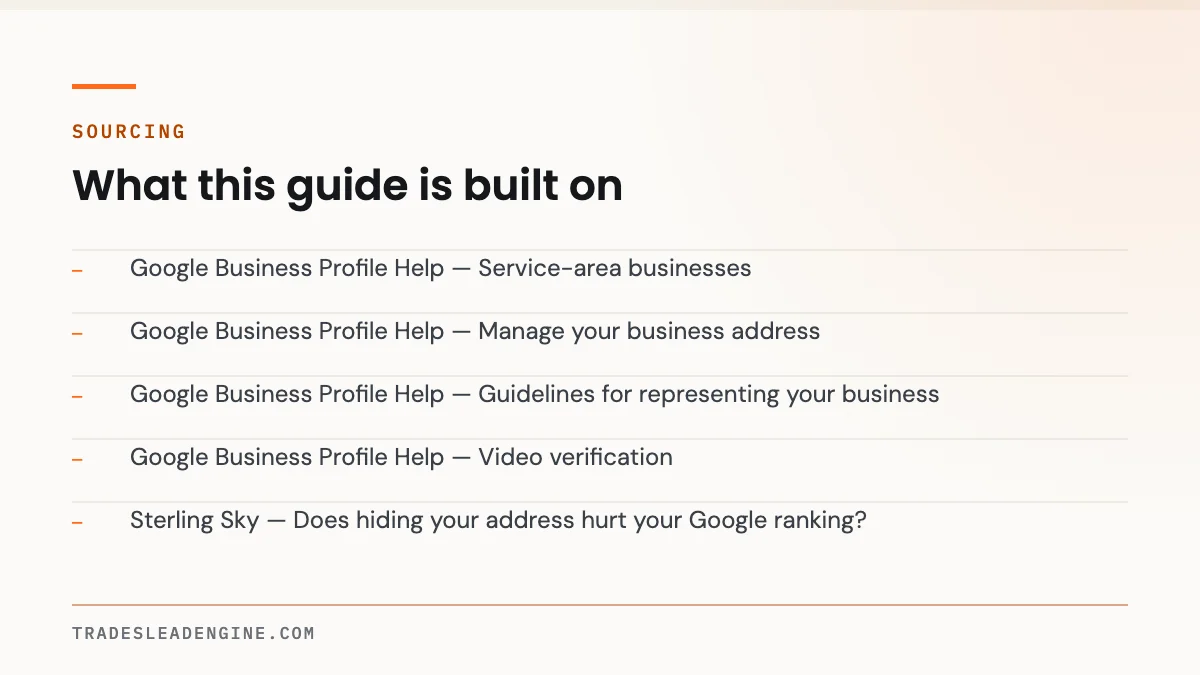
- Google Business Profile Help — Service-area businesses (SAB definition, address removal requirement, one profile per service area, 20 areas, no radius, ~2-hour boundary)
- Google Business Profile Help — Manage your business address (“only choose to not show your address if your business is a service-area business”; 10 minutes to 30 days to propagate)
- Google Business Profile Help — Guidelines for representing your business (co-working conditions, one page per location, business name restrictions)
- Google Business Profile Help — Video verification (unedited 30-second minimum from a mobile device; tools, equipment or branded materials as proof for service-area businesses)
- Sterling Sky — Does hiding your address hurt your Google ranking?, October 30 2024 (controlled one-month on/off test)
- Whitespark — Local Search Ranking Factors 2026 (47 practitioners; proximity of address #2 and physical address in city of search #4 for the local pack)
- Google Business Profile Help Community — can’t hide business address to change to a service-area business
- ACHR News, August 2026 — HVAC contractor loses thousands after Google suspends Business Profile
The ranking evidence here rests on a single published controlled test of one business over one month, plus a practitioner survey — not on anything Google has published about how address visibility affects ranking. Google makes no public statement on that question. We’ve marked which claims are Google’s and which are third parties’ throughout, and we’d rather tell you the evidence is thin than pretend otherwise.