

You set the profile up once, years ago, in about twenty minutes. Somebody in the office picked a category off a dropdown in the Business Profile setup — probably “Contractor,” maybe “Construction company” — and nobody has looked at it since. The reviews have piled up, the trucks got wrapped, the revenue tripled, and that one dropdown never moved.
Meanwhile the shop across town, half your size, outranks you on the search that matters most. The explanation you’ll usually get is that they’re “doing more SEO,” or that they’ve got better content, or that Google likes them. Occasionally somebody will tell you categories are just labels for the directory and don’t affect anything.
That last one is the expensive mistake. In Whitespark’s 2026 Local Search Ranking Factors survey — 47 local search practitioners scoring the inputs they believe drive placement — primary Google Business Profile category scores as the single highest-weighted individual factor for the local pack, above proximity, above keywords in the business name, above having an address in the city being searched. Google itself has never published a word confirming that, which is exactly why the people who know it don’t advertise it.
This piece gives you the evidence on Google Business Profile categories and how to read it honestly, what primary and secondary categories each actually do, a trade-by-trade starting table for Texas HVAC, plumbing, roofing, remodeling, electrical and solar, how to choose when two categories both look right, and how to make a change on an established profile without triggering a review.
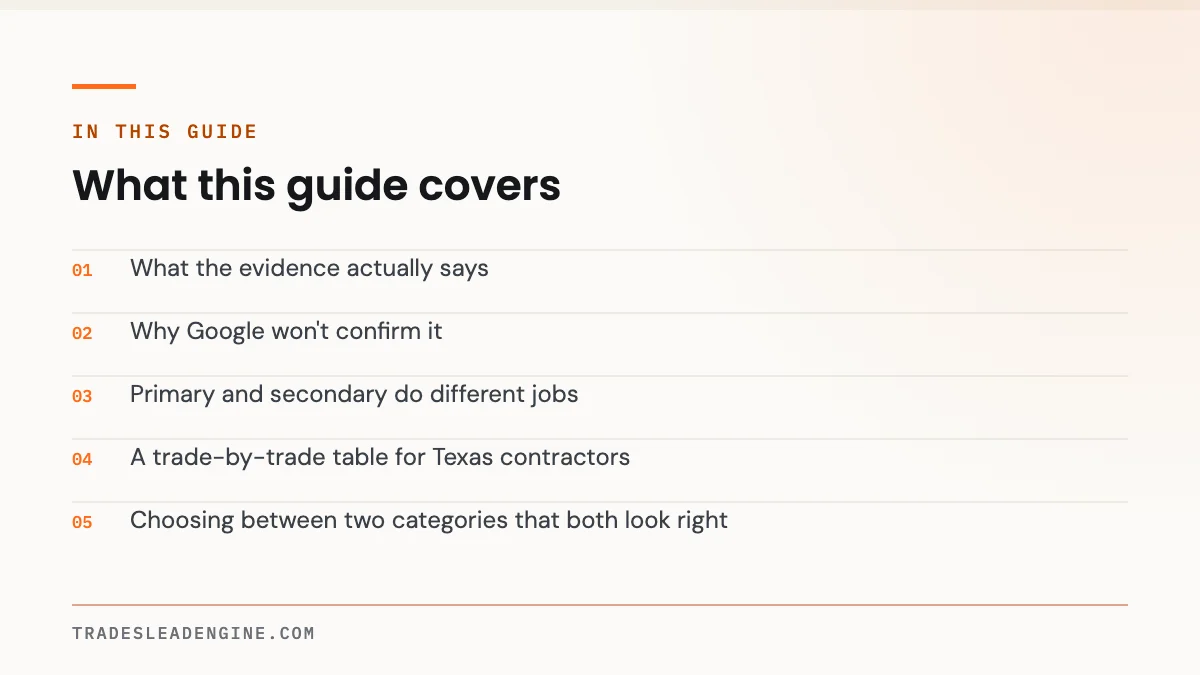
What’s in this guide
- What the evidence actually says
- Why Google won’t confirm it
- Primary and secondary do different jobs
- A trade-by-trade table for Texas contractors
- Choosing between two categories that both look right
- How many secondary categories to use
- Changing a category on an established profile
- Questions contractors actually ask
What the evidence actually says
Whitespark has run its Local Search Ranking Factors study annually for years, and it works by surveying practitioners who do this professionally and asking them to score the inputs they believe move local placement. The 2026 edition drew on 47 of them. It is the nearest thing this field has to a consensus document, and it is a survey of opinion, not a measurement of Google’s algorithm. Hold both of those in your head at once.
The five highest-scored individual local pack factors
Whitespark Local Search Ranking Factors 2026 — panel scores, 47 practitioners surveyed.
That is the whole argument for taking categories seriously. Of the five inputs the panel weighted most heavily, primary category is the only one that is both free and fully under your control. Keywords in the business title score high too — and stuffing them in is a guidelines violation that gets profiles suspended, which we cover in the reinstatement guide. Category is the one lever at the top of the list that carries no policy risk when you use it truthfully.
Zoom out one level and the same study puts Google Business Profile signals as a whole at roughly 32% of local pack weight — the largest single category, ahead of reviews at 20% and your website at 15%. Your category choice sits inside the biggest block.
Why Google won’t confirm it
Google publishes no ranking statement about categories. None. What Google does publish is that local results are based primarily on relevance, distance and prominence, and that complete and accurate information helps Google understand your business. It has never said “your primary category is the strongest relevance signal,” and we’re not going to put that sentence in Google’s mouth.
The “#1 ranking factor” line belongs to Whitespark’s practitioner panel, not to Google. It is expert consensus from people who test this for a living, which is meaningfully better than a guess and meaningfully worse than documentation. If you read a page that says Google says your primary category is the top ranking factor, that page is inventing a source — and if it’s inventing that one, assume it’s inventing the rest.
Why does this matter to you, practically? Because it sets how confidently you should act. Strong enough to audit your category today and fix it if it’s wrong. Not strong enough to justify switching categories every quarter chasing movement, or to explain away a ranking problem that’s actually about proximity or reviews.
Primary and secondary do different jobs
There are roughly 4,000 Google Business Profile categories, according to BrightLocal’s category research, and you get one primary plus up to nine secondary.
Your primary category tells Google what the business fundamentally is. It’s the label that appears under your name in Maps, it carries the most relevance weight in any local SEO effort, and it also determines which profile features you get — booking, service menus, certain attributes. Secondary categories add relevance for adjacent queries, but they do not carry the same weight, and this is where most contractors misread the system.
Here’s the practical consequence. If water heater work is 40% of your revenue but it sits in a secondary slot, you are structurally behind any shop whose primary matches that query. Adding a ninth secondary does not fix that. Choosing the right primary might.
So the question isn’t “what describes my business.” It’s “what is the one query I most need to win, and which category does Google map that query to.” Most contractors pick the category that flatters the business. The better move is picking the category that matches the money.
Find out what your competitors’ primary category is
The free Lead Engine Scorecard pulls the primary category of the top three profiles ranking in your market for your core service, shows where your own profile sits, and flags the guideline risks on it. No sales call required.
Get the free Scorecard
Or call (726) 224-4920 — same business day reply.

A trade-by-trade table for Texas contractors
This is the part nobody publishes, because writing it requires taking a position. So here’s ours: a defensible starting primary for each of the six trades we work with, the secondary categories most worth claiming, and the specific way each trade tends to get it wrong.
| Trade | Primary to start from | Secondaries worth claiming | Where this trade goes wrong |
|---|---|---|---|
| HVAC | HVAC contractor | Air conditioning contractor · Air conditioning repair service · Heating contractor · Furnace repair service · Air duct cleaning service | Texas is a cooling market for eight or nine months a year. If AC repair is where the revenue actually is, test “Air conditioning repair service” as primary against “HVAC contractor” rather than assuming the broad one wins. |
| Plumbing | Plumber | Drainage service · Gas installation service · Water softening equipment supplier · Septic system service · Water damage restoration service | Claiming septic or restoration categories for work you subcontract out. If you wouldn’t dispatch your own truck for it, don’t claim it. |
| Roofing | Roofing contractor | Gutter cleaning service · Siding contractor · Waterproofing service · Construction company | After a hail event in Dallas–Fort Worth or the Hill Country, everyone wants to rank for storm damage. There is no storm damage category. That demand gets captured with service items, pages and reviews — not a dropdown. |
| Remodeling | The narrow one that matches your money work — Kitchen remodeler or Bathroom remodeler | General contractor · Remodeler · Flooring contractor · Deck builder · Cabinet maker | Defaulting to “General contractor” because it sounds bigger. It’s the vaguest category in the trade and it competes against everyone. Specific beats impressive. |
| Electrical | Electrician | Electrical installation service · Lighting contractor · Security system installer · Electrical repair shop | Whole-home generator work is a distinct demand curve in Texas and a distinct query set. Make sure something in your category list and your service items speaks to it rather than burying it under “Electrician.” |
| Solar | Solar energy contractor | Solar energy equipment supplier · Electrician · Energy equipment and solutions | Adding “Roofing contractor” because solar touches roofs. Unless you actually perform roofing work, that’s an inaccurate category — dilution at best, a guidelines problem at worst. |
There are around 4,000 categories and Google adds, merges and retires them without announcement. A category that existed when an article was written may not exist when you read it, and some are region-specific. If you type a name from a blog post into the picker and nothing comes up, that’s usually the explanation — not a fault in your account. Search the picker for the service word instead and take what’s actually offered.
Choosing between two categories that both look right
Most contractors stop at “which one describes us.” That is not analysis. Run it as a decision instead.
| If this is your situation | Pick this as primary | Why |
|---|---|---|
| One service is 60–70% of revenue | The category that names that service | Relevance follows the query that makes you money, not the org chart. |
| Revenue is split roughly evenly between two services | The one your top three map pack competitors use | Their primary is visible on their profile in Maps. If all three use the same one, that’s the market telling you which category the demand resolves to. |
| Your best service is seasonal | The category covering year-round revenue; put the seasonal one in a secondary slot | You can’t re-rank a profile twice a year without editing a critical field twice a year, which is its own risk. |
| You’re brand new with no revenue history | The most specific category that still names your trade accurately | Specific beats broad when you have no prominence yet — there’s less competition to out-weigh. |
| The service you want has no category at all | Neither — use service items, page content and reviews | Storm damage, emergency board-up, and most niche specialities have no category. A dropdown can’t invent one. |
One caution on competitor copying: check whether the profile you’re modelling is actually winning on category or on proximity. A shop that sits four blocks from downtown ranks for reasons you can’t replicate from twenty miles out. Sample the top three across several cities before you conclude anything — and if you want the full picture of why the same profile ranks differently city to city, that’s a separate structural problem.
How many secondary categories to use
Use every secondary that is genuinely true, and stop at the exact point where you’d have to stretch. Not all nine for the sake of nine.
The test we use: would you dispatch your own crew for that work tomorrow, at your normal rate, without subcontracting it? If yes, claim it. If you’d need to call somebody, leave it off. Inaccurate categories are a guidelines issue, they dilute the relevance of the ones that matter, and they pull you into query sets you can’t convert — which is a worse outcome than not ranking at all, because you pay for the click and the phone call either way.
Two more things secondaries quietly control. Some categories unlock or remove profile features and attributes, so a category added carelessly can change what your profile displays. And several categories map to query sets that overlap heavily, so claiming five near-identical ones adds far less than contractors expect. Three accurate secondaries beat nine padded ones.
Changing a category on an established profile
Category is a critical field. Editing critical fields in volume is the trigger most commonly reported by practitioners who handle suspension cases — Sterling Sky puts excessive edits at the top of its observed list. So the change is worth making, and it’s worth making carefully.
The discipline:
- Baseline first. Run a rank grid for your core terms across the cities you serve, screenshot it, date it. If you don’t do this you will never know whether the change helped.
- Change one thing. Category this week. Not the business name, not the phone number, not the address visibility, not the hours. One field, one week.
- Don’t do it during an open appeal. If the profile has been suspended before, or is currently under review, leave it alone entirely until it’s stable.
- Give it two to four weeks before you judge. Local rankings are noisy day to day and a single bad Tuesday means nothing.
- Revert once, not repeatedly. If it clearly hurt, put it back — and then leave it. Flipping the same field back and forth is exactly the pattern that draws scrutiny.
Open your profile. Write down your primary category. Now open Maps, search your highest-value service plus your city in an incognito window, and write down the primary category of the top three profiles. If yours doesn’t appear in that list, you have found something worth more than a month of most SEO retainers — and it costs nothing to fix.
A word on testing, because you’ll see people promise A/B tests of categories. You cannot A/B test a single Business Profile. You have one profile, so any comparison is before-and-after with every other variable moving underneath it — competitor changes, seasonality, algorithm updates, your own review flow. The best available method is the one Sterling Sky used on address visibility: change it, hold everything else still, measure, change it back, measure again. That’s a sequence, not a controlled trial, and anyone selling you more certainty than that is selling certainty they don’t have.
Finally, the category you choose feeds more than the map pack now. When someone asks an AI assistant who to call for a burst line in Houston, the systems answering that question draw on the same structured business data — so an accurate, specific category is part of how you show up there too. That’s a different ranking game with different inputs, and we’ve mapped it in how AI Overviews and ChatGPT actually pick which contractor to recommend.
Questions contractors actually ask
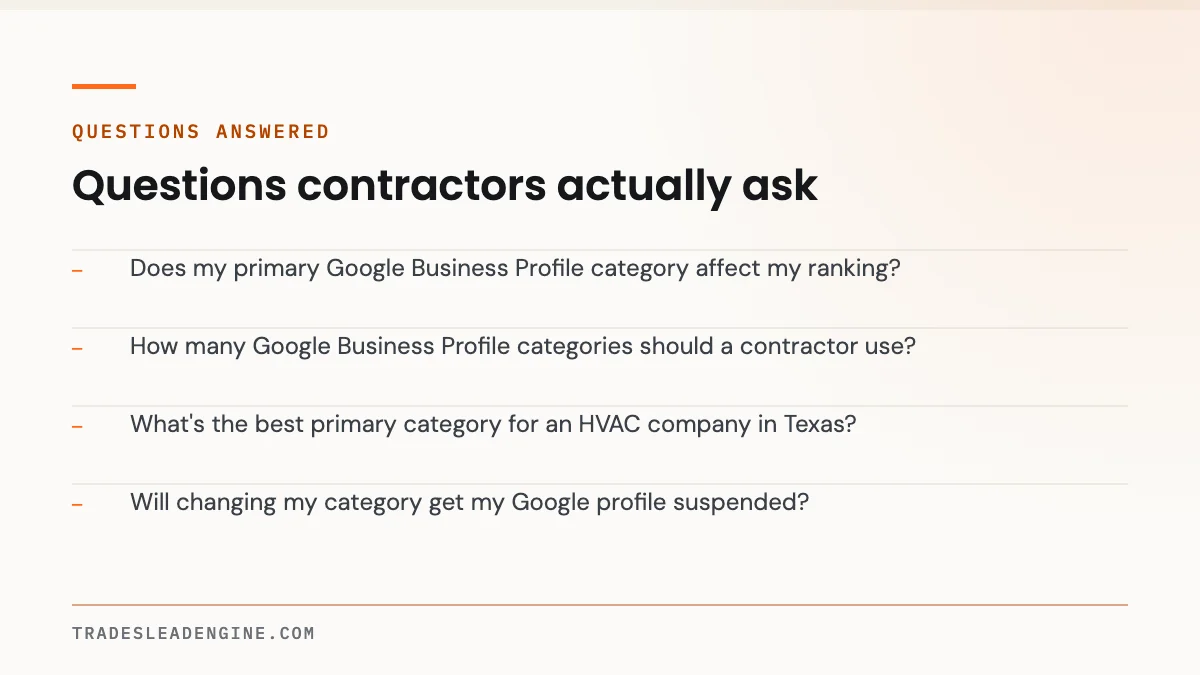
Does my primary Google Business Profile category affect my ranking?
The evidence says strongly yes. In Whitespark’s 2026 Local Search Ranking Factors survey of 47 practitioners, primary category scores as the highest-weighted individual factor for local pack placement, ahead of proximity of your address to the searcher. That’s expert consensus, not a Google statement — Google publishes nothing about how categories affect ranking.
How many Google Business Profile categories should a contractor use?
One primary plus as many accurate secondaries as genuinely apply — not all nine for the sake of it. The test: would you dispatch your own crew for that work tomorrow at your normal rate? If you’d have to subcontract it, leave the category off. Three accurate secondaries beat nine padded ones.
What’s the best primary category for an HVAC company in Texas?
“HVAC contractor” is the standard starting point. But Texas is a cooling market for most of the year, so if air conditioning repair is where your revenue actually comes from, it’s worth testing “Air conditioning repair service” as primary instead. Check the primary category of the three profiles already ranking for your core query in your city before deciding.
Will changing my category get my Google profile suspended?
Changing one category accurately is normal maintenance. The risk comes from volume — practitioners who handle suspension cases report excessive edits to critical fields as the most common trigger they observe, and category is a critical field. Change one thing at a time, don’t stack it with name, phone or address edits, and don’t do it while a profile is under review.
Can I rank for a service that has no Google category?
Not through categories, no. Storm damage restoration, emergency board-up and plenty of niche specialities simply don’t exist in the category list. You capture that demand with service items on the profile, dedicated pages on your site, and reviews from customers who describe the work in their own words.
How long does it take to see a change after switching Google categories?
Give it two to four weeks before drawing any conclusion, and compare against a rank grid you captured before the change. Local rankings move day to day for reasons that have nothing to do with you, so a single week of data tells you very little.
Should I copy the category my top competitor uses?
Use it as a signal, not an instruction. A competitor’s primary category is publicly visible as the label under their name in Maps. But check whether they’re ranking on category or on proximity — a business physically in the city centre ranks for reasons you can’t copy. Sample the top three across several cities before you conclude anything.
Do secondary Google Business Profile categories help as much as the primary?
No. Secondary categories add relevance for adjacent queries but carry noticeably less weight. If a service is a major share of your revenue, having it in a secondary slot leaves you structurally behind any competitor whose primary matches that query — and adding more secondaries won’t close that gap.
What to do with this
Go and look at your primary category right now. Most contractors reading this will find something generic sitting there that somebody chose in a hurry years ago, and fixing it is free, legal, and sits at the top of the only credible list of what moves local placement.
Then do the comparison. Top three profiles, your highest-value query, each city you actually care about. If their primaries agree with each other and disagree with yours, that’s your answer. If they’re split, weight toward the one that matches where your revenue comes from rather than what sounds most complete.
After that, leave it alone. The profile work that compounds isn’t category churn — it’s a steady flow of recent reviews, accurate hours, real photos, and a site that ranks organically in the cities your pin can’t reach. Get the category right once, then go spend your effort on the 68% of local pack weight that isn’t your Business Profile.
Get your category checked against the profiles beating you
The free Lead Engine Scorecard compares your primary and secondary categories against the top-ranking profiles in each market you serve, flags inaccurate or risky entries, and shows what else is holding your local visibility back.
Get the free Scorecard
Questions first? leads@tradesleadengine.com · (726) 224-4920
Sources
- Whitespark — Local Search Ranking Factors 2026 (47 practitioners; primary category scored 227 as the top individual local pack factor, ahead of proximity 225, business title keywords 223, address in city of search 213 and open at time of search 189; grouped local pack weights of 32% Google Business Profile, 20% reviews, 15% on-page)
- BrightLocal — Google Business Profile categories, updated October 2025 (approximately 4,000 categories; one primary plus up to nine secondary)
- Google Business Profile Help — Guidelines for representing your business (business name restrictions, accuracy requirements, suspension authority)
- Google Business Profile Help — Service-area businesses (one profile per service area, 20 service areas, no radius)
- Google Business Profile Help — Appeal a suspended Business Profile (profile-level and account-level enforcement; no published review timeframe)
- Sterling Sky — Top reasons Google suspends listings, updated March 2026 (excessive edits to critical fields as the most commonly observed trigger)
- Sterling Sky — Does hiding your address hurt your Google ranking?, October 2024 (the on/off test method referenced here)
Google publishes no statement about how Business Profile categories affect ranking. Every ranking claim in this article is attributed to Whitespark’s practitioner survey, which is a panel of expert opinion rather than a measurement of Google’s systems. The trade-by-trade table is our recommendation based on how these categories map to Texas demand, not guidance from Google, and category names change without notice — verify them in your own dashboard.