

Yes, you can build service area pages for the cities you actually work in, and no, there is no page count that triggers a penalty. What Google’s published spam policy targets is purpose: pages built to catch a search and hand the visitor straight to the same place everyone else lands. Eight to fifteen pages you would be happy for a customer to read is a real asset. Forty near identical pages with the city name swapped is the thing the policy was written about.
What’s in this guide
- The short answer on service area pages
- What Google actually calls a doorway page
- The five questions Google published, and how to use them
- Duplicate content is not the thing that gets you
- Scaled content abuse, the rule that replaced the old one
- What a real penalty looks like, and how you would know
- How many service area pages is too many
- What a city page has to contain to be worth building
- Your Business Profile is a different system with different limits
- The order to build them in
- Numbers you should not believe
- What to ask the company selling you forty pages
- What to do on Monday
- Questions owners actually ask
The short answer on service area pages
Someone has quoted you a package. Forty city pages, one for every town within an hour of your yard, live in three weeks. Someone else has told you that city pages are doorway pages and Google will bury your whole site for them. Both people sound confident and they cannot both be right.
They are both describing the same tactic at different doses. Google does not publish a number. It publishes a test about intent, and that test is easy to apply to your own site in about ten minutes.
Build a page for a city when you have something specific to say about working in that city. Do not build a page for a city because the city exists. If a page would be identical to another page apart from the city name, it is not a page, it is a variable.
That is not a softer rule than the one you were afraid of. It is a harder one, because it rules out most of what gets sold. But it is the rule Google actually wrote down, and you can read it yourself in about four minutes.
What Google actually calls a doorway page
The relevant policy is on one page, the spam policies for Google web search, and the section is called doorway abuse. Here is the definition and the example that matters to you, quoted from it.
Doorway abuse is when sites or pages are created to rank for specific, similar search queries. They lead users to intermediate pages that aren’t as useful as the final destination.
Google Search Central, Spam policies for Google web search
The examples listed under it include “having multiple domain names or pages targeted at specific regions or cities that funnel users to one page” and “creating substantially similar pages that are closer to search results than a clearly defined, browseable hierarchy.”
Read the second half of each example. Not “pages targeted at specific regions or cities.” Pages targeted at cities that funnel users to one page. Not “similar pages.” Substantially similar pages that are closer to search results than a clearly defined hierarchy. The geography is not the violation. The dead end is.
The difference in practice
A page that says you do water heater replacement in New Braunfels, shows two jobs you did there, names the permit office, and lets someone book from that page is a destination. A page that says you do water heater replacement in New Braunfels and then asks the reader to click through to your main water heater page to learn anything at all is an intermediate page. The first is a page. The second is a turnstile.
Open your own city page on a phone. If the only thing you can do on it is click to another page on your site, it is a doorway page by Google’s own wording, no matter how much text is on it.
The five questions Google published, and how to use them
In March 2015 Google’s webspam team published a post announcing a ranking adjustment aimed at doorway campaigns. It is still live on Search Central and it contains the most useful thing Google has ever written on this subject: five questions to ask about your own pages.
Is the purpose to optimize for search engines and funnel visitors into the actual usable or relevant portion of your site, or are they an integral part of your site’s user experience?
Google Search Central Blog, An update on doorway pages, March 16, 2015
The other four ask whether the pages are intended to rank on generic terms while the content is very specific, whether they duplicate aggregations that already exist on the site, whether they exist only to draw traffic and send users along, and whether they are islands that are difficult or impossible to navigate to from the rest of the site.
That last one is worth sitting with. Most contractor city pages fail it and nobody ever checks. They are reachable from a sitemap and from Google, and from nowhere in the visible navigation. Google’s word for that is island.
The same post is blunt about why any of this is enforced: “searchers might get a list of results that all go to the same site. So if a user clicks on one result, doesn’t like it, and then tries the next result in the search results page and is taken to that same site that they didn’t like, that’s a really frustrating experience.”
Run the five questions on your own site
- Can a visitor reach your Seguin page from your menu, your footer or a service page, without a search engine?
- Does the page hold anything that is not on your main service page?
- Can the job be booked, priced or scheduled from the page itself?
- If you deleted the city name, would the page still make sense, and would it be indistinguishable from eleven others?
- Would you send this page to a customer who called you?
Three or more noes and you have a doorway campaign, whatever your vendor calls it.
Duplicate content is not the thing that gets you
This is where most of the fear comes from, and it is misplaced. Google has said for eighteen years that duplicate content is not, by itself, a penalty. From the Search Central post that killed the phrase “duplicate content penalty”, still published:
Duplicate content on a site is not grounds for action on that site unless it appears that the intent of the duplicate content is to be deceptive and manipulate search engine results.
Google Search Central Blog, Demystifying the “duplicate content penalty”
What Google does instead is choose. Where several of your pages are near enough identical, it consolidates them and shows one. You do not get punished, you get collapsed. Twelve pages become one page in the index and eleven of them quietly do nothing.
That is the real cost of the forty page package, and it is not a penalty at all. It is spending money on pages that never get shown.
The evidence on the other side, and it is real
Colan Nielsen at Sterling Sky documented a service area business with 35 service area pages built over several years whose content matched 84% on average according to Siteliner, and those pages drove traffic and leads. His conclusion is that the danger is thinness rather than duplication, and that reusing a strong core while customising 10 to 20 percent per city works.
Take that seriously. It is a practitioner reporting a measured case rather than repeating a rule of thumb. It also happens to agree with Google’s wording: overlap is not the trigger, purpose is.
Scaled content abuse, the rule that replaced the old one
The doorway policy is not the only one in play any more, and the newer one is the one most contractors trip over in 2026. In March 2024 Google announced three new spam policies. One of them is scaled content abuse, and it was written to close a loophole in the old automatically generated content rule.
This new policy builds on our previous spam policy about automatically-generated content, ensuring that we can take action on scaled content abuse as needed, no matter whether content is produced through automation, human efforts, or some combination of human and automated processes.
Google Search Central Blog, What web creators should know about our March 2024 core update and new spam policies, March 5, 2024
Read “no matter whether content is produced through automation, human efforts, or some combination” twice. The old defence was “a human wrote these, they are not auto generated.” That defence is gone. A person hand typing forty near identical city pages is covered by the same policy as a script producing them.
The policy definition on the spam policies page is short: “Scaled content abuse is when many pages are generated for the primary purpose of manipulating search rankings and not helping users.” The listed examples include “using generative AI tools or other similar tools to generate many pages without adding value for users” and “creating many pages where the content makes little or no sense to a reader but contains search keywords.”
Google’s own status dashboard records the September 2026 spam update beginning at 09:15 Pacific on 24 September 2026, “which applies globally and to all languages”, with a rollout that “may take up to two weeks to complete.” If your rankings moved in the last week and you have a stack of thin city pages, that is the first place to look, not the last.
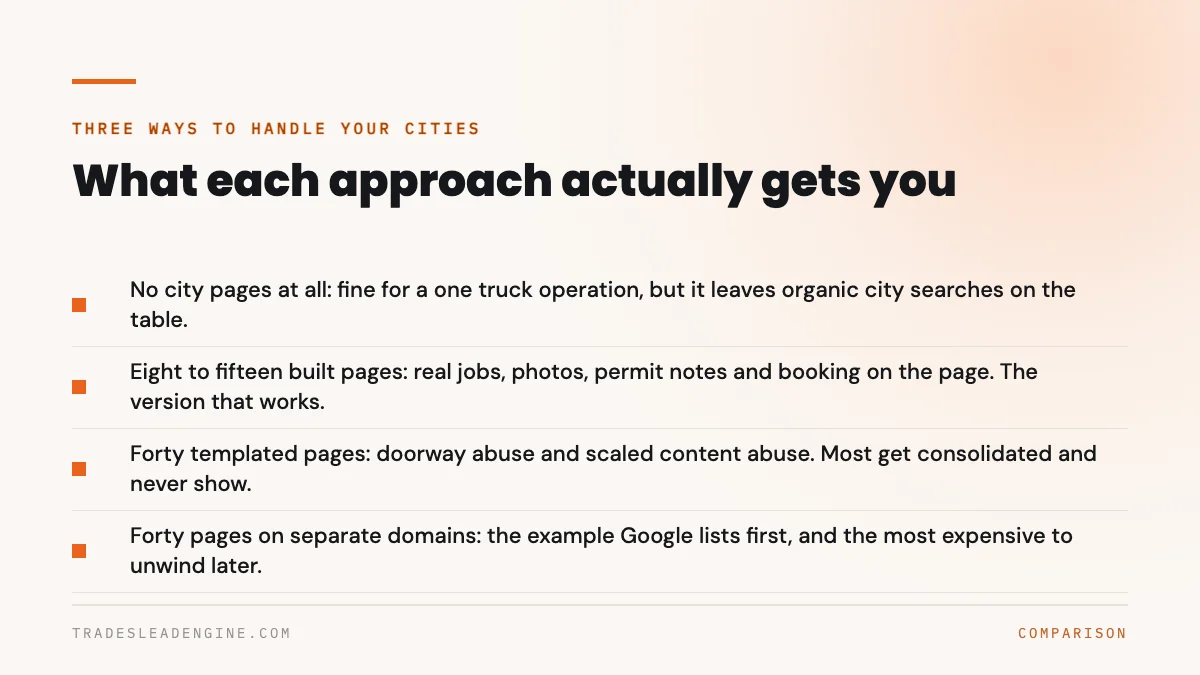
| Approach | What it looks like | Which policy it touches | Realistic outcome | Effort per page |
|---|---|---|---|---|
| No city pages at all | One service page per trade, a service area listed in the footer, a Business Profile with the areas set | None | You compete on the profile and on the main service pages. Fine for a one truck operation. Leaves organic city searches on the table. | 0 |
| Eight to fifteen built pages | Real jobs, real photos, local permit and code notes, named technicians, booking on the page, linked from the menu | None, if each page stands on its own | The version that works. Slow to build, hard to copy, and the pages keep earning after the campaign stops. | 3 to 6 hrs |
| Forty templated pages | One template, city name swapped, a paragraph of generic history, a button back to the main service page | Doorway abuse and scaled content abuse | Most get consolidated and never show. The rest carry policy risk. You pay for forty and are shown one or two. | 5 to 20 min |
| Forty pages on separate domains | A domain per city, each a copy of the main site | Doorway abuse, named explicitly | The example Google lists first. Also the most expensive to unwind later. | Varies |
What a real penalty looks like, and how you would know
The word penalty gets used loosely. Google has two different things and only one of them sends you a message.
The first is algorithmic: your pages simply rank lower, or get consolidated, and nothing tells you. That is what happens to most thin city pages. The second is a manual action, where a human reviewer at Google has looked at your site. Doorway pages sit inside the manual action category called thin content with little or no added value, alongside thin affiliate pages and scraped content.
If your site is affected by a manual action, we will notify you in the Manual actions report and in the Search Console message center.
Google Search Console Help, Manual Actions report
So there is a free, definitive way to answer “have I been penalised”: open Search Console, go to the Manual actions report, and read it. If it says no issues detected, you have not been penalised. You may still be invisible, which is a different problem with a different fix, and our guide on traffic with no calls covers the invisible version.
If you do not have Search Console, that is the single most valuable free thing you are missing. It is where Google tells you directly about manual actions, indexing and which queries you appear for. Nobody needs to sell it to you.
Worth being honest about the thing the forums fear most: manual actions for doorway pages on small local sites are uncommon. The usual outcome is quieter and cheaper for Google, which is to consolidate the pages and move on. That is not permission to build forty. It means the punishment for building forty is normally that you wasted the money, not that you were struck down.
Not sure whether your city pages are helping or just sitting there
The free Lead Engine Scorecard checks your site the way a cautious homeowner and an AI assistant both check it: speed, conversion blockers, trust signals, rankings and whether you are being cited in AI answers at all. No sales call required.
Get the free Scorecard
Questions first? leads@tradesleadengine.com · (726) 224-4920 · see what local SEO actually involves
How many service area pages is too many
Google publishes no number and will not, because the number is not the thing being measured. But two published numbers do bound the sensible range, and both come from Google’s own Business Profile documentation rather than from anybody’s opinion.
The first is the cap on service areas in your profile: “You can have up to 20 service areas.” The second is the geographic limit: “The boundaries of your overall area shouldn’t be more than about 2 hours of driving time from where your business is based.”
Google will not let you claim more than twenty areas in the system it controls. A website offering to sell you forty city pages is proposing a footprint twice the size of the one Google itself considers plausible for a service area business.
The documented boundary, drawn to scale
Google’s two published limits on a service area business, against a forty page package. Drive time bar at 6.2 pixels per minute; each square is one area.
Our working answer, and it is a judgement rather than a rule: build the pages you can fill. For most Texas trades businesses with one to five trucks that lands between eight and fifteen. If you cannot name a job you did in a town, you cannot write a page about that town that anybody should land on.
The exception worth knowing
A genuine second location with a staffed address, its own phone and its own team is not a service area page at all. It is a location, it gets its own Business Profile, and the rules are different. Renting a mailbox to fake one is covered by a separate rule and does not work, which we cover in the guide on hiding your address on a Business Profile.
What a city page has to contain to be worth building
Here is the build spec we use. Every item on it exists because it is the kind of thing that cannot be templated, which is exactly why it answers the doorway test.
Things only you can put on the page
- Two or three jobs you actually did there, with the problem, what you replaced and roughly what it cost. Not a case study, three sentences.
- Your own photographs from that town. A crew photo in front of a Tyler house is not stock and cannot be scaled.
- The local permitting and inspection reality. Which jurisdiction pulls the permit, how long the inspection queue runs, whether the city requires a licensed contractor to be on site.
- Housing stock notes. The 1970s slab foundations in one town and the new build subdivisions in the next produce different calls. Say which you see.
- Reviews from customers in that area, quoted accurately and attributed as your review platform shows them.
- Your actual response time and coverage: who is nearest, what the callout looks like, whether it changes after hours.
Things that do not count, however many words they are
- The town’s founding date and population, copied from an encyclopedia.
- A list of neighbourhoods and zip codes with no sentences attached.
- The same three service paragraphs with one noun changed.
- A weather paragraph explaining that Texas summers are hot.
- An embedded map of the city and nothing else.
Google’s guidance on people first content asks a question that settles the argument faster than any checklist: “Is the content primarily made to attract visits from search engines?” If the honest answer for your city page is yes, no amount of padding fixes it.
Print two of your city pages, cover the city names, and hand them to whoever answers your phone. If they cannot tell which is which, neither can a reader and neither can Google.
The linking rule that most packages skip
Doorway question five is about islands. Every city page you keep should be reachable by a human from at least one other page: a service area menu, a footer block, or a linked list on the relevant service page. If a page can only be found through Google, you have told Google what it is for.
Your Business Profile is a different system with different limits
City pages on your website and coverage on Google Maps are two separate machines and they are scored differently. Adding pages to your website does not extend your map coverage, which is the single most common misunderstanding behind a forty page purchase.
Google’s guidelines are explicit about the profile side. Service area businesses “should have one profile for the central office or location with a designated service area”, and the instruction is “do not create more than one page for each location of your business, either in a single account or multiple accounts.”
On the ranking side Google publishes only three factors and no weights: relevance, “how well a Business Profile matches what someone is searching for”; distance, “how far each business is from the customer who’s searching”; and prominence, “how well-known a business is.” Google also states plainly there is no way to request or pay for a better local ranking.
Distance is measured from your verified address to the searcher, and a web page about a town forty miles away does not move it. That is why our guide on why you do not show up on Google Maps in every city exists, and it is the right companion to this one.
Organic results, which sit below the map pack and follow different rules. A well built page for a town you work in can rank there even when the map pack is locked up by businesses with an address in that town. That is a real and reachable win, and it is a different win from the one most packages promise.
The order to build them in
If you have decided to build some, the sequence matters more than the count, because the first three teach you whether the next twelve are worth doing.
- Fix the main service pages first. A city page inherits the quality of the page it is modelled on. If the parent page does not convert, twelve children will not either. Our guide on what a contractor website costs in Texas covers what that work is worth paying for.
- Get the Business Profile right. Categories, service areas, hours, photos. This is cheaper and faster than any page, and it is where the map pack is won. See how categories actually work.
- Build three city pages to the full spec. Pick the three towns where you already have jobs and photos.
- Wait a full quarter and measure. Not clicks, calls. Local results move on a scale of months, which we cover in how long local SEO takes.
- Only then decide about the next batch, and only for towns where you now have material.
This sequence is slower than the package and it is the reason the package exists. Forty pages can be delivered in three weeks and invoiced. Three good pages take a month and require your photographs and ten minutes of your time on the phone.
If you already bought the forty
Do not panic and do not mass delete on day one. Work out which pages have ever produced a call or a form, keep those, improve the best five or six, and redirect the rest to the relevant service page. Deleting a page that was earning is a self inflicted version of the drop everybody fears after a redesign.
Numbers you should not believe
This corner of marketing runs on statistics that nobody can trace, and city page pitches carry more of them than most. We do not publish a number here unless we opened the source. These are the ones that come up in this conversation and what happened when we went looking.
- “42% of clicks go to the local pack.” No openable primary source. It circulates with an attribution that leads nowhere.
- “Adding city pages increased direction requests by 2,717%.” The same figure is attached to half a dozen unrelated tactics across the industry. There is no study behind it.
- “Consistent listings make you 40% more likely to rank.” Widely quoted, never sourced.
- “46% of all Google searches are local” and “97% of consumers search online for local businesses.” Both are attributed to research nobody links to. They may once have been real. If someone quotes either at you, ask for the link before you agree to anything priced against it.
- “Each city page is worth X dollars a month.” Nobody can know this about your business without your close rate and your average ticket, and neither of those is in a slide deck.
The honest version is unglamorous. Google publishes three local ranking factors, no weights, and an explicit statement that ranking cannot be bought. Everything past that is measurement on your own site.
What to ask the company selling you forty pages
You do not need to become an SEO to have this conversation. Five questions will tell you what you are buying.
- “Show me the pages you built for another client in my trade.” Then open three and compare them. If you can see the template, so can Google.
- “What goes on each page that is specific to that town, and where does it come from?” The right answer involves asking you for jobs and photos. A wrong answer involves the word “researched.”
- “Will these pages be linked from the site navigation?” If not, ask why, and read doorway question five again.
- “What happens to these pages if I stop paying?” Ownership of the pages and the domain is a separate fight worth having up front, covered in do you actually own your website.
- “What will you show me in ninety days, and will it be calls or rankings?” Rankings are a proxy. Calls are the thing.
A good vendor answers all five without defensiveness. Several will tell you the forty page package is not right for you, which is worth more than the package.
What to do on Monday
None of this requires a decision about a package. It requires an hour with your own site.
- Open Search Console and read the Manual actions report. Now you know whether the word penalty applies to you at all.
- List every city page you already have. Sort them by whether they have produced a call. Most teams have never looked at this and the answer is usually stark.
- Open two of them side by side and cover the city names. If you cannot tell them apart, you have your verdict.
- Check whether a human can reach them from your menu or footer. If not, either link them or accept what they are.
- Set your service areas in your Business Profile properly, up to twenty, inside about two hours of driving time. This is free and it is the part that moves the map.
- Pick the three towns where you have jobs and photos and write those pages to the spec above. Then stop and measure for a quarter.
Two things sit outside a marketer’s remit and should go to the right professional. If your city pages carry price claims, warranty language or guarantees, that wording is an advertising compliance question for an attorney, not a copywriting question. And if you hold a Texas plumbing, air conditioning or electrical licence, every one of those pages is advertising under the state rules, which means your licence number has to be on them. We cover exactly where it goes in the guide on putting your license number on your website in Texas. Forty city pages built without it is forty separate advertising violations, which is a genuinely expensive way to be thorough.
Every page that promotes your services is an advertisement under Texas rules, and a city page is a page that promotes your services. If your footer carries the licence number site wide you are covered. If your city pages use a stripped down template without the footer, check them today.
Questions owners actually ask
Should I build a separate page for every city I serve?
No. Build a page for every city you can say something specific about. Google’s spam policy targets pages “targeted at specific regions or cities that funnel users to one page”, which is a description of purpose rather than a page count. For most Texas trades businesses with one to five trucks, eight to fifteen genuinely built pages is the sensible range, and the limiting factor is how many towns you have jobs and photographs from.
Will Google penalise me for city pages?
Not for having them. Google issues manual actions when a human reviewer decides pages violate the spam policies, and doorway pages fall under thin content with little or no added value. In practice, thin city pages on a small local site are far more likely to be consolidated and ignored than manually actioned. You can check your own status for free in the Manual actions report in Search Console, which says whether any action exists.
Is duplicate content across my city pages a problem?
Not in itself. Google’s own position, published on Search Central, is that duplicate content “is not grounds for action on that site unless it appears that the intent of the duplicate content is to be deceptive and manipulate search engine results.” What happens instead is that near identical pages get consolidated and one is shown. The cost is wasted pages rather than a penalty. Thinness is the real risk, not overlap.
How many service area pages should a plumbing or HVAC company have?
Start with three, built properly, and add only where you have material. Two published Google numbers bound the range usefully: a Business Profile allows up to 20 service areas, and the overall area should not extend more than about two hours of driving time from your base. A vendor proposing forty pages is proposing a footprint twice the size of what Google considers plausible for one service area business.
Do city pages help me show up on Google Maps in other towns?
Barely, and not in the way the pitch implies. Map results are driven by relevance, distance and prominence, and distance is measured from your verified address to the searcher. A web page does not move your address. Where city pages genuinely work is the organic results below the map pack, which follow different rules and are often winnable in towns where the map pack is locked up by local addresses.
My competitor has sixty city pages and outranks me. What is going on?
Usually one of three things. They may be ranking on the strength of everything else they do, with the city pages contributing little. The pages may be better than they look from a template scan. Or they may be ranking today and about to stop, since Google shipped a spam update on 24 September 2026 that was still rolling out at the end of the month. Copying a site whose results you cannot measure is how most bad SEO decisions get made.
Does AI search change any of this?
It sharpens it. Assistants summarise and cite a small number of sources rather than listing ten links, so a page that exists only to catch a query and pass the reader along has nothing quotable in it. Specific, checkable detail is what gets extracted. Our guides on how AI picks which contractor to recommend and why you are not showing up in ChatGPT go into what that means for a trades site.
I already have forty thin city pages. Should I delete them?
Not all at once. Find which ones have ever produced a call or a form submission and keep those. Improve the best five or six to the full spec. Redirect the rest to the relevant service page rather than leaving them to return errors. Mass deleting pages that were quietly earning is how sites lose traffic they did not know they had, and it is avoidable with an afternoon of checking first.
Find out which of your pages are actually working
The free Lead Engine Scorecard looks at your site the way a homeowner and an AI assistant both do, and tells you where the calls are being lost. It takes a couple of minutes and there is no sales call attached.
Get the free Scorecard
Or talk it through: leads@tradesleadengine.com · (726) 224-4920 · more guides in the guide library
Sources
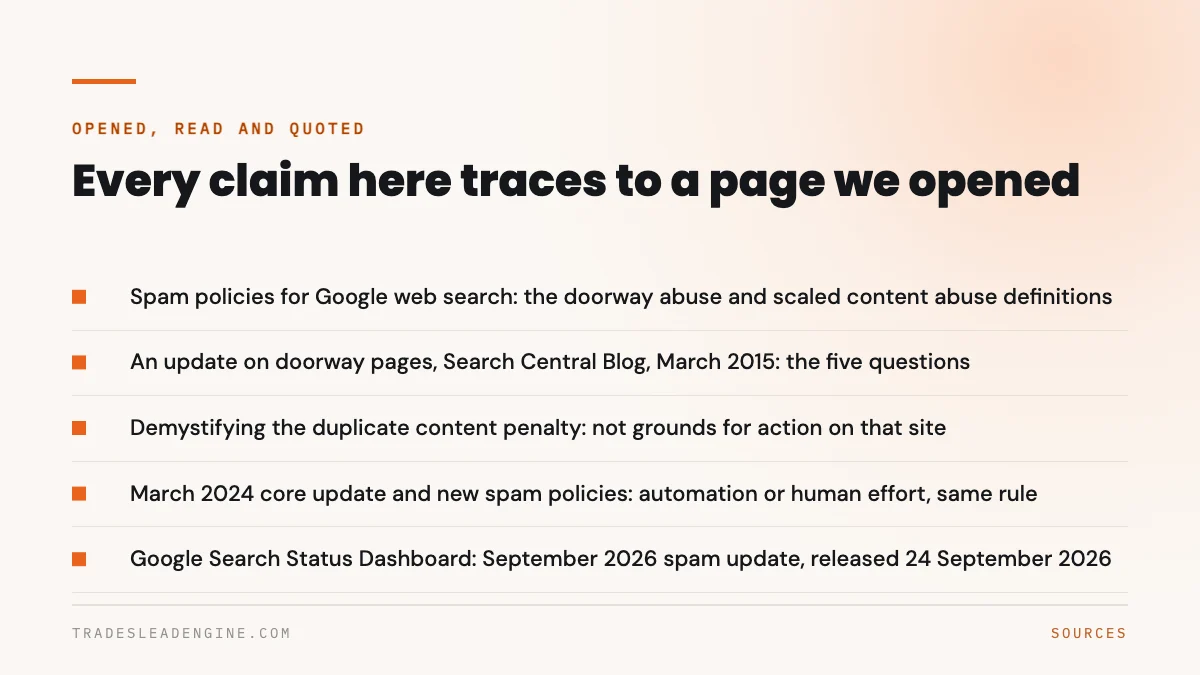
- Spam policies for Google web search: the doorway abuse definition and its four examples, including pages “targeted at specific regions or cities that funnel users to one page”, and the scaled content abuse definition and examples.
- An update on doorway pages, Google Search Central Blog, March 16, 2015: the five questions to ask of pages that could be seen as doorway pages, and Google’s reasoning about frustrated searchers.
- What web creators should know about our March 2024 core update and new spam policies, March 5, 2024: the scaled content abuse policy and the statement that it applies “no matter whether content is produced through automation, human efforts, or some combination”.
- Demystifying the “duplicate content penalty”, Google Search Central Blog: duplicate content “is not grounds for action on that site unless it appears that the intent of the duplicate content is to be deceptive”.
- Google Search Status Dashboard, September 2026 spam update: released 24 September 2026 at 09:15 Pacific, applies globally and to all languages, rollout up to two weeks.
- Manual Actions report, Google Search Console Help: what a manual action is, that doorway pages sit under thin content with little or no added value, and that Google notifies you in the report and the message centre.
- Creating helpful, reliable, people-first content, Google Search Central: the self assessment questions, including “Is the content primarily made to attract visits from search engines?”
- Guidelines for representing your business on Google: service area businesses “should have one profile for the central office or location with a designated service area”, and “do not create more than one page for each location of your business”.
- Set your service area, Google Business Profile Help: “You can have up to 20 service areas” and the roughly two hours of driving time boundary.
- Improve your local ranking on Google: the definitions of relevance, distance and prominence, and the statement that local ranking cannot be requested or paid for.
- Can service area pages with duplicate or similar content increase traffic?, Colan Nielsen, Sterling Sky: the 35 page case at 84% average content overlap per Siteliner, and the argument that thinness rather than duplication is the risk.
- Best way to create city pages without looking spammy, Local Search Forum: practitioners arguing the same question, including one who caps client builds at 10 to 20 pages per location.