
If your Google reviews disappeared, there are seven documented reasons and they do not all end the same way. Some are a delay and fix themselves in days. One is a pause Google puts on your profile deliberately, which looks exactly like a deletion from where you are sitting. And one is permanent: Google says plainly that reviews pulled for breaking a policy are not coming back, no matter who you call. The first job is working out which one you have, because five of the seven you can diagnose yourself in about ten minutes.
What’s in this guide
- The short answer on why your Google reviews disappeared
- Check whether your Google reviews disappeared for everyone or only for you
- Cause 1: Google paused reviews on your profile
- Cause 2: the July 2026 wave, and the gap between resolved and fixed
- Cause 3: a policy removal, which is permanent
- Cause 4: the review praised your technician by name
- Cause 5: your own crew left the reviews
- Cause 6: a suspension, a duplicate, or the wrong profile
- Cause 7: you changed your name, your address or your owner
- What Google removes at scale, in Google’s own numbers
- The honest odds on getting a legitimate review back
- Taking down a bad review has a federal rule attached
- What to do Monday morning
- Review numbers you should not believe
- What to stop paying for
- Questions owners ask about missing reviews
The short answer on why your Google reviews disappeared
Reviews leave a Business Profile in three different ways, and the difference decides whether you have a problem or a wait.
The first is a delay. Every review goes through a compliance check before it shows, and Google says that check can take a few days. Nothing is wrong. The review is in a queue.
The second is a pause. When Google’s systems think something unusual is happening on a profile, they stop new reviews landing and they pull recent ones while they look. Google describes this in its own words as taking “a range of actions including removing reviews and temporarily pausing reviews on the profile to prevent further abuse.” From the truck this is indistinguishable from reviews being deleted, and almost nobody knows it exists.
The third is a removal, and removals split again. If the review broke a content policy, it is gone for good. If it was swept up by mistake, there is a narrow route back that works sometimes and is not quick.
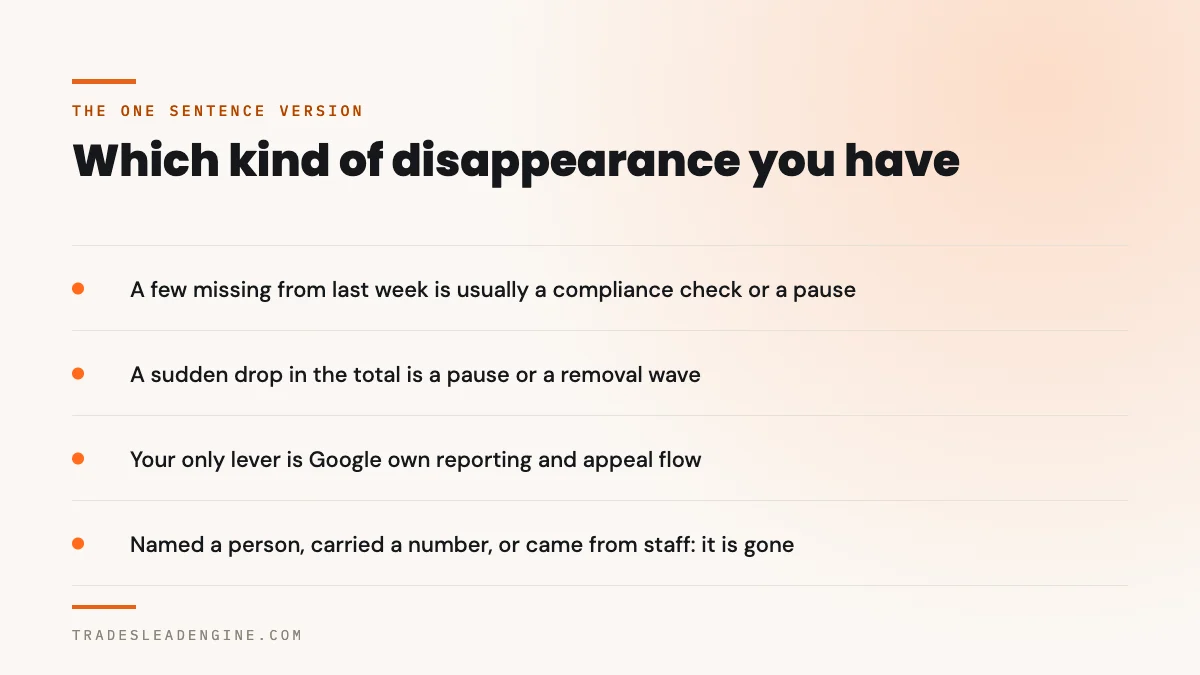
A handful of missing reviews from the last week is usually a compliance check or a pause and worth leaving alone for a few days. A sudden drop in your total, or reviews vanishing right after you reported somebody else’s, is a pause or a removal wave, and the only lever you have is Google’s own reporting and appeal flow. If the review named a person, mentioned a competitor, carried a phone number or came from an employee, assume it is not coming back.
Check whether your Google reviews disappeared for everyone or only for you
Before anything else, rule out the boring possibility. Reviews that are missing in your Business Profile dashboard but present to the public are a reporting glitch, not a loss, and the reverse is also true.
Do this in two browser windows. In the first, stay signed in and open your profile the way you normally do. In the second, open an incognito window, search your business name plus your town, and count the reviews on the public panel. Then open Google Maps in that same incognito window and count again.
Three outcomes, three different problems:
Same count in both
Nothing has gone missing. Somebody is looking at the wrong profile, or at a filtered view, or has been told a story. Check that the profile people are reviewing is the one you manage, which is the subject of cause six below.
Lower count in incognito
The reviews are genuinely off the public profile. Note the exact number and the date you checked, because that single figure is the only evidence you will have if you ever need to escalate, and nobody keeps it.
Count fell and new reviews will not post
This is the pause. A customer who tries to leave you a review gets an error, or the review appears for them and nobody else. That combination is the clearest signal available and it changes what you should do next.
Google gives you no history of your own review count. There is no chart showing it was 84 last Tuesday and 61 today. If you cannot state the before number, every conversation with support starts from nothing. Put a reminder in your phone for the first of each month and type two numbers into a note: total reviews and average rating. It takes fifteen seconds and it is the only baseline that will ever exist.
Cause 1: Google paused reviews on your profile
This is the cause that explains the most confusing version of the problem, and it is documented by Google itself in a product announcement rather than a help page, which is why so few people know about it.
In April 2026 Google described a new protection for businesses hit by review attacks. If a sudden surge of suspicious reviews lands on a profile, Google will remove the fake content, stop new reviews going on the profile for a while, and tell the owner. The announcement is explicit that the pause is deliberate and protective, and that consumers see a banner explaining why contributions are paused.
Our systems now better detect specific scam patterns, which lets us stop suspicious posts before they ever go live.
Google, New ways we’re protecting businesses on Maps, April 16, 2026
Read that from a contractor’s seat. You got hit with four one-star reviews from accounts you do not recognise. You reported them. A day later your reviews are down by six and a customer tells you her review will not post. You conclude Google has punished you for complaining.
What is far more likely is that the system saw an abnormal pattern, took the four fake reviews down, took two legitimate ones with them, and stopped the profile accepting anything new until the pattern settled. The protection fired. It just happens to feel identical to the attack.
What to do with a pause
Wait, and keep asking. The pause lifts on its own. What you must not do is tell your customers to try again repeatedly from the same addresses or the same phones, because repeated identical attempts are themselves a pattern Google’s policies treat as suspicious. Ask the next five customers normally, through the usual link, and watch whether the newest one appears within a week.
The part that genuinely is unfair
Reporting fake reviews can precede a pause, and practitioners have reported exactly that sequence. That means the honest business doing the right thing takes collateral damage. There is no setting to opt out of it and no way to pre-clear your profile. It is a cost of the system working at a billion reviews a year, and the only real defence is a review flow steady enough that a short pause does not empty your profile.
Cause 2: the July 2026 wave, and the gap between resolved and fixed
If your reviews went missing in the second half of 2026, you may have been caught in something bigger than your own profile.
On July 3, 2026, Search Engine Roundtable documented a wave of complaints from Business Profile owners whose reviews had vanished, in some cases almost all of them. One owner reported dropping from roughly 4,651 reviews to 63 inside a day. Treat that specific figure as what it is, an owner’s own account on a forum rather than a verified number, but the volume of similar reports was large enough that Google responded on the record.
We are investigating the issue and will restore any reviews that were incorrectly removed.
A Google spokesperson, quoted in Search Engine Land, Google is investigating reports of reviews going missing
By July 9 the same Search Engine Roundtable article carried an update saying Google reported the issue resolved and that missing reviews should be visible again.
That is where the official story stops, and it is not where the reports stop. In August 2026 a Business Profile coach posted a detailed account of seven reviews left by attendees of a live class on July 22, all removed shortly afterwards, with the profile never suspended, support closing the case as a duplicate of an unrelated ticket, and no human reachable. Later in the same month, practitioners were reporting reviews still missing on profiles that had been reinstated after a suspension.
“Resolved” at Google’s scale means the systemic bug was fixed. It does not mean every review came back, and it does not mean your particular reviews were in scope. If yours went missing in or after July 2026 and never returned, you are not confused and you have not been singled out. You are in the remainder, and the remainder is handled one case at a time through the reporting flow below.
Cause 3: a policy removal, which is permanent
Here is the line most people selling review services will not say out loud. Google’s own help page on missing reviews states it in seven words.
Reviews removed for policy violations won’t be restored.
Google, About missing or delayed reviews
Not appealed, not escalated, not recovered by a vendor with a contact at Google. If a review broke a content policy and Google removed it for that reason, the review is finished. The same page explains that reviews are checked against the policies before they show, that the check can take a few days, and that removals are usually for things like spam or inappropriate content.
So the useful question is not “how do I get it back” but “which policy did it break”, because the answer tells you whether the next twenty reviews will survive.
The policies that catch ordinary trades reviews
Most of Google’s prohibited content list is obviously not about you. Four parts of it catch honest contractors constantly.
Advertising and solicitation. Reviews are not allowed to carry promotional content, and Google specifically names email addresses, phone numbers, social media links and links to other websites inside reviews. A happy customer who writes “call the office direct, the mobile number is on the side of the van, ask for the crew that did my unit” is fine. The same customer who types the actual number into the review has written something that can be pulled for the number alone.
Off-topic. Content has to be based on an experience at that location. A review that is mostly about the manufacturer, or the weather in February, or the state of the trade generally, is off-topic by the policy’s own definition, which rules out general commentary and personal rants.
Repetitive content. Posting the same content more than once, from one account or several, is prohibited. This is what happens when a landlord with nine properties leaves you nine near-identical reviews, or when an office manager pastes the same sentence for every job.
Rating manipulation. This covers incentivised and biased reviews, and Google also names content showing unusual volumes or patterns of review contributions, plus content based on a conflict of interest. A gift card competition is squarely inside it, which is the subject of a separate guide on paying for Google reviews.
Every one of those four is preventable at the point of asking. If your review request tells the customer what to write, asks for a specific name, offers anything at all, or goes out to the same five people every quarter, you are manufacturing removals and will blame Google when they happen. A plain ask with a direct link, sent once, to someone who actually paid you, survives.
Cause 4: the review praised your technician by name
This one surprises everybody, and it is the single most common reason a glowing five-star review on a trades profile quietly disappears.
Google’s content policy on personal information opens with a flat instruction: “Do not distribute or post personal information without consent.” It then gives examples of what that covers, and a full name or a last name is on the list, as is a person’s face in a photograph or video.
“Marcus was fantastic, he found the leak in twenty minutes and showed me the pipe” is a review that identifies an employee by name without that employee’s recorded consent. It can be removed on that basis. Nothing about it is dishonest, nothing about it is spam, and losing it feels like a glitch.
The exceptions, which matter in the trades
The same policy carves out names that are part of the business itself. It allows an individual’s name where it is part of the commonly known or advertised business entity, and where the person is a public-facing professional conducting business under their name. The examples given include contractors doing business under their own names, alongside doctors, lawyers, realtors and financial planners, and it extends to executives whose names and professional connection to the place are publicly known.
So if the business is Dale Whitaker Plumbing and the review thanks Dale, the name is the business. If the business is a company name and the review thanks a technician, the technician is a private individual.
The temptation is obvious: tell customers to mention the tech, because named reviews read better and help with crew morale. Google’s policy on rating manipulation prohibits merchants requesting that staff solicit reviews including specific content, and names a staff member as exactly that kind of specific content. Asking for it puts you on the wrong side of two policies at once, and the reviews you generate are the ones most likely to be pulled.
If you want to recognise a technician, do it on your own website where you control the page. There is a related point about what you can and cannot put on a Texas trades site in the guide on license numbers on your website.
Cause 5: your own crew left the reviews
In November 2025 a senior care operator running automated review monitoring reported a weekend in which a large batch of employee-written reviews was removed across many profiles in his industry, favourable and unfavourable alike, and he was clear about how they were identified: the wording made it obvious the authors were employees.
Days later the same thread reported legitimate customer reviews going with them, which is the collateral pattern that shows up in every one of these waves.
Employee reviews sit inside the conflict of interest wording in Google’s misrepresentation policy, and also inside the rating manipulation policy. They are not ambiguous. The person has an interest in the business being seen well, which is the definition.
Two practical consequences. First, if a chunk of your early reviews came from the shop, your office or your family, treat that chunk as borrowed rather than owned. Second, if your review count has a floor made of those reviews, your real number is lower than you think, and the guide on how many Google reviews you actually need to rank is worth reading against your true count rather than your displayed one.
Cause 6: a suspension, a duplicate, or the wrong profile
Sometimes the reviews are fine and the profile is not.
Suspension
A suspended or removed profile is not visible to the public, which means its reviews are not either. Google’s page on restricted and suspended profiles says plainly that for a removed profile the public cannot go to it and the owner and managers cannot act on it. Nothing has been deleted. The shop window has been boarded up. Reinstatement restores the profile along with its owners and managers, and there is a full walkthrough of that process in the guide on a suspended Google Business Profile.
The honest caveat, reported by practitioners through August 2026, is that some profiles came back from reinstatement with reviews still missing. That is a known pattern, not something you did.
A duplicate profile
If a second profile exists for your business, customers can be reviewing one while you are watching the other. Google’s guidelines are firm that a business gets one profile per location, and reviews left on a duplicate do not merge themselves. The route is to contact Google and ask for the reviews to be transferred from the old profile to the new one, which the move-reviews page describes directly.
Somebody else’s profile
The darkest version is a profile you do not control at all, claimed years ago by a marketing company or a franchise office. You see your name, your reviews and your photos, and you have no access to any of it. If a former agency holds your profile, the reviews are not the first problem, and the recovery sequence is in the guide on getting your Business Profile back from your old marketing company.
Before you spend another hour on this
The free Lead Engine Scorecard checks the things that decide whether reviews are even your bottleneck: whether your Business Profile is public and verified, whether there is a duplicate competing with it, whether your review flow is steady enough to survive a pause, and whether your site and phone convert the people reviews bring. No sales call required.
Cause 7: you changed your name, your address or your owner
Three events make reviews move, stay or break, and Google documents all three.
New owner, same name. Reviews stay. Google’s wording is that if a business has a new owner or manager but keeps the same name, the reviews remain, and owners are invited to reply to older reviews to explain the change. If you bought the company and the reviews are still there, that is correct behaviour, not a loophole.
New address, same name. Google says it transfers the reviews automatically, with a warning that for some categories they might not move.
New name. A minor change keeps the reviews. A name change that does not meet Google’s criteria makes it a new business, and a new business starts at zero.
If you are thinking about renaming the company, the reviews are a real asset with a real risk of being written off, and the decision belongs before the sign order, not after. Changing the trading name, the service area and the address in the same quarter is the version most likely to reset you to zero. Stagger them, and keep the old name inside the new one if the goodwill is worth more than the aesthetics. The same caution applies to hiding an address, which is covered in the guide on hiding your address on a Business Profile.
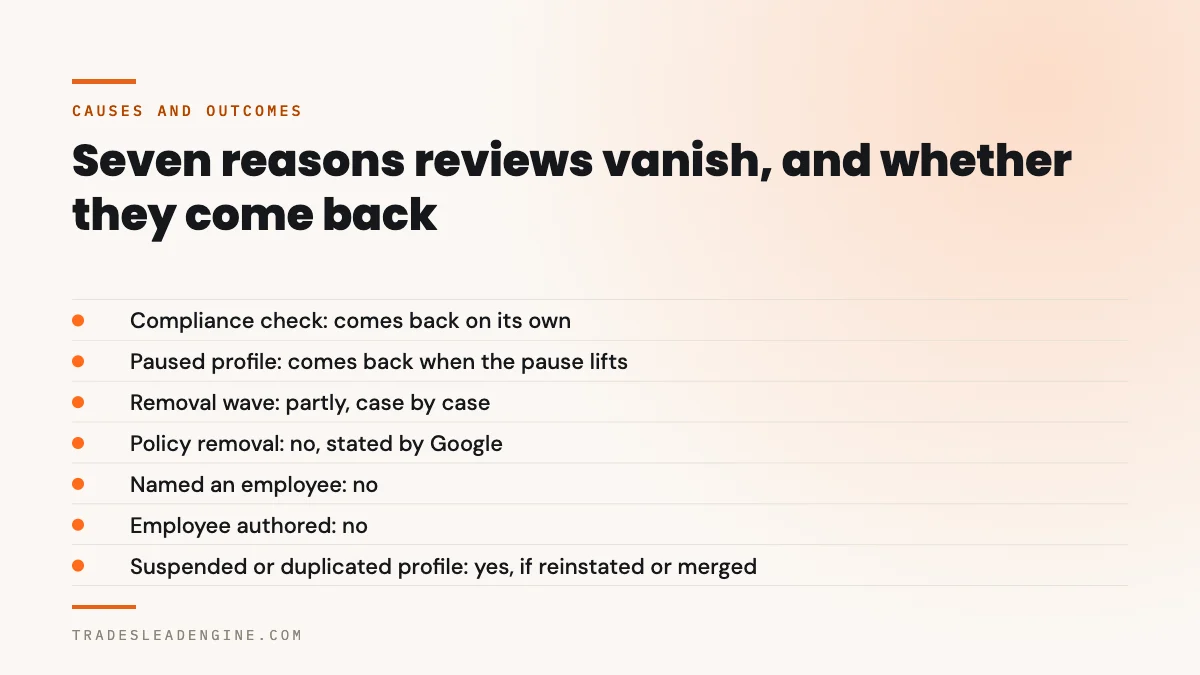
| Cause | What it looks like | How to confirm it | Comes back? | Who fixes it |
|---|---|---|---|---|
| Compliance check | One or two recent reviews missing, total otherwise normal | Wait a few days and look again | Yes, on its own | Nobody, leave it |
| Paused profile | Count fell and new reviews will not post at all | Ask a customer to try, in front of you | Usually, when the pause lifts | Nobody, keep asking normally |
| Removal wave | Sharp drop with no pattern you can see | Count logged out, compare to your own note | Partly, case by case | Google support, with evidence |
| Policy removal | Specific reviews gone, others untouched | Read the missing ones against the policy list | No, stated by Google | Nobody. Prevent the next one |
| Named an employee | Your best reviews are the missing ones | Did the text name a technician? | No | Change how you ask |
| Employee authored | Oldest reviews gone, newer ones fine | Do you recognise the names as staff? | No | Nobody. Build real volume |
| Profile problem | Everything gone at once, including photos | Search logged out: is the profile there? | Yes, if reinstated or merged | You, through appeals or support |
What Google removes at scale, in Google’s own numbers
It helps to know how big the machine is that took your reviews, because it reframes the whole thing from personal to statistical.
Google publishes an annual account of this. For 2025 it reported that people shared over a billion reviews on Maps, and that it blocked or removed over 292 million policy-violating reviews, blocked 79 million inaccurate or unverified edits, put posting restrictions on more than 782,000 accounts, and removed over 13 million fake Business Profiles. The equivalent 2024 figures, published in April 2025, were more than 240 million reviews and more than 12 million fake profiles, with posting restrictions on more than 900,000 accounts.
Two things follow from those numbers, and they pull in opposite directions.
The first is that enforcement is enormous and increasing, so a small number of honest reviews being caught in it is arithmetically certain. The second is that most of what gets removed deserves to be: Google says the majority of policy-violating reviews are taken down before anybody sees them, which is why your competitor’s suspicious five-star run sometimes evaporates without you reporting it.
Review enforcement on Maps, drawn to scale from Google’s published figures
Top panel: millions of reviews, at 0.62 pixels per million. Bottom panel: the July 2026 missing-reviews wave on a day axis at 13 pixels per day.
The honest odds on getting a legitimate review back
There is a route, it is narrow, and it is the only one that exists. Anybody offering you a faster one is selling you something.
The route
Google’s page on removing reviews describes a reporting flow with a status you can watch, three possible states, and one appeal. A report sits at decision pending until it is assessed. If the outcome is no policy violation and you disagree, you can submit a one-time appeal. Escalated cases get an email with the final decision. The page is explicit that review evaluation typically takes several days, and equally explicit about what not to do.
Do not report a review just because you disagree with it or dislike it.
That same page acknowledges that automated spam detection sometimes removes legitimate reviews by mistake, and directs you to support when it does. That acknowledgement is the hook your case hangs on. You are not arguing that the review was good. You are arguing that it was legitimate and was caught by an automated system, which Google concedes happens.
What a case that gets taken seriously looks like
Four things, and most owners supply none of them.
First, the before and after count, with dates. Second, the names of the specific reviewers and roughly when they posted. Third, evidence they were real customers: an invoice number, a job date, an address you worked at. Fourth, a statement of what you did not do: you did not run a competition, you did not pay, you did not ask staff to post, you did not send a bulk blast from one device.
The coach whose seven class reviews vanished in July 2026 reported that roughly 70 per cent of more than forty past removals on that profile had been reinstated after a human looked at them. One practitioner’s experience is not a statistic you should plan around, and he also reported that the July cases went nowhere. But it does suggest the difference between a case that works and one that does not is whether a person ever reads it, which is a function of how documented it is.
If a reputation vendor quotes you a success rate on getting removed reviews back, ask them for the sample size and the source. Google publishes no such rate, holds the only decision, and states flatly that policy removals are not restored. A guarantee here is either about reporting other people’s fake reviews, which is a different service, or it is a guess with a price on it. There is a fuller treatment of what can and cannot be done about a bad review in the guide on removing a fake Google review.
Taking down a bad review has a federal rule attached
This part is not Google policy, it is federal law, and it changes what you are allowed to do about a negative review that is simply true and unflattering.
The Federal Trade Commission’s rule on consumer reviews and testimonials, at 16 CFR Part 465, makes review suppression an unfair or deceptive practice. Section 465.7 covers two things. The first is using an unfounded legal threat, a physical threat, intimidation or a knowingly false public accusation to stop a review being written or to get one taken down. The second is misrepresenting that the reviews on display represent most or all of what was submitted when negative ones have been held back on the basis of their rating or sentiment.
The rule does allow suppression that applies evenly to all reviews regardless of sentiment, listing categories such as reviews containing another person’s personal information, reviews that are defamatory or harassing, reviews the seller reasonably believes are fake, and reviews wholly unrelated to the products or services offered.
Where a review crosses from unflattering into defamatory, or where a demand letter is the right move, that is a question for an attorney licensed in Texas, not for a marketing company. What a marketer can tell you is that the aggressive playbook still circulating in the trades, threatening a customer with a lawsuit to get a one-star review pulled, now sits inside a federal rule with civil penalties attached. If somebody is advising you to do that, get a lawyer’s view before you send anything. The practical alternatives are covered in the guide on a customer threatening a bad review.
What to do Monday morning
Five steps, in order, none of them requiring a vendor.
1. Count, logged out, and write it down
Incognito window, your business name plus your town, count the reviews and note the average rating. Do the same in Maps. Put both numbers and the date in a note. This is now your baseline and it is the single most valuable thing in this list.
2. Check the profile itself is healthy
Still in that incognito window: is the profile there at all, are the photos there, is the category right? A profile that is gone or restricted is a different problem with a different fix, and the guide on Business Profile categories covers the one that quietly changes what you rank for.
3. Search for a duplicate
Search your phone number on its own, then your old business name if you have one, then your street address. If a second profile surfaces, that is where some of your reviews are, and the transfer route runs through Google support.
4. Test whether new reviews can post
Ask one customer you are on good terms with to leave a review while you are on the phone with them, then check it in incognito the next day. If it does not appear, you are paused, and the answer is patience rather than pressure.
5. Read your missing reviews against the policy list
If you can remember any of the text, test it against the four policies above: did it name a technician, carry a phone number or a link, repeat another review, or come from somebody who works for you? If yes to any of them, stop chasing the restoration and change how you ask. That is where the return is.
Reviews are the one marketing asset you cannot own, cannot back up and cannot move. The only defence against losing some of them is a steady enough inflow that a bad week is noise rather than a catastrophe. A business adding three or four reviews a month survives a pause and barely notices a removal wave. A business sitting on nineteen reviews collected in one push two years ago loses a third of its credibility in an afternoon and has no way to rebuild quickly. The fix is unglamorous: ask every paying customer, once, the same way, forever.
Review numbers you should not believe
This corner of the industry runs on figures nobody can source, and review statistics are the worst of it. Four that come up constantly in pitches, none of which traces to anything you can open:
- “Businesses with 50 or more reviews are 266 per cent more likely to appear in the local pack.” No openable source. The precision is the tell.
- “42 per cent of clicks go to the local pack.” Quoted everywhere, attributed to nothing that resolves.
- “Consistent listings make you 40 per cent more likely to rank.” Same pattern.
- “A one-star increase is worth 5 to 9 per cent in revenue.” This one is a distortion of real academic work on restaurant pricing, stretched to cover every industry and every platform.
Two more sit in a softer category, where the number may once have been real research but has no openable source today: “97 per cent of consumers search online for local businesses” and “88 per cent of consumers trust online reviews as much as personal recommendations.” Rather than calling those fabrications, do this instead: ask the person quoting them for the link before you agree to anything priced against them. If they cannot produce one, you have learned how current the rest of their advice is.
Everything in this guide is from a page you can open yourself, and the sources are listed at the end so you can check every one.
What to stop paying for
Three services get sold hard the week after reviews go missing, and all three are worth refusing.
Review recovery with a success guarantee. Covered above. Google holds the decision and publishes no mechanism anyone else can use.
Review gating, sold as “reputation protection.” A survey that routes happy customers to Google and unhappy ones to a private form is the thing 16 CFR Part 465 was written about. Most of the tools sold to contractors still work this way and most owners do not know it.
Review volume packages. Buying reviews, trading them, or running a competition for them all land inside Google’s rating manipulation policy, which means you are paying somebody to generate the exact reviews most likely to be removed, and risking the profile at the same time. There is a longer version of this argument in the guide on whether you can pay for Google reviews, and the ranking side of it in the guide on showing up on Google Maps in other cities.
What is worth paying for is boring: a system that asks every customer once, a profile that stays verified and accurate, a phone that gets answered so the reviews keep coming, and a website that converts the people who read them. Those are also the things covered in the reviews and reputation service page, and the rest of the library is indexed on the guides hub.
Find out whether reviews are even your bottleneck
The free Lead Engine Scorecard checks your Business Profile, your review flow, your site and your phone handling, and tells you which one is actually costing you jobs. If missing reviews turn out to be a symptom rather than the problem, you will know before you spend anything. Questions in the meantime go to leads@tradesleadengine.com or (726) 224-4920.
Questions owners ask about missing reviews
Why did my Google reviews disappear overnight?
Most likely one of three things. A compliance check is holding recent reviews, which Google says can take a few days. A pause has been placed on the profile because its systems saw an unusual pattern, which stops new reviews landing and can remove recent ones. Or specific reviews were removed for breaking a content policy. The fastest way to tell them apart is to count your reviews in an incognito window and then ask one customer to try posting a new one. If nothing new can post, you are paused and waiting is the right answer.
Will Google put my removed reviews back?
If they were removed for a policy violation, no. Google’s help page on missing reviews says that reviews removed for policy violations will not be restored, and that is the end of it regardless of who you speak to. If they were caught by mistake, there is a reporting and appeal flow with one appeal per decision, and Google acknowledges that automated spam detection sometimes removes legitimate reviews. A documented case with dates, reviewer names and proof they were customers has a far better chance than a complaint.
How long does Google take to check a review?
Google says a compliance check can take a few days, and that review evaluation after you report something typically takes several days. After a profile merge it says reviews from both profiles can take a few days to display. None of those are commitments and none of them come with a tracking number beyond the status shown in the reporting tool. If a review has been missing for more than two weeks it is unlikely to be a delay.
Can I get a negative review removed if it is unfair?
Only if it breaks a policy. Google states directly that you should not report a review simply because you disagree with it or dislike it, and a report on those grounds wastes your one appeal. What does qualify is a review that is off-topic, that contains personal information, that is promotional, that is repetitive, or that you have genuine reason to believe is fake. Separately, federal rules now restrict what you can do to pressure a reviewer into taking one down, so if you are considering a legal threat, speak to an attorney first.
Why did the review that praised my technician by name get removed?
Because a full name or last name is personal information under Google’s content policy, and posting it without consent is not allowed. The policy does allow a name that is part of the commonly known or advertised business entity, or where someone is a public-facing professional conducting business under their own name, with contractors named among the examples. So “Dale was great” survives at Dale Whitaker Plumbing and is at risk at a company trading under a different name. Do not try to fix it by asking customers to name staff, because requesting specific review content is itself prohibited.
Can I ask my employees to leave reviews?
No, and they are among the first removed in any enforcement sweep. Employee reviews fall foul of the conflict of interest wording in Google’s policies and of the rating manipulation policy. In November 2025 practitioners documented a weekend in which large numbers of employee-written reviews were removed across one industry, identified by the wording of the reviews themselves. If a chunk of your review count came from staff, treat it as temporary.
Do I lose my reviews if I change my business name or move?
Not usually. Google says that if a business has a new owner or manager but keeps the same name, the reviews remain, and that moving to a new address while keeping the same name transfers reviews automatically, with a caveat that for some categories they might not move. A minor name change keeps them. A substantial name change can make it a new business in Google’s eyes, which starts the review count at zero. Stagger a rename, a move and a service-area change rather than doing all three at once.
Does losing reviews hurt my Google ranking?
Reviews are one input among many into local ranking, so losing a block of them can affect where you appear, though Google publishes no weighting and nobody outside Google can measure it precisely. The more immediate damage is to conversion: a profile that shows nineteen reviews instead of sixty persuades fewer people to call, and the calls you do get still have to be answered, which is the point made in the guide on what a missed call actually costs.
Sources
- Google, About missing or delayed reviews: compliance checks that can take a few days, delays after a profile merge, removals usually being for spam or inappropriate content, the temporary disabling of user-created content, and the statement that reviews removed for policy violations will not be restored.
- Google, Prohibited and restricted content on Maps: the personal information policy and its exceptions for business names and public-facing professionals, fake engagement, rating manipulation including requests that staff solicit reviews naming a staff member, advertising and solicitation, repetitive content, off-topic content, misrepresentation and conflict of interest, and enforcement up to account termination.
- Google, Remove reviews from your Business Profile on Google: the reporting flow and its statuses, the instruction not to report a review because you disagree with it, review evaluation typically taking several days, the one-time appeal, escalation by email, and the acknowledgement that automated spam detection can remove legitimate reviews.
- Google, Report inappropriate reviews, photos and Q and A: tracking the status of a report, the single appeal, and Google’s discretion to restore or remove content regardless of a report’s outcome.
- Google, Move your reviews across Business Profiles: reviews remaining when a business changes owner or manager but keeps its name, automatic transfer on an address change with a category caveat, name changes that make it a new business, and asking support to transfer reviews off a duplicate profile.
- Google, Restricted, suspended or disabled Business Profiles: a removed profile being invisible to the public and unmanageable by its owners, account restriction suspending the profiles you manage, and reinstatement restoring the profile along with its owners and managers.
- Google, New ways we’re protecting businesses on Maps, April 16, 2026: detection of scam patterns before posts go live, removing fake content and pausing new reviews on a profile after a spam spike with an alert to the owner, and the 2025 figures of over 1 billion reviews shared, over 292 million policy-violating reviews blocked or removed, 79 million edits blocked, posting restrictions on more than 782,000 accounts and over 13 million fake Business Profiles removed.
- Google, Google Maps uses AI to fight fake Business Profiles, April 7, 2025: the 2024 figures of more than 240 million policy-violating reviews and more than 12 million fake profiles blocked or removed, posting restrictions on more than 900,000 accounts, most removals happening before anyone saw them, and alerts telling owners when suspicious five-star reviews have been removed.
- Search Engine Land, Google is investigating reports of reviews going missing and pausing reviews on local listings: the Google spokesperson’s statement that detection of suspicious reviews triggers removals and temporary pauses, and that Google would restore reviews removed incorrectly.
- Search Engine Roundtable, Google local reviews go missing for many businesses, July 3, 2026, updated July 9: the volume of forum complaints, owner reports of large losses, and the July 9 update that Google considered the issue resolved with missing reviews visible again.
- Search Engine Roundtable, Google aware of reviews missing after Business Profile reinstatement, August 24, 2026: profiles returning live from reinstatement with their reviews still absent.
- Local Search Forum, More reviews by employees removed over the weekend: the November 2025 removal of employee-written reviews identified by their wording, favourable and unfavourable alike, followed days later by reports of legitimate customer reviews going with them.
- Local Search Forum, Seven legitimate class attendee reviews removed, every official channel exhausted, August 2026: seven reviews posted on July 22, 2026 removed on an unsuspended profile, a support case closed as a duplicate, reposting blocked, and the practitioner’s own figure of roughly 70 per cent of past removals reinstated after human review.
- Electronic Code of Federal Regulations, 16 CFR 465.7, Review suppression: unfounded legal threats, physical threats, intimidation and knowingly false public accusations used to prevent or remove a review, misrepresenting that displayed reviews represent most or all of those submitted, and the categories of even-handed suppression that are not treated as sentiment-based.