

No, and the reason that will actually cost you is not the one your inbox is full of. Review gating, screening customers so only the happy ones get the Google link, has been against Google’s own written policy since April 2018, and Google enforces it by deleting reviews. The federal fake reviews rule everybody quotes at you is real, but the section that gets cited does not say what people claim it says, and knowing the difference tells you which risk to take seriously.
What is in this guide
- The short answer on review gating
- What it actually looks like in a trades business
- Google has prohibited this since April 2018
- What happened to two businesses that got caught
- The federal rule everybody cites, and what it says
- Why the section number keeps getting quoted wrong
- Where the FTC does answer this, and the answer is no
- What a violation costs, and why the number held in 2026
- Who the FTC has actually gone after
- The ten minute test you can run on your own phone
- Four questions to put to your review tool in writing
- What to do instead, which works better anyway
- The unhappy customer you were trying to divert
- Where this stops being a marketing question
- Numbers about reviews you should not believe
- What to do on Monday
- Questions trades owners ask about review gating
- Sources
The short answer on review gating
No. Asking only the customers you expect to be happy is not a clever workaround, it is the thing two separate rulebooks describe and prohibit. Google calls it rating manipulation and says merchants may not selectively solicit positive reviews. The Federal Trade Commission, asked almost exactly your question in its own published guidance, answers with a single word: no.
What separates the two is the consequence. The FTC writes letters and files cases, slowly, against businesses it has reason to look at. Google runs software that looks at every profile, and when it concludes a rating has been manipulated it removes reviews, sometimes years of them, with no appeal that works. If you are weighing which to worry about, worry about the one with the delete button.
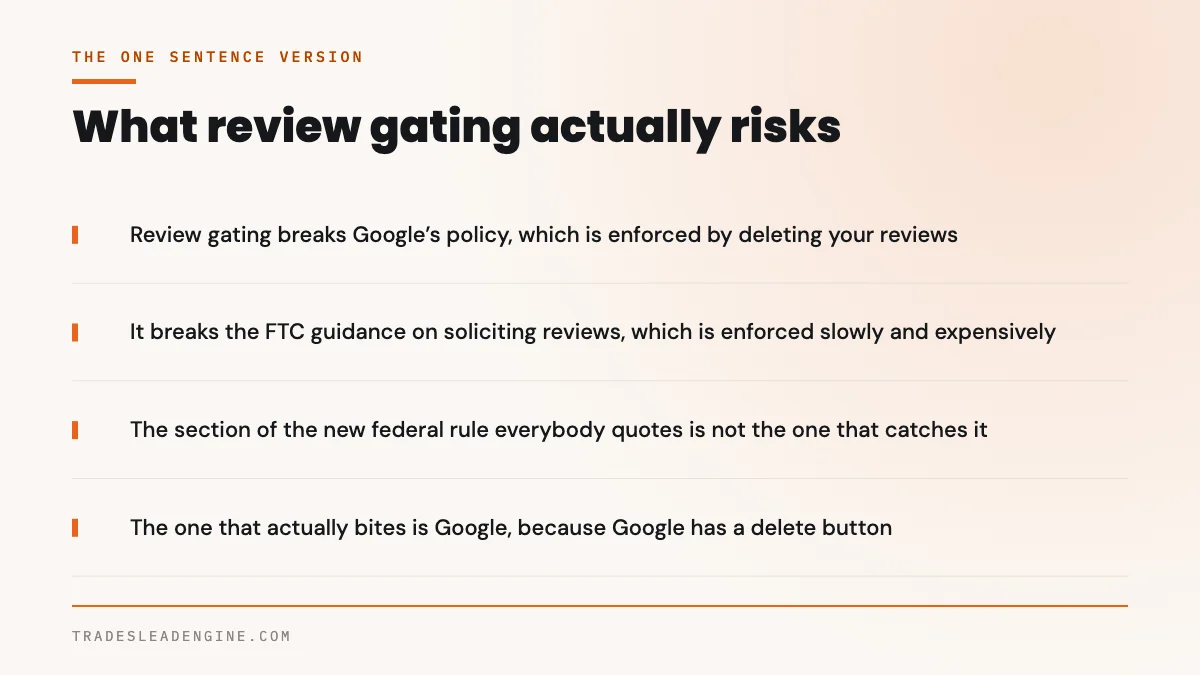
Review gating breaks Google’s policy, which is enforced by deleting your reviews, and it breaks the FTC’s published guidance on soliciting reviews, which is enforced slowly and expensively. The specific section of the new federal rule that everybody quotes at you is not actually the one that catches it.
There is a second reason to stop, and it has nothing to do with rules. A gate buys you a rating you cannot keep. In the one documented case with before and after numbers, the business lost 386 reviews when Google caught it, and its average rating went down afterwards. The gate had been holding up a number that the real customers did not support.
What it actually looks like in a trades business
Almost nobody sets out to break a rule. What happens is that a review tool gets bought, the default template gets left alone, and the default template contains a gate. The flow is always the same shape.
The customer gets a text or an email after the job asking how it went, usually as a thumbs up or thumbs down, or a one to five rating. Thumbs up goes straight to the Google review form. Thumbs down goes to a private feedback box that lands in the office inbox and nowhere else. The customer who was annoyed about the arrival window never sees the Google link at all.
Joy Hawkins of Sterling Sky describes the mechanism the same way, and names what it is for:
Google review gating is when businesses filter customers before asking them to leave a Google review. Businesses review gate by sending customers an email template that asks them if they had a positive or negative experience. If they had a positive experience, they are directed to leave a review on Google (or Facebook, etc.). But if they had a negative experience, they are prompted to leave private feedback for the business and are never given the option to leave a public review. In this way, businesses can ‘rig the system’ by reducing the number of negative reviews that appear on the public-facing platforms.
Joy Hawkins, Sterling Sky, Google Review Gating Is Against Google Maps User Generated Content Policy
The three variations that are also gates
The survey version is the obvious one. Three others do the same job and get defended as something else.
Sending the review link only to the jobs that went well, chosen by whoever ran them, is a gate operated by hand. So is asking the technician to request reviews only from customers who seemed pleased on the day. So is a tablet at the counter where the office manager decides who gets handed it.
Ask one question about your own process: can a customer who is unhappy with us reach the Google review form through the same path as a customer who is delighted, with the same message, at the same point after the job? If the answer is no, you have a gate, whatever the vendor calls the feature.
Google has prohibited this since April 2018
This is the part most owners have never been shown, because it is buried in a policy document rather than announced. Google’s Maps User Generated Content Policy has a section called Rating Manipulation, and inside it is a short list of things merchants are not allowed to do. The second item is the gate, in Google’s own words:
We do not allow merchants to: Offer incentives – such as payment, discounts, free goods and/or services – in exchange for posting any review or revision or removal of a negative review. Discourage or prohibit negative reviews, or selectively solicit positive reviews from customers
Google, Prohibited and restricted content, Maps User Generated Content Policy
Read the second sentence slowly. “Selectively solicit positive reviews from customers” is not a description of fake reviews. Every review your gate produced was from a genuine customer about a genuine job. The policy is not about whether the reviews are real. It is about whether the set of people you asked was chosen by how they would answer.
The same section tells you what is allowed, which is the useful half:
We do allow merchants to: Solicit or encourage the posting of content that does represent a genuine experience, without offering incentives to do so or attempting to influence the rating or the contents of the review.
Google, Prohibited and restricted content, Maps User Generated Content Policy
When the wording appeared
Sterling Sky dates the change precisely. On 12 April 2018 Google updated its review guidelines to add the line “Don’t discourage or prohibit negative reviews or selectively solicit positive reviews from customers.” The wording has been tidied since and now sits in the Maps content policy, but the prohibition is the same one and it is eight and a half years old.
That matters for a practical reason. Vendors still selling gated flows sometimes argue that the rules are new and unsettled. On Google’s side they are neither. The federal rule arrived in 2024. Google’s line predates it by more than six years.
What happened to two businesses that got caught
Policies are only as real as their enforcement, so here is the only published record of what enforcement looks like, from the same Sterling Sky write-up. Two businesses, both caught, both with numbers attached.
The first had 464 reviews at an average of 4.1 stars. After Google acted it had 78 reviews at an average of 3.9. Google removed 386 reviews, including ones left long before the policy wording existed. Note the direction of the rating: it fell. The gate had produced a 4.1 that the surviving reviews did not support, which is the whole argument against gating in one line.
The second business was caught gating through a third-party tool. It had more than 30 reviews on the listing, and after being reported, Google removed every one of them.
What getting caught looks like, drawn to scale
Top: the one documented case with before and after review counts, at 1.4 pixels per review. Bottom: how long each rulebook has prohibited this, on one day axis at 0.25 pixels per day.
There is no documented route to restoring reviews Google removed as rating manipulation. The one appeal a profile gets is for content Google took in error, and a gate is not an error. Treat anything a gate produced as money already spent.
One more detail worth sitting with: Google removed reviews that were left years before the policy sentence was published. If your tool has been gating since 2021, the exposure is every review it collected, not the ones since you read this.
The federal rule everybody cites, and what it actually says
In August 2024 the Federal Trade Commission finalised 16 CFR Part 465, the Rule on the Use of Consumer Reviews and Testimonials. The vote was 5-0 and the rule took effect on 21 October 2024. It has six operative sections: fake reviews, buying positive or negative reviews, insider reviews, company-controlled review sites, review suppression, and fake social media indicators.
The section that gets quoted at trades owners is § 465.7, Review suppression. It has two limbs, and this is the whole of the second one, which is the limb people mean:
For a business to materially misrepresent, expressly or by implication, that the consumer reviews of one or more of the products or services it sells displayed in a portion of its website or platform dedicated in whole or in part to receiving and displaying consumer reviews represent most or all the reviews submitted to the website or platform when reviews are being suppressed (i.e., not displayable) based upon their ratings or their negative sentiment.
Now read it against your situation. The subject is reviews “displayed in a portion of its website or platform” that is dedicated to receiving and displaying reviews, and the wrong is misrepresenting that what is shown there is most or all of what was submitted. That is a testimonials page on your own site, filtered, presented as the full picture.
A gate that stops an unhappy customer from ever reaching Google is a different act. Those reviews were never submitted to your website. Google is not your platform. On the plain words of § 465.7(b), the classic Google review gate is not what the paragraph describes.
The other limb, and the one real overlap
The first limb of § 465.7 covers threats: an unfounded or groundless legal threat, a physical threat, intimidation, or a knowingly false public accusation, used to stop a review being written or to get one removed. That is a different playbook, and if your process includes any of it you have a bigger problem than a survey template.
Where the rule does bite on filtering is the case the Commission spelled out when it published the rule. Asked to change the definition of a review so that unpublished submissions counted, it declined, and explained why in a sentence worth keeping:
A consumer review that is submitted to a website or platform but never published does not in and of itself deceive consumers, although the failure to publish a review may be deceptive pursuant to paragraphs (a)(1) and (b) of Sec. 465.7.
So if you collect reviews into your own site and hold back the bad ones, you are squarely inside the rule. If your gate simply never hands over the Google link, you are outside this particular paragraph and inside Google’s policy and the FTC’s guidance instead. Both of those still say no.
The prevalence evidence behind the rule included something the FTC found in an investigation: it describes learning about “more than 4,500 merchants that were automatically publishing only 4- or 5-star consumer reviews.” That is the FTC’s own number for automated review filtering, and it is the closest thing to a real statistic this topic has.
Why the section number keeps getting quoted wrong
If somebody has sent you a warning about this, check the citation. A large share of the secondary writing on review gating cites the wrong paragraph, and a surprising amount of it cites a paragraph that does not exist.
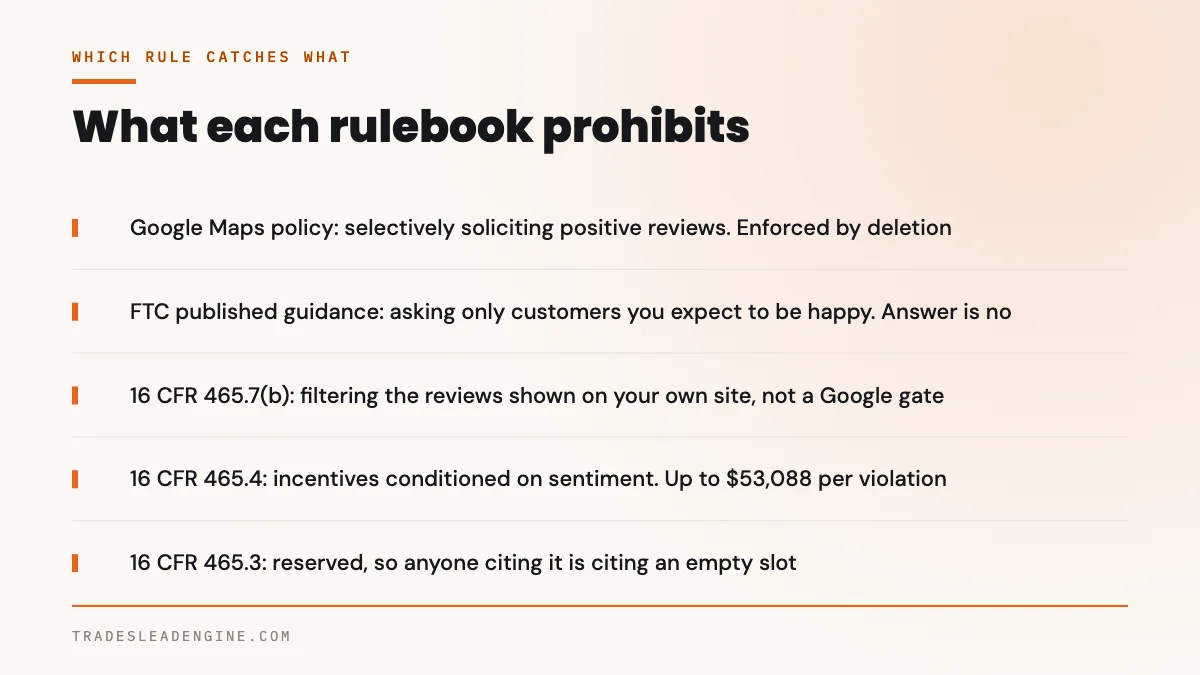
Part 465 skips a number. The eCFR text reads “§ 465.3 [Reserved]”: there is no section 465.3 in the final rule. Anyone quoting § 465.3 at you is quoting an empty slot.
The three sections that get mixed up are worth keeping straight, because they prohibit different things:
| Rule or policy | What it prohibits | Catches a Google gate | Enforced by | What it costs you |
|---|---|---|---|---|
| 16 CFR § 465.4 | Compensation or incentives in exchange for, or conditioned on, a review expressing a particular sentiment | No. This is the paid-review section | FTC, civil penalties | Up to $53,088 per violation |
| 16 CFR § 465.5 | Undisclosed reviews and testimonials written by officers or managers of the business | No. This is the insider section | FTC, civil penalties | Up to $53,088 per violation |
| 16 CFR § 465.7(a) | Legal threats, physical threats, intimidation or knowingly false public accusations used to stop or remove a review | No, unless your process includes threats | FTC, civil penalties | Up to $53,088 per violation |
| 16 CFR § 465.7(b) | Misrepresenting that the reviews shown on your own site are most or all of those submitted, while suppressing by rating or sentiment | Only if you collect reviews onto your own site and filter them | FTC, civil penalties | Up to $53,088 per violation |
| FTC Act Section 5, read with the Endorsement Guides | Deceptive review collection, including asking only customers you expect to be happy where it skews the result | Yes, on the FTC’s own published answer | FTC, case by case | An investigation and an order, no automatic penalty |
| Google Maps User Generated Content Policy | Discouraging or prohibiting negative reviews, or selectively soliciting positive ones | Yes, directly and by name | Google, automatically | Your reviews, deleted, with no route back |
There is also a naming muddle that makes searching harder. The eCFR heading is the Rule on the Use of Consumer Reviews and Testimonials. The FTC’s own December 2025 announcement calls it the Consumer Review Rule. Its May 2026 announcement calls it the Reviews and Testimonials Rule. All three are the same part 465.
The phrase “review gating” appears nowhere in the final rule document. Search the Federal Register text for “gating” and every hit is part of the word “promulgating”. It is an industry term, not a legal one, which is part of why writing about it goes wrong so often.
Where the FTC does answer this, and the answer is no
The rule is not the only thing the FTC publishes. Its guidance documents answer practical questions in plain language, and two of them answer this one directly. These are not regulations, but they are the agency’s stated position on what it considers deceptive, and they are what an investigator would hold up.
In the Endorsement Guides question and answer document, a business asks almost word for word what a contractor asks:
My company would like to get more online reviews by sending a link to a review page to customers in specific regions where we have the highest customer satisfaction. We would not send a link to customers in areas where we know our customer experience is poor. Is that OK? No. Only asking for reviews from customers who you think are more likely to be happy with your product would be misleading if it substantially skews the favorability of the reviews.
The second source is shorter and blunter. The FTC’s guide for marketers lists rules of thumb for asking for reviews, and one of them is a single sentence: “Don’t ask for reviews only from customers you think will leave positive ones.”
The qualifier matters, and it is not a loophole
Notice the condition in the Endorsement Guides answer: it would be misleading “if it substantially skews the favorability of the reviews.” That is a real limit. Asking the four customers whose jobs you finished this week, in the order you finished them, is not a gate even if all four were happy.
But a tool that routes by sentiment skews by design. Skewing the result is the only thing it does. There is no version of a sentiment gate that does not meet the condition, which is why the answer in that document is the word no rather than a discussion.
What the FTC says about delay, which is the next thing people try
Once the gate goes, the usual next idea is to hold the bad ones back for a day or two while somebody calls the customer. The FTC has answered that too, and the distinction it draws is useful:
If you want to delay posting reviews in order to have time to respond to them, you should delay posting all reviews, positive and negative, for the same, reasonable period of time. Treating all reviews equally in this way would not result in injury or deception. However, delaying the posting only of negative reviews, even just by a few days, could create a biased picture of a product at any given time, which makes this practice problematic.
The same answer closes the other half of the idea: delaying negative reviews while you try to change the customer’s mind and then not posting the original would, in the FTC’s words, likely give a biased and misleading picture of what customers think.
The principle underneath all of it is evenhandedness. Treat every review the same way, and you are fine. Treat them differently according to what they say, and you are not, whether the mechanism is a gate, a delay or a decision somebody makes in the office each Friday.
Not sure what your own review flow does with an unhappy customer
The free Lead Engine Scorecard checks the things a homeowner and a search engine both check: speed, conversion blockers, trust signals, rankings, and whether your review and reputation setup is helping you or quietly storing up a problem. No sales call required.
Get the free Scorecard
Questions first? leads@tradesleadengine.com · (726) 224-4920 · see how reviews and reputation work
What a violation costs, and why the number held in 2026
The figure attached to part 465 is $53,088 per violation. It is real, it comes from the FTC rather than from a marketing blog, and the agency repeats it in its own announcements. Its December 2025 warning-letter release says Rule violations can result in “civil penalties of up to $53,088 per violation.”
Where it comes from is worth knowing, because it is adjusted annually. The FTC’s February 2025 announcement records the move: “The maximum civil penalty amount has increased from $51,744 to $53,088 for violations of Sections 5(l), 5(m)(1)(A), and 5(m)(1)(B) of the FTC Act,” effective when published in the Federal Register on 17 January 2025.
The number did not rise in 2026, and there is a documented reason. On 15 September 2026 the FTC published a notice stating that its “civil penalty amounts will remain unchanged during 2026” and that it “will continue to apply the 2025 civil penalty levels.” The annual inflation adjustment was cancelled on OMB guidance, because the data it is calculated from was not produced. So $53,088 is current, and it is current for a reason worth checking rather than assuming.
Two caveats on the number, because it gets waved around carelessly. It is a maximum, not a tariff, and it applies per violation, which a court decides how to count. And civil penalties under a rule like this are sought through the Department of Justice on a referral from the Commission, which is not something that happens to a four-truck plumbing company over a survey template.
What is proportionate to worry about is the thing in the next two sections: who actually receives the letters, and what Google does without needing anyone’s permission.
Who the FTC has actually gone after
This is where the topic stops being theoretical for a trades business, because the FTC’s recent review work has not been aimed at Amazon sellers.
On 22 December 2025 the Commission announced that staff had sent warning letters to ten companies over possible violations of the rule. The letters were based on consumer complaints and information the companies provided, and the release is explicit that they are “not formal determinations that the recipients have violated the Consumer Review Rule.” Christopher Mufarrige, Director of the Bureau of Consumer Protection, said in the same release that “as consumers increasingly depend on online reviews, the FTC is committed to ensuring companies comply with this Rule.”
The FTC’s own release does not say what kind of companies received them. The law firm DLA Piper, writing in July 2026, reports that the ten were six property management companies, three personal injury law firms and one accounting firm, and that the conduct involved incentives such as lease discounts or gift cards offered for positive reviews. That breakdown is a law firm’s account of letters later published, not an FTC statement, and it is worth reading as such.
The home repair case
On 11 May 2026 the FTC and the State of Illinois took action against a company called Premium Home Service and its owner. The allegation is not gating, it is fake listings and fabricated reviews, but the sector is the point. According to the complaint, as described in the FTC’s release:
Tens of thousands of consumers searching for local home repair service companies have been diverted to the defendants’ business profiles, which include common keywords used to search for such services, including “electrical services,” “plumbing,” “heating and cooling” and “garage door repair”
The complaint was filed in the US District Court for the Northern District of Illinois and the Commission voted 2-0 to refer a civil penalty complaint to the Department of Justice. The alleged conduct includes fabricated five-star reviews and calls routed to representatives elsewhere, including the Philippines.
Not as a warning about gating, which is not what it alleges. It is useful as evidence that review conduct in the home trades is now something the FTC files cases about, with a state attorney general alongside it. The sector is on the list.
Keep the two risks in proportion. Federal enforcement is slow, selective and aimed at scale. Google’s enforcement is automatic and lands on ordinary profiles, which is covered in more detail in the guide to why Google reviews disappear.
The ten minute test you can run on your own phone
You do not need your vendor’s cooperation to find out whether you are gating, and you should not take their word for it. Run the flow on yourself.
Book a job in your own system under a name and mobile number nobody in the office will recognise, or ask a friend whose number is not in your database to let you use theirs. Mark the job complete so the review request fires the way it would for a real customer.
When the message arrives, answer it the way an unhappy customer would. Give one star. Tap the sad face. Type that the crew was late. Then watch what the next screen does.
| What happens after you give a low score | What it means | What to do |
|---|---|---|
| You get the same Google review link a happy answer would get | No gate. Your flow treats everyone the same | Nothing. Record the result and move on |
| You get a private feedback form and no Google link anywhere | A gate, the standard kind | Turn it off today, then read the next section |
| You get a private form, and a Google link appears after you submit it | A soft gate. The path exists but it is longer for unhappy customers | Ask the vendor to make both paths identical |
| You get an apology screen and a promise someone will call | A gate wearing a service recovery costume | Keep the call, add the review link to the same screen |
| No request arrives at all for a low score | Either a gate upstream or a broken automation | Check the tool’s logs before blaming either |
Screenshot every screen as you go. Two reasons: you will want the evidence when you raise it with the vendor, and if the flow is clean you have a dated record that it was, which is worth having.
Four questions to put to your review tool in writing
If the test showed a gate, the next conversation is with whoever sold it to you. Ask in writing, by email, and keep the reply.
One. What happens to a customer who scores us low in the request flow: show me the exact screens and links they see. Not a description of the philosophy, the screens.
Two. Is sentiment routing on in our account today, and was it on when we started? A tool that can gate is not the same as a tool that is gating, and you need the setting and the date.
Three. Which setting turns it off, and what does our flow look like afterwards? Some tools only offer gating as the default template and need the template replaced rather than a switch flipped.
Four. Show me where your product documentation addresses Google’s policy on selectively soliciting positive reviews. If the answer is a sales rep’s reassurance rather than a page you can read, you have learned how current the rest of their advice is.
“Everyone does it” and “Google has never enforced that” are both answers to a different question. Neither is a page you can read, and the second one is contradicted by the only published cases there are.
This is the same move that works whenever a supplier quotes something stale: ask them to show you the current page. It is the approach the guide to competitors stuffing keywords in their business name recommends for profile claims, and it transfers without modification.
What to do instead, which works better anyway
The honest reason to drop the gate is not compliance, it is that the gate is a bad trade. It suppresses a handful of bad reviews and in exchange it suppresses the volume and the recency that actually move you in local results, because the customers it filters out are a third of the people you could have asked.
Here is what replaces it, and none of it needs new software.
Ask everybody, the same way, at the same point
One message, sent to every completed job, with the Google link in it. No rating question in front of it, no branching. If you want to know how the job went, ask that in a separate conversation that is not attached to the review request.
Volume is the thing you were giving up. A steady flow of genuine reviews with the occasional three-star in it reads as real to a homeowner and counts as real to Google, which is the point the guide on how many Google reviews you need to rank gets into.
Fix the thing the gate was hiding
A gate is a symptom. If a meaningful share of your customers would leave a bad review, the gate is not solving that, it is paying a subscription to not hear about it. The arrival window, the quote that changed on the day, the unreturned call: those produce the reviews you were filtering, and they are fixable.
The unreturned call is usually the biggest single one, and it is measurable rather than a matter of opinion. The guide on what a missed call actually costs covers how to put a number on it.
Reply to the bad ones in public
A calm, specific, non-defensive reply under a two-star review does more for a reader than the two-star does against you. It is also the only part of this that your competitors reliably skip.
Same message to every finished job. Review link in the first screen, no rating gate in front of it. No incentive of any kind, which is a separate rule in both rulebooks. A separate private survey if you want operational feedback. A written reply to anything under four stars within two business days.
One thing to leave alone while you are in here: incentives. Offering a discount, a gift card or a prize draw for a review is prohibited by § 465.4 and by Google’s policy whether the review is positive or not, which the guide on whether you can pay for Google reviews covers in full.
The unhappy customer you were trying to divert
Dropping the gate does not mean doing nothing when a job goes wrong. It means separating two jobs that the gate had welded together.
The first job is the review request, which goes to everyone unchanged. The second is service recovery, which is a phone call from a person, made because the work was not right, not because a review is at stake. Run both. Just do not make the second one a condition of the first.
The FTC addresses this directly: contacting customers who left negative reviews and trying to make them happy is permitted. What it says you cannot do is ask them to change or delete the review as part of it.
If the review is already up and it is false
That is a different question with a different process, and it has nothing to do with gating. Google’s reporting route and what it realistically achieves is covered in the guide on removing a fake Google review.
If a customer is threatening a bad review to get something
Also a different question, and the one place where § 465.7(a) is genuinely relevant to you, because the temptation is to answer a threat with a threat. Do not. The guide on a customer threatening a bad review walks through it.
Where this stops being a marketing question
Everything above is a reading of published rules, policies and guidance, with links so you can read them yourself. Whether any particular flow in your business violates a federal rule is a question for an attorney who can see the flow, and a few of the questions below are genuinely unsettled.
Three situations call for a lawyer rather than a marketer.
The first is a testimonials page on your own website that shows a selected set of reviews and reads as though it shows all of them. That is the one scenario where § 465.7(b) applies on its plain words, and the question of whether a given page “materially misrepresents” anything is a legal judgement, not a marketing one.
The second is an embedded review widget on your site that pulls from a platform and filters by star rating. Whether the widget makes a portion of your site “dedicated in whole or in part to receiving and displaying consumer reviews” is exactly the kind of question the rule leaves open, and § 465.1 does not define the phrase.
The third is any letter from a regulator or a plaintiff’s firm. Answer it with counsel, not with a marketing agency, the same way a Texas licensing question goes to the regulator rather than a web designer, which the guide on putting your license number on your website in Texas sets out.
Numbers about reviews you should not believe
This topic attracts invented statistics the way few others do, and several of the most quoted ones trace back to pages that cite nobody. If a proposal prices itself against one of these, ask for the link before you agree to anything.
Four that do not survive a search for a source: that businesses with 50 or more reviews are 266 per cent more likely to appear in the local pack; that 42 per cent of clicks go to the local pack; that consistent listings make you 40 per cent more likely to rank; and that a one-star increase is worth 5 to 9 per cent in revenue, which is a real piece of restaurant pricing research stretched across every industry on earth.
Three more are in a softer category, where the figure may once have come from real research but has no openable source today. Rather than calling them fabrications, ask whoever is quoting them to send you the study: that 97 per cent of consumers search online for local businesses, that 88 per cent of consumers trust online reviews as much as personal recommendations, and that it takes a specific number of positive reviews to cancel out one bad one.
$53,088 per violation, from the FTC’s own announcements, and “more than 4,500 merchants that were automatically publishing only 4- or 5-star consumer reviews,” from the FTC’s own rulemaking document. Both are linked below. There is no credible published figure for how many contractors use gated review tools, and this guide does not offer one.
What to do on Monday
Four things, and the first one is the only one that cannot wait.
Run the test. Ten minutes, your own phone, a low score through your own review request. You will know by lunchtime whether you have a gate.
If you have one, turn it off. Not after the quarter, not after you have found a new vendor. The exposure grows with every review the gate collects, and Google has removed reviews predating the policy wording by years.
Write down today’s numbers. Review count and average rating, with the date. If Google ever acts on your profile you will want a baseline, and almost no owner has one.
Send the four questions to your vendor. In writing. Keep the reply. If the answer is a reassurance rather than a page, you have learned something useful about everything else they have told you.
One thing not to do: do not go back through old reviews trying to tidy anything up. Nothing in either rulebook asks you to remove reviews a gate produced, and deleting or editing your own review history is not a move that helps you.
Want somebody to check the whole review setup, not just the gate
The free Lead Engine Scorecard looks at your profile, your reviews, your site speed and your lead capture together, and tells you which of them is actually costing you jobs this month. It takes a couple of minutes and there is no sales call attached to it.
Get the free Scorecard
Or talk it through: leads@tradesleadengine.com · (726) 224-4920 · more guides in the library of contractor marketing guides
Questions trades owners ask about review gating
Is it OK to only ask my happy customers for reviews?
No. Google’s Maps User Generated Content Policy says merchants may not “selectively solicit positive reviews from customers,” and the FTC, asked this question in its own Endorsement Guides guidance, answers no on the basis that it would be misleading if it substantially skews the favorability of the reviews. Ask everybody, with the same message, at the same point after the job.
Is review gating actually illegal, or just against Google’s rules?
Both answers are partly right, which is why this gets muddled. It is plainly against Google’s policy. On the federal side, the section of the fake reviews rule that gets cited, § 465.7(b), is about misrepresenting the reviews displayed on your own website, so a gate that simply withholds the Google link is not what that paragraph describes. The FTC’s published guidance still says do not do it, and that guidance reflects its view of what is deceptive under the FTC Act. Whether your specific setup crosses a line is a question for an attorney.
Will Google really delete my reviews over this?
It has. The one published case with numbers went from 464 reviews at 4.1 stars to 78 reviews at 3.9 stars, and a second business lost all 30 or so of its reviews after being reported. Google also removed reviews that had been left long before the policy wording was published, so the exposure is the whole history a gate collected, not just the recent ones.
My review tool says it is FTC compliant. Does that settle it?
No, for two reasons. A vendor’s compliance claim is usually about the federal rule, and the rule is not the thing most likely to cost you: Google’s policy is, and Google is not the FTC. And compliance claims are about the product rather than your account, where sentiment routing may be switched on in a template nobody has looked at since setup. Run the ten minute test instead of relying on the claim.
Can I ask how the job went before I send the review link?
You can ask, as long as the answer does not decide what happens next. A satisfaction survey that everyone receives, followed by the same review request to everyone regardless of what they said, is not a gate. A rating question whose answer routes the customer to either a review form or a private box is. The difference is whether the sentiment changes the path.
What if I send the link to fewer customers rather than filtering them?
It depends entirely on how you choose. Asking every third completed job, or only the jobs over a certain value, is a selection rule that has nothing to do with sentiment, and the FTC’s own qualifier is about skewing favorability. Choosing by who you think will be nice about you is the thing the guidance names. Write your selection rule down, and if you cannot state it without mentioning how happy the customer is, it is a gate.
Can I take a bad review off my own website testimonials page?
This is the one part of the topic where the federal rule applies most directly, and it is genuinely a legal question rather than a marketing one. § 465.7(b) is about a business misrepresenting that the reviews shown in a review section of its own site are most or all of those submitted while suppressing by rating or sentiment. A curated testimonials page that never claimed to be complete is a different thing from a review feed that filters. Ask an attorney about your page.
We have been gating for two years. Do we have to tell anyone?
Nothing in Google’s policy or the federal rule requires you to disclose past practice or to notify anybody. What is worth doing is turning it off, writing down your current review count and rating with today’s date so you have a baseline, and getting your vendor’s confirmation in writing that routing is now off. If a regulator or a plaintiff’s firm ever asks, that is a question for counsel.
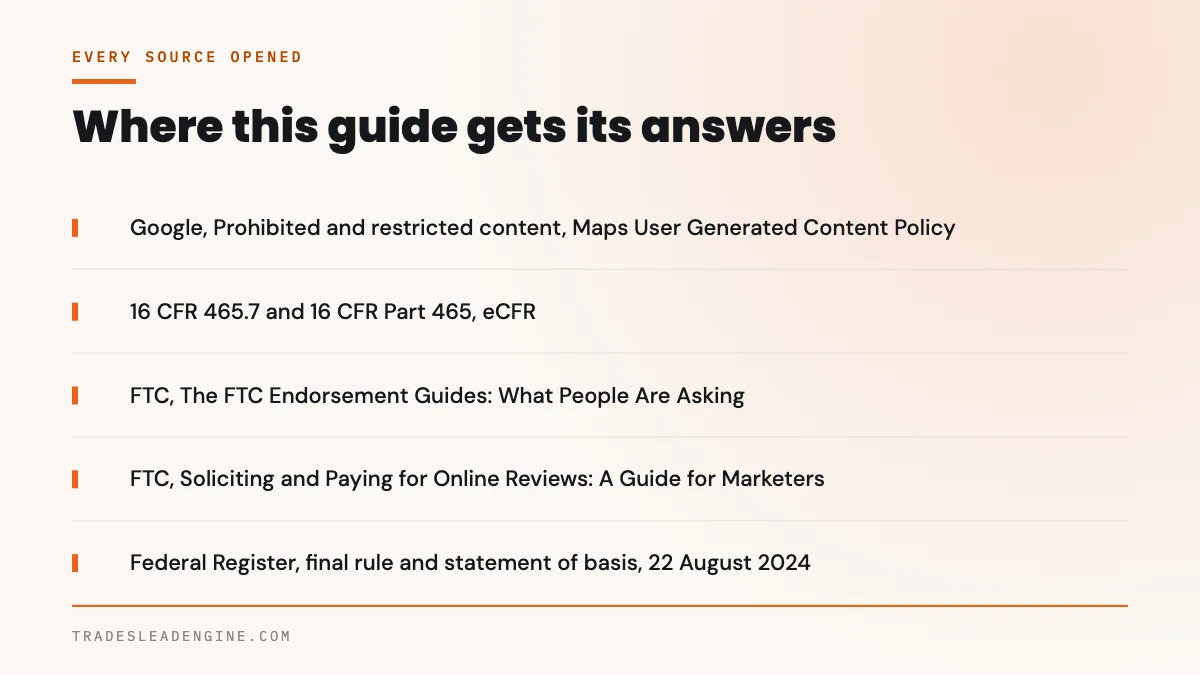
Sources
Sources
- Prohibited and restricted content, Google Maps User Generated Content Policy: the Rating Manipulation section, including “We do not allow merchants to… Discourage or prohibit negative reviews, or selectively solicit positive reviews from customers” and the permitted alternative. Opened and quoted 29 October 2026. Note that the policy text sits inside collapsed sections, so it is easy to miss on a quick read.
- 16 CFR § 465.7, Review suppression, eCFR: the full text of both limbs, including the “portion of its website or platform” wording and the list of evenhanded withholding criteria that do not count as suppression.
- 16 CFR Part 465, Rule on the Use of Consumer Reviews and Testimonials, eCFR: the section list showing “§ 465.3 [Reserved]”, and the text of § 465.4 on compensation or incentives conditioned on sentiment and § 465.5 on insider reviews.
- The FTC’s Endorsement Guides: What People Are Asking, Federal Trade Commission: the question about sending review links only to high-satisfaction regions and the answer “No. Only asking for reviews from customers who you think are more likely to be happy with your product would be misleading if it substantially skews the favorability of the reviews”, plus the answers on delaying negative reviews and on contacting unhappy customers.
- Soliciting and Paying for Online Reviews: A Guide for Marketers, Federal Trade Commission: the rules of thumb, including “Don’t ask for reviews only from customers you think will leave positive ones.”
- Trade Regulation Rule on the Use of Consumer Reviews and Testimonials, Federal Register, 22 August 2024: the Commission’s statement that “the failure to publish a review may be deceptive pursuant to paragraphs (a)(1) and (b) of Sec. 465.7”, the prevalence finding about “more than 4,500 merchants that were automatically publishing only 4- or 5-star consumer reviews”, and “The rule will take effect October 21, 2024.”
- Federal Trade Commission Announces Final Rule Banning Fake Reviews and Testimonials, FTC, August 2024: the summary of the review suppression provision and the 5-0 Commission vote.
- FTC Warns 10 Companies About Possible Violations of the Agency’s New Consumer Review Rule, FTC, 22 December 2025: “civil penalties of up to $53,088 per violation”, the statement that the letters are not formal determinations, and the quote from the Director of the Bureau of Consumer Protection.
- FTC Publishes Inflation-Adjusted Civil Penalty Amounts for 2025, FTC: the increase “from $51,744 to $53,088 for violations of Sections 5(l), 5(m)(1)(A), and 5(m)(1)(B) of the FTC Act”, effective on publication in the Federal Register on 17 January 2025.
- Civil Penalty Inflation Adjustments, Federal Trade Commission notice, Federal Register, 15 September 2026: the FTC’s “civil penalty amounts will remain unchanged during 2026” and it “will continue to apply the 2025 civil penalty levels”, following OMB guidance after the inflation data was not produced.
- FTC and Illinois Take Action to Stop Deceptive Conduct by Company that Created Thousands of Business Listings of Fake Local Home Repair Businesses, FTC, 11 May 2026: the diverted-consumer allegation and the search keywords “electrical services,” “plumbing,” “heating and cooling” and “garage door repair”, the Northern District of Illinois filing, and the 2-0 referral vote.
- Google Review Gating Is Against Google Maps User Generated Content Policy, Joy Hawkins, Sterling Sky, 24 September 2026: the definition of gating quoted above, the 12 April 2018 date on which Google added the wording, and the two documented enforcement cases (464 reviews at 4.1 stars falling to 78 at 3.9, and a listing losing all 30-plus reviews after a report). A practitioner account rather than a platform statement, and labelled as such.
- FTC’s 2026 enforcement approach to fake reviews takes shape, DLA Piper, July 2026: the law firm’s account of which ten companies received the December 2025 warning letters (six property management companies, three personal injury law firms, one accounting firm) and the incentive conduct alleged. The FTC’s own release does not identify the recipients, so this is a secondary account.