

If you hold a Texas plumbing, air conditioning or electrical licence, then yes: the state requires a license number on website advertising, and the written exceptions do not cover a website. If your trade is not licensed by the state at all, which covers roofing, remodelling, painting and general contracting, no such rule exists and inventing a number to look official is its own problem.
That is the whole answer. What follows is the wording of the three rules, the exact exceptions, what happens to the businesses that ignore them, and the two places where the rules are genuinely unclear and a lawyer is the right person to ask rather than a marketer.
This matters more than it used to. Texas homeowners are told by the plumbing board itself to look for the number before they hire anyone, which means the number is not only a compliance box. It is a trust signal you are currently either sending or withholding.
What’s in this guide
- The short answer, by trade
- Does a website even count as advertising
- Where to put the license number on website pages, footers and forms
- The exceptions, and why none of them covers your website
- Plumbers: the RMP of record’s number, on everything
- Air conditioning: the affiliated licensee’s number
- Electricians: the name as well as the number
- Trades Texas does not license at all
- Google Business Profile, Facebook and paid ads
- What getting it wrong actually costs
- The numbers you will see elsewhere, and should not believe
- What to do on Monday
- Questions Texas contractors actually ask

The short answer, by trade
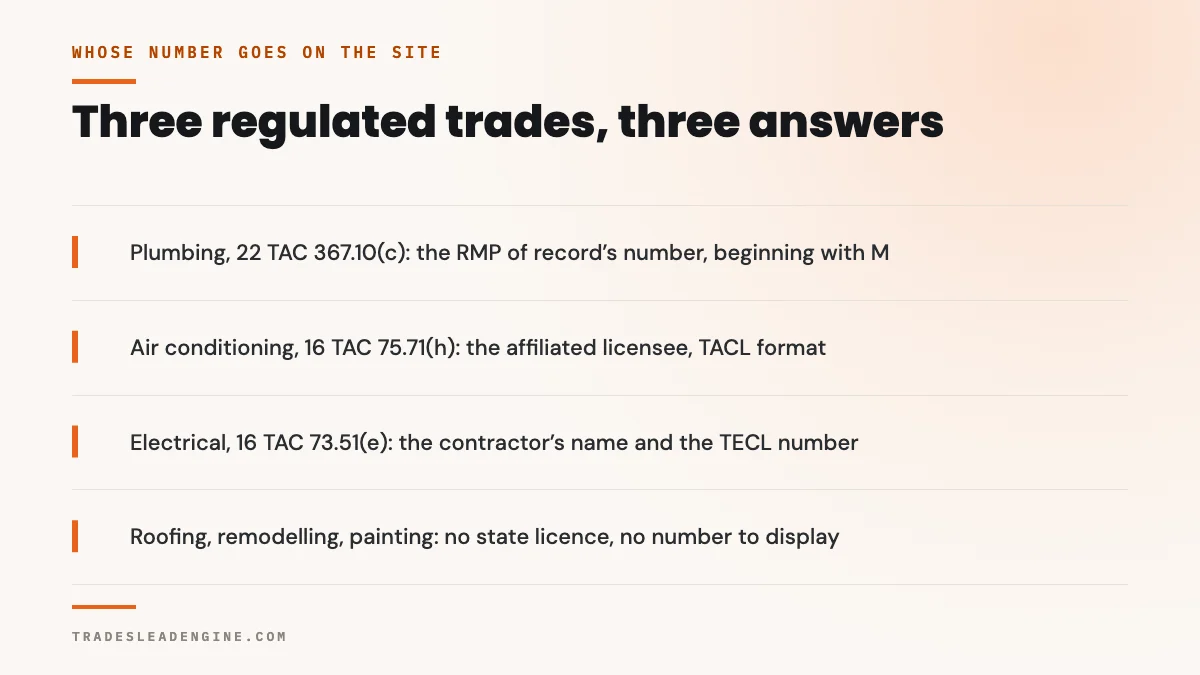
Three Texas trades have a written rule that names advertising directly. Plumbing is regulated by the Texas State Board of Plumbing Examiners. Air conditioning and refrigeration contracting and electrical contracting are both regulated by the Texas Department of Licensing and Regulation, under two separate chapters of rules.
All three say the same thing in slightly different language: advertising designed to solicit that kind of work has to carry the licence number. None of the three carves out websites. One of them, the plumbing rule, closes the door explicitly by saying the requirement applies “regardless of the type of media used.”
The differences are in whose number goes on the page, whether the company name has to sit next to it, and what the fine looks like if an inspector or a competitor files a complaint.
| Trade | Regulator | Rule | Whose number goes on the site | Company name required too |
|---|---|---|---|---|
| Plumbing | Texas State Board of Plumbing Examiners | 22 TAC 367.10(c) | The RMP of record (Responsible Master Plumber), number begins with M | Not required by this subsection |
| Air conditioning and refrigeration | Texas Department of Licensing and Regulation | 16 TAC 75.71(h) | The affiliated licensee, in the form TACL/A/000000/C | Not required in advertising, required on vehicles |
| Electrical | Texas Department of Licensing and Regulation | 16 TAC 73.51(e) | The electrical contractor, number preceded by TECL | Yes, name and number |
| Roofing, remodelling, painting, general contracting, handyman | No state licensing programme | n/a | There is no state number to display | n/a |
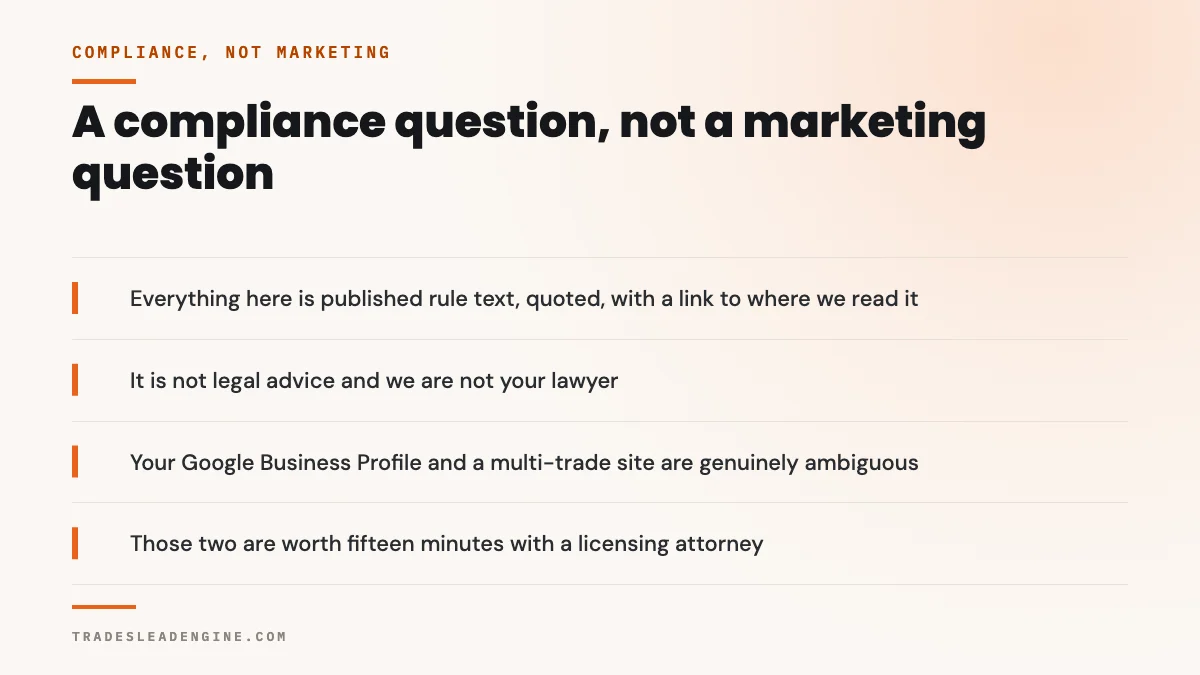
Everything below is the published rule text, quoted, with a link to where we read it. It is not legal advice and we are not your lawyer. Two of the situations further down (your Google Business Profile, and a site that advertises several trades at once) are genuinely ambiguous on the face of the rules. Those are worth fifteen minutes with an attorney who does licensing work, not a guess from anybody who sells websites. We take the same line on the other Texas compliance question owners ask us most, whether an AI phone agent is legal in Texas.
Does a website even count as advertising
This is the question owners actually get stuck on, because all three rules were written before most contractors had a website and none of them uses the word “website.” The answer is in the definitions, not in the advertising subsections.
The air conditioning rules define the term outright. Under 16 TAC 75.10, “Advertising” or “Advertisement” means:
Any commercial message which promotes the services of an air conditioning and refrigeration contractor.
Texas Administrative Code, 16 TAC 75.10, Definitions
A home page that says you fix air conditioners in Texas and asks people to call you is a commercial message promoting the services of an air conditioning contractor. There is no reading of that sentence that leaves a website out.
The electrical rules get there by a different route. They define “Offer to perform” as including advertising “in any form through any medium” that a business is an electrical contractor, or that “implies in any way” that the business is available to do electrical work. Again, a website is squarely inside that.
The plumbing rule does not bother with a definition. It closes the question in the operative sentence itself.
Both the RMP of record and owner of a plumbing company shall ensure that all advertisements by a plumbing company designed to solicit plumbing business state the license number of the RMP of record, regardless of the type of media used. This includes business cards, “flyers,” referral coupons, or other handouts.
Texas Administrative Code, 22 TAC 367.10(c), Display of RMP Name and License Number
“Regardless of the type of media used” is the clause that settles it. If a printed coupon is covered, a landing page with a form on it is covered.
Where to put the license number on website pages, footers and forms
The rules say the advertisement must “include” or “state” the number. They do not specify a font size, a position, or a page. That gives you room to do it tastefully, and it also means “it’s on the contact page somewhere” is a weak answer if every service page is its own advertisement.
The approach that has never caused a client of ours a problem, and that costs nothing to implement, is simple: put it in the site footer, where it appears on every single page, and repeat it on the pages that do the selling.
The four placements worth doing
The global footer. One line, near the copyright: the company name, the licence number with its correct prefix, and nothing else. Because the footer is templated, this covers the home page, every service page, every city page, every blog post and every landing page in one edit.
The contact page and every quote form. A form is where the solicitation actually happens. Put the number in the form’s supporting text or immediately beneath the submit button. It also quietly raises conversion, because it is the exact thing a cautious homeowner is looking for.
The automated confirmation. Your form’s thank-you page and the email it fires are both still soliciting the job. They are cheap to fix and almost universally forgotten.
Any downloadable PDF. Financing sheets, maintenance plan brochures and rebate explainers get sent to customers and shared. They are advertising in every sense the rules describe.
All three trades also have a separate rule about proposals and invoices, and the plumbing and electrical versions require a block of regulator contact information, not just the number. If you generate quotes or invoices from software, that template is where a violation is most likely to be sitting right now. Check it the same afternoon you fix the footer. Details are in the trade sections below.
What it should actually say
Write it the way the regulator writes it. For plumbing, the number begins with M. For electrical, the rules require the contractor’s name alongside the number and use the prefix TECL. For air conditioning, TDLR issues numbers in the form TACL/A/000000/C, where the letter after TACL is the licence class and the letter at the end is the endorsement.
Do not abbreviate it, do not set it in 9px grey on a grey background, and do not put it in an image. A number that exists only inside a graphic is invisible to a screen reader, to a search engine and to the AI assistants that increasingly answer “is this contractor licensed” before a human ever reaches your site. If you are wondering how those systems read your pages, our guide on how AI picks which contractors to recommend covers what they can and cannot see, and why you might not be showing up in ChatGPT covers the mechanics.
The exceptions, and why none of them covers your website
Each of the three rules ends with a list of advertising that does not need the number. People hear “there are exceptions” and assume one of them must cover the internet. Read them and almost none does.
The plumbing rule lists six. Nationally placed or interstate television. Internet advertising by a franchisor on behalf of its franchisees, provided a statement says local licence numbers are available on request. Advertisements with no visual component, such as radio or a phone call. Promotional items of nominal value such as ball caps and T-shirts. Signs on or adjacent to your permanent business location. And telephone book listings or other aggregated company information you do not control.
Only one of those six mentions the internet, and it is written for a franchisor advertising on behalf of franchisees. If you are an independent plumbing company in Texas, it is not yours. If you are a franchisee, the exception covers the franchisor’s national site, not the local site you run.
The air conditioning and electrical lists are older and narrower still. The closest thing to an internet exception in either is “telephone book listings that contain only the name, address, and telephone number.” A website is not a phone book listing, and it contains a great deal more than three fields.
“Signs located on the contractor’s permanent business location” is not a website. It means a physical sign on your building. We have twice been shown a proposal from another agency arguing that a website is “your digital storefront” and therefore covered by the signage exception. That is a metaphor, not a rule, and no regulator has ever written it down.
Plumbers: the RMP of record’s number, on everything
The plumbing rule is the strictest of the three and also the clearest. Three separate subsections of 22 TAC 367.10 apply to a plumbing company, and only one of them is about advertising.
Advertising
Subsection (c), quoted in full above, requires the RMP of record’s licence number on all advertisements designed to solicit plumbing business, regardless of media, and names business cards, flyers, referral coupons and handouts specifically. The number is the RMP of record’s, not the company’s and not a journeyman’s. Master Plumber numbers begin with M.
Proposals, invoices and contracts
Subsection (b) is the one most plumbing companies are quietly failing. The first page of any written or electronic proposal, invoice or contract must carry, in at least 12-point font: the first and last name of the RMP of record, that person’s licence number, the phrase “regulated by the Texas State Board of Plumbing Examiners”, and the board’s mailing address, phone number and website. The subsection sweeps in estimates, receipts and any document that defines services and costs.
If your field software emails a quote from a template, that template needs editing. Twelve-point is a specific instruction and a default 10px HTML email is smaller than it.
Vehicles
Subsection (a) requires the RMP’s licence number and the company name on both sides of every service vehicle, in a contrasting colour, at least two inches high, with the number preceded by M, MPL or RMP. Not a website problem, but it is the violation an inspector sees first, from a parking lot, without anyone filing a complaint.
You cannot advertise plumbing at all without an RMP
One step further back, 22 TAC 367.9(a) says a person or company “shall not advertise, contract for or otherwise offer or agree to perform plumbing work for or provide plumbing services to the public” unless it has secured the services of at least one RMP holding a current Master Plumber licence. Putting up a plumbing website before you have an RMP in place is itself the violation, separately from whether a number appears on it.
Air conditioning: the affiliated licensee’s number
16 TAC 75.71(h) is the advertising rule for air conditioning and refrigeration contracting companies:
All advertising by air conditioning and refrigeration contracting companies designed to solicit air conditioning or refrigeration business must include the affiliated licensee’s license number.
Texas Administrative Code, 16 TAC 75.71(h), Responsibilities of the Licensee and Contracting Company
Note the wording carefully. It is the affiliated licensee’s number, meaning the individual licence holder your company is registered against, not a company registration number and not a city permit number. TDLR issues those numbers in the form TACL/A/000000/C, where the class letter is A or B and the trailing letter is the endorsement.
The seven exceptions under (h) are national TV with an availability statement, phone book listings containing only name, address and telephone number, manufacturer and distributor trade ads, phone solicitations with a compliance statement, promotional items of nominal value, letterheads and printed forms for office use, and signs at the contractor’s permanent business location. No website exception exists.
The invoice rule most companies miss
Subsection (i) goes further than the other two trades. An invoice must be provided to the consumer for all air conditioning and refrigeration work performed. The company name, address and phone number must appear on all proposals and invoices, the affiliated licensee’s number must appear on all proposals and invoices, and a specific regulator block must be listed on proposals and invoices, on written contracts, and on a sign prominently displayed in the place of business if customers may visit it for service. The block is:
Regulated by The Texas Department of Licensing and Regulation, P.O. Box 12157, Austin, Texas 78711, 1-800-803-9202, 512-463-6599, www.tdlr.texas.gov
Texas Administrative Code, 16 TAC 75.71(i)
Three separate documents, plus a physical sign if the public comes to your shop. If your invoicing runs out of a field service platform, that is a settings change, not a redesign.
Vehicles and unmarked subcontractors
Subsection (g) requires the affiliated licensee’s number and the company name in letters not less than two inches high on both sides of every vehicle used in the work. It also handles a case the other trades do not: when an unlicensed subcontractor is on a job site with no marked vehicle, the site must be identified by a temporary sign on the subcontractor’s vehicle, or by a sign visible and readable from the nearest public street carrying the contractor’s affiliated licence number and company name.
Not sure what your site is missing beyond the licence number
The free Lead Engine Scorecard checks your site the way a cautious homeowner and an AI assistant both check it: speed, conversion blockers, trust signals, rankings and whether you are being cited in AI answers at all. No sales call required.
Get the free Scorecard
Questions first? leads@tradesleadengine.com · (726) 224-4920 · see contractor website design
Electricians: the name as well as the number
The electrical rule asks for one thing the other two do not.
All advertising by electrical contracting companies designed to solicit electrical business shall include the electrical contractor’s name and license number. This includes business cards.
Texas Administrative Code, 16 TAC 73.51(e), Electrical Contractors’ Responsibilities
Name and licence number. A footer that reads “TECL 12345” and nothing else does not satisfy the wording. It needs the contractor’s name next to it. If you trade under a DBA that differs from the licensed name, this is worth checking rather than assuming, because the rule says the electrical contractor’s name.
The six exceptions mirror the air conditioning list: national television with an availability statement, phone book listings with only name, address and telephone number, manufacturer and distributor trade ads, phone solicitations with a compliance statement, promotional items of nominal value, and signs at the permanent business location.
The paragraph that goes on every proposal
Subsection (f) requires the electrical contractor’s name, address, phone number and licence number on all proposals, invoices and written contracts, plus this exact block of text on all three:
Regulated by The Texas Department of Licensing and Regulation, P.O. Box 12157, Austin, Texas 78711, 1-800-803-9202, 512-463-6599; website: www.tdlr.texas.gov
Texas Administrative Code, 16 TAC 73.51(f)
Subsection (d) handles vehicles: name and licence number on both sides of each vehicle, contrasting colour, at least two inches high, number preceded by TECL.
Trades Texas does not license at all
This is where most of the confusion in the trades comes from, and where a lot of published advice is simply wrong.
TDLR lists the industries it regulates on its own home page. As of September 2026 that list runs to 39 programmes and includes air conditioning and refrigeration contractors, electricians, elevator and escalator safety, boiler safety, industrialized housing and buildings, mold assessors and remediators, water well drillers and pump installers, and residential solar retailers.
It does not include roofing. It does not include general contracting, remodelling, painting, concrete, drywall, framing, landscaping, fencing, or handyman work. Texas has no statewide general contractor licence, and there is no state roofing licence to put on a website.
What that means for your site
If your trade is not on the list, no state rule requires a number on your advertising, because there is no state number. What still applies:
- Do not display a number that is not what it looks like. A trade association membership number, a manufacturer certification ID or an LLC filing number presented as though it were a state licence is a misrepresentation problem, and that is a consumer protection question for a lawyer, not a marketing decision.
- “Licensed and insured” is a claim. If you have no state licence, the word “licensed” needs something behind it. Many roofers write “insured and bonded”, which is accurate and reads just as well.
- Cities are separate. Municipal registration, permitting and bonding requirements exist independently of state licensing and vary by city. Ask the city you work in, not a marketing company.
- Mixed-trade companies inherit the strictest rule. A company doing HVAC and roofing is still an air conditioning contracting company for the purposes of 16 TAC 75.71 and needs the number on the site.
The plumbing board’s own consumer page tells Texans to check that “the RMP’s license number should be displayed in all advertisements”, to verify the number in the state database, to confirm a certificate of insurance is on file, and to phone the enforcement department and ask whether any valid complaints exist. Homeowners are being coached to look for the thing you might be leaving off. A licence number in your footer is free proof for a customer who has been told to go looking for it.
Google Business Profile, Facebook and paid ads
This is the part where an honest answer is “the rules do not say, and here is how we would read them.”
The plumbing rule’s sixth exception covers “telephone book listings or other company information aggregated by a third party for which the plumbing company does not possess editorial control or influence over the content, and does not otherwise participate in the dissemination or promotion of such content.” That describes a scraped directory listing you never touched.
It does not obviously describe a Google Business Profile that you have claimed, verified, categorised, photographed and post to every week. You have editorial control over it. You participate in its dissemination. On a plain reading, the exception is not yours to use. The air conditioning and electrical exceptions are narrower still: “telephone book listings that contain only the name, address, and telephone number” is a long way from a modern profile with a description, a services list, photos and posts.
The practical answer costs you nothing. Put the number in your Business Profile description field and in your Facebook page’s About section. Nobody has ever been penalised for including a licence number, and if you run Local Services Ads, Google’s own screening for Texas trades already expects licence documentation. Our guide on choosing Google Business Profile categories covers what else belongs in that profile, and getting your profile back from an old agency covers what to do if you cannot edit it because someone else holds the keys.
Paid search and paid social are easier to reason about. A Google or Facebook ad is unambiguously an advertisement designed to solicit the work, you control every word of it, and none of the listed exceptions mentions paid digital advertising. Put the number in the ad copy or, where character limits make that impossible, on the landing page it points to. The landing page is under your control and is where the solicitation completes.
The one place we would ask a lawyer
A site that advertises several trades at once, where only one of them is state licensed, raises a question none of the three rules answers: does the number have to appear on the roofing page as well as the HVAC page, or does a site-wide footer suffice? A footer on every page is the conservative answer and it is what we implement. Whether the narrow answer is different is an attorney’s call.
What getting it wrong actually costs
Both regulators publish their penalty schedules, so this is not guesswork.
TDLR classes “failed to include license number in advertisement which requires the license number” under 75.71(h) as a Class A violation for air conditioning contractors, with a penalty range of $500 to $1,000. The same schedule treats failing to put the number on a proposal or invoice, and failing to display the name and number correctly on vehicles, as Class A public notice violations.
On the electrical side, “failed to include contractor name and license number in advertising” is cited against 16 TAC 73.51(e) and three sibling rules, and the electrical schedule’s Class A range is $500 to $2,000. The higher classes escalate quickly: Class B is $1,000 to $3,500 and can carry up to a year of full suspension, Class C is $2,000 to $5,000 plus a probated suspension up to revocation, and Class D is $5,000 and revocation.
Administrative penalty ranges, drawn to scale
TDLR published sanction schedules, read September 24, 2026. An advertising violation without a licence number is a Class A violation in both programmes.
The part that is not the fine
A four-figure penalty is annoying. The durable cost is that disciplinary outcomes are public. The plumbing board publishes its board orders by name, grouped into default orders and penalty orders after each board meeting. Those pages sit on a government domain, they are indexed, and they do not expire. A homeowner searching your company name at the exact moment they are deciding between you and a competitor can find one.
Given how much work goes into the rest of your reputation, losing a job that way over a line of text you could have added in ten minutes is a poor trade. If reviews are how you win the close, our guide on how many Google reviews you actually need is the companion piece to this one.
The numbers you will see elsewhere, and should not believe
We check every figure we publish against a source we opened. A lot of contractor marketing content does not, and this topic attracts two specific kinds of invention.
The first is factual error about licensing itself. Pages aimed at Texas contractors routinely state that Texas requires a general contractor licence, or that roofers need a state licence. TDLR’s own list of the 39 industries it regulates includes neither. Any page telling a Texas roofer to display a state licence number is telling them to display something that does not exist.
The second is the standing stock of fabricated statistics in this niche. You will have seen them: “62% of business calls go unanswered”, “$285 per missed call”, “42% of clicks go to the local pack”, “53% of visitors abandon after three seconds”, “50 or more reviews makes you 266% more likely to appear in the local pack”. None of those traces back to an openable primary source. Several appear to originate on AI-generated statistics pages that invent attributions to HomeAdvisor, Angi and IBISWorld, and then get cited onward by people who never clicked through.
We have no number for how many Texas contractor websites are missing their licence number, because nobody has measured it and we are not going to invent one. What we can tell you is what we see: it is missing more often than it is present on the sites we are asked to audit, and it is missing on a majority of the sites that were built cheaply and fast. If you want the honest version of what a build costs and what that price buys, our cost guide lays out the tiers.
What to do on Monday
This is a morning’s work, not a project.
- Find your own number and check it is current. Look it up in the regulator’s public database rather than copying it off an old invoice. Plumbing numbers begin with M, electrical carry TECL, air conditioning follow the TACL class and endorsement format.
- Add one line to the site footer. Company name, licence number with the correct prefix. Electricians need the contractor name next to the number by rule, not by preference.
- Add it to every form. Contact page, quote form, thank-you page, and the automatic confirmation email.
- Open your quoting and invoicing template. This is where the real exposure usually is. Plumbers need the RMP’s name and number plus the board’s contact block in at least 12-point font on page one. Electricians and air conditioning contractors both need the TDLR block on proposals, invoices and written contracts.
- Add it to your Google Business Profile description and your Facebook About section. Free, takes four minutes, removes the ambiguity entirely.
- Walk out to the trucks. Two inch letters, contrasting colour, both sides, correct prefix. It is the violation an inspector can see without anyone complaining.
- If you own the website, make the edits yourself. If you cannot, that is a separate and more urgent problem, covered in do you actually own your website.
If a compliance line is the only thing missing from your site you are in good shape. If the site also gets traffic and no phone calls, that is a different diagnosis, and we wrote that one up separately.
Get a plain-English read on what your site is missing
The free Lead Engine Scorecard looks at your site the way a homeowner and an AI assistant both do: trust signals, speed, conversion blockers, local rankings and whether you show up in AI answers. You get the list, not a pitch.
Get the free Scorecard
Questions first? leads@tradesleadengine.com · (726) 224-4920 · browse the guide library
Questions Texas contractors actually ask
Do I have to put my license number on my website in Texas?
If you are a licensed plumbing, air conditioning and refrigeration, or electrical contractor, yes. 22 TAC 367.10(c) requires the RMP of record’s number on all plumbing advertisements “regardless of the type of media used”, 16 TAC 75.71(h) requires the affiliated licensee’s number on all air conditioning advertising, and 16 TAC 73.51(e) requires the electrical contractor’s name and licence number. None of the listed exceptions covers a website you control. If your trade is not licensed by the state, there is no state number and no such requirement.
Is a website really “advertising” under these rules?
Yes. TDLR’s air conditioning rules define advertising as “any commercial message which promotes the services of an air conditioning and refrigeration contractor”. The electrical rules define “offer to perform” to include advertising “in any form through any medium”. The plumbing rule says the requirement applies regardless of the type of media used. A site that promotes your services and asks people to call is inside all three definitions.
Does it have to appear on every page or is the contact page enough?
The rules say the advertisement must include or state the number and do not specify placement. Because each service page and landing page is arguably its own advertisement, the conservative and easiest approach is a single line in the site footer, which appears on every page, plus a repeat on the contact page and next to every form. That is what we implement and it has never caused a problem.
Whose license number goes on the site if I have several licensed people?
For plumbing it is the RMP of record, the Responsible Master Plumber under whose licence the company contracts, and that number begins with M. For air conditioning it is the affiliated licensee your contracting company is registered against. For electrical it is the electrical contractor’s licence, shown with the contractor’s name and the TECL prefix. A journeyman or apprentice number is not a substitute for any of these.
What about my Google Business Profile, Facebook page and Google Ads?
The plumbing rule exempts listings “aggregated by a third party” that you do not have editorial control over. A profile you have claimed, verified and post to is not obviously that, and the air conditioning and electrical equivalents only exempt phone book listings containing name, address and telephone number. Paid ads are plainly advertising you control. Put the number in the profile description, the Facebook About section and the ad landing page. It costs nothing and removes the question.
I am a roofer in Texas. Do I need a license number on my website?
There is no Texas state roofing licence, so there is no number to display. TDLR’s published list of the 39 industries it regulates does not include roofing, general contracting, remodelling, painting or handyman work. Check whether the cities you work in require registration or bonding, and avoid presenting an association membership or manufacturer certification number in a way that reads like a state licence.
What is the penalty if I leave it off?
TDLR treats a missing licence number in air conditioning advertising as a Class A violation with a $500 to $1,000 penalty range. The electrical schedule cites the same kind of violation against 16 TAC 73.51(e), and its Class A range is $500 to $2,000, rising to $5,000 and revocation at Class D. The plumbing board publishes its penalty and default orders by name after each board meeting, which is the part that lasts longer than the fine.
Do the same rules apply to my quotes and invoices?
They apply more strictly. Plumbing requires the RMP’s first and last name, licence number, the phrase “regulated by the Texas State Board of Plumbing Examiners” and the board’s address, phone and website on the first page of any proposal, invoice or contract in at least 12-point font. Air conditioning and electrical both require the licence number plus a specified TDLR contact block on proposals, invoices and written contracts. Air conditioning also requires that block on a sign in the place of business if customers visit it.
Sources
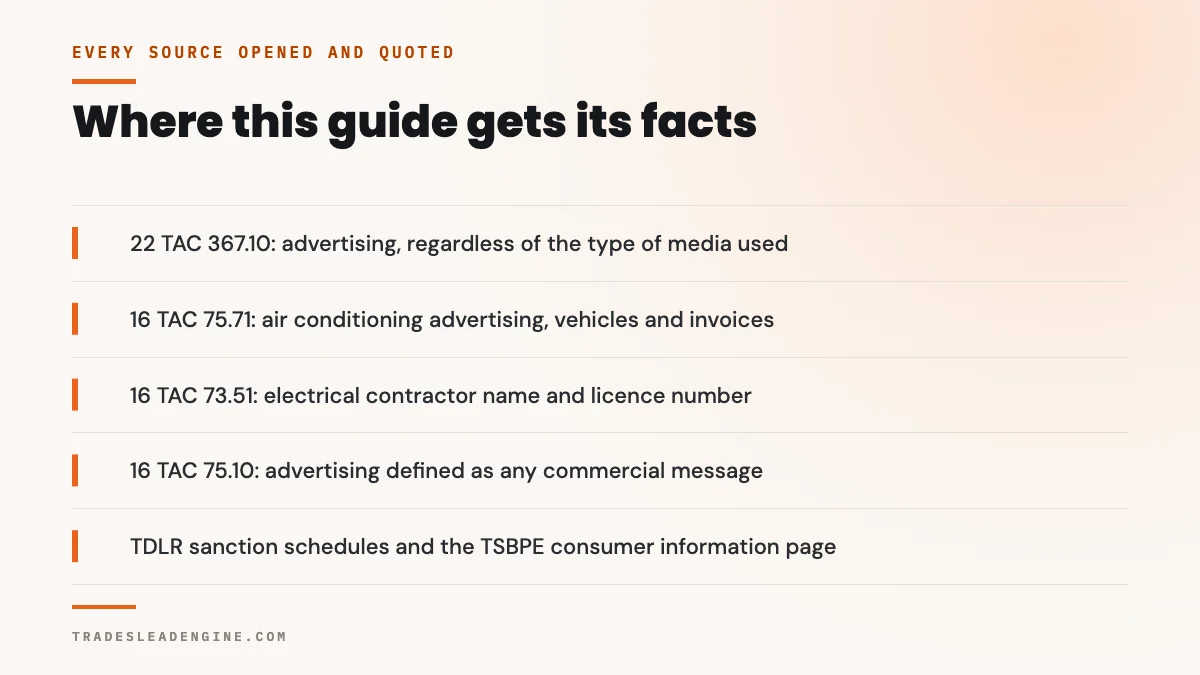
- 22 TAC 367.10, Display of RMP Name and License Number: Texas State Board of Plumbing Examiners rule. Advertising must state the RMP of record’s number “regardless of the type of media used”, with six listed exceptions; vehicle and proposal requirements.
- 22 TAC 367.9, Advertising; Offering to Perform Plumbing: a company may not advertise plumbing work without having secured the services of an RMP holding a current Master Plumber licence.
- 16 TAC 75.71, Responsibilities of the Licensee and Contracting Company: the air conditioning advertising rule at (h), the vehicle and job site rule at (g), and the invoice and regulator block at (i).
- 16 TAC 75.10, Definitions: “advertising” defined as any commercial message which promotes the services of an air conditioning and refrigeration contractor.
- 16 TAC 73.51, Electrical Contractors’ Responsibilities: name and licence number required in advertising at (e), proposals and the TDLR block at (f), vehicles and the TECL prefix at (d).
- 16 TAC 73.10, Definitions: “offer to perform” includes advertising in any form through any medium that implies a business is available to perform electrical work.
- TDLR air conditioning and refrigeration sanction schedule: “failed to include license number in advertisement which requires the license number” cited to 75.71(h) as a Class A violation, penalty range $500 to $1,000.
- TDLR electrical sanction schedule: “failed to include contractor name and license number in advertising” cited to 16 TAC 73.51(e) and others; Class A $500 to $2,000 through Class D $5,000 and revocation.
- Texas State Board of Plumbing Examiners, Consumer Information: tells homeowners the RMP’s licence number should be displayed in all advertisements and to verify it before hiring.
- Texas State Board of Plumbing Examiners, Board Orders: default and penalty orders published by name after each board meeting.
- Texas Department of Licensing and Regulation: the published list of the 39 industries TDLR regulates, which includes air conditioning and electricians and does not include roofing, general contracting, painting or handyman work.
- TDLR, Apply for an Air Conditioning and Refrigeration Contractor License: Class A and Class B scope, endorsements, and the TACL licence number format.
- TDLR rulemaking, September 1, 2026: the most recent electrician rule change adopts the 2026 National Electrical Code in 16 TAC 73.100 and does not alter the advertising requirements.
Every quoted sentence and every dollar figure in this guide comes from the pages above, read on September 24, 2026. Statistics that circulate elsewhere in contractor marketing about missed calls, local pack click share and review counts are not cited here because they do not trace to a source that can be opened. Nothing here is legal advice, and the two ambiguous cases flagged above are worth an attorney’s time rather than a marketer’s opinion.