
You’re two weeks from switching on an after-hours answering agent, and someone in your office asks the question that stalls the project: “Are we allowed to record these? Do we have to tell people it’s a robot?” Nobody in the room knows. So you search it, and you find a vendor page that says Texas requires a recording announcement, and another that says the new Texas AI law makes disclosure mandatory.
Both of those are wrong. They’re wrong in the same direction — toward more obligation than actually exists — which is its own kind of tell, because a vendor that overstates the rules never gets blamed for it.
The real answers are simpler than the confusion suggests, and the real risk sits somewhere most contractors aren’t looking. Texas recording law is genuinely permissive for a business recording its own calls. The Texas Responsible AI Governance Act genuinely does not reach private companies. But the penalties for getting recording wrong are severe enough to be worth understanding properly, and there’s a whole separate body of federal rules that kicks in the moment your system sends anything outbound.
This piece walks through AI phone agent call recording, disclosure, and the federal outbound question in that order — with the statute cites, the penalty numbers, and a clear line between what the law requires and what we’d recommend anyway.
This is general information, not legal advice. We are a marketing agency, not a law firm, and nothing here creates an attorney–client relationship. Statutes change and facts matter — have a Texas attorney review your call scripts, your recording notice and your disclosure language before you deploy anything. What follows is a map of the questions to bring them, not a substitute for asking.
What’s in this guide
- The short answer to all three questions
- Texas call recording: one-party consent
- What getting recording wrong actually costs
- When the caller isn’t in Texas
- What TRAIGA actually requires — and who it covers
- The federal rules that apply to outbound, not inbound
- Why best practice is stricter than the legal minimum
- What to put in the greeting
- Questions contractors actually ask
The short answer to all three questions
| The question | What Texas law requires | What we recommend | Why the gap |
|---|---|---|---|
| Can I record inbound calls? | Yes. Texas is a one-party consent state and your business is a party to its own calls. | Record, and announce it. | Out-of-state callers, and the fact that a notice costs you nothing. |
| Must I announce the recording? | No. No beep tone and no oral notice is legally required for a party to the call in Texas. | Announce it in the first sentence. | All-party-consent states, and jury appeal if a call ever becomes evidence. |
| Must I disclose that it’s AI? | No. TRAIGA’s disclosure duty reaches governmental agencies and healthcare providers, not private companies. | Disclose it. | A trust decision, not a legal one — and finding out later is worse than being told. |
Texas call recording: one-party consent
Texas sits in the majority of states on this. Under Tex. Penal Code § 16.02(c)(4)(A), a participant in a communication may record it without notifying the other parties. That’s the whole rule. There is no beep-tone requirement, no scripted disclosure requirement, and no waiting period for a private party recording a call it is part of.
A second provision matters in edge cases: Tex. Code Crim. Proc. art. 18.20 carves out communications where there’s no reasonable expectation of privacy. Most contractor calls don’t need that exception, but it’s the one your attorney will reach for if a recording’s admissibility is ever argued.
The part that trips people up is whether an AI agent counts as “a participant.” It does, in the sense that matters: the agent answers on behalf of your business, which is itself a party to the call. A Texas contractor recording their own inbound calls — whether a human, a voicemail system or an AI agent picks up — is operating inside the one-party rule. The technology answering the phone doesn’t change who the parties are.
Do you have to announce that you’re recording?
The decision as Texas law actually structures it, for a business recording its own inbound calls.
What getting recording wrong actually costs
The reason to take this seriously isn’t that the rule is complicated. It’s that the consequence of falling outside it is disproportionate to almost anything else in your compliance world.
| Authority | What it covers | Exposure |
|---|---|---|
| Tex. Penal Code § 16.02(b) | Unlawful interception of a wire, oral or electronic communication | Second-degree felony — 2 to 20 years, fine up to $10,000 |
| Tex. Civ. Prac. & Rem. Code § 123.004 | Private civil action by the intercepted party | $10,000 per occurrence as a floor, plus actual and punitive damages and attorney’s fees |
| Tex. Penal Code § 16.02(c)(4)(A) | The participant exception you are relying on | No liability — a party to the call may record it |
| Tex. Code Crim. Proc. art. 18.20 | Communications carrying no reasonable expectation of privacy | Separate statutory exception |
A “$10,000 per occurrence” floor is the number to sit with. A recording system runs on every call, which means a configuration mistake isn’t one violation — it’s one per call, for as long as the mistake is live. That’s the asymmetry that makes a one-sentence notice look like the cheapest insurance you’ll ever buy.
Know what your phone is doing before you change how it’s answered
The free Lead Engine Scorecard maps how inbound calls reach you, what share never get to a person, and where the leads are coming from — the baseline you need before any of this is worth configuring.
Get the free Scorecard
Or call (726) 224-4920 — same business day reply.
When the caller isn’t in Texas
The one-party rule protects you for calls between Texas parties. It gets more complicated when the person on the other end is somewhere else, because a meaningful minority of states require all parties to consent — and where the two laws conflict, the stricter one generally controls.
The all-party-consent states are California, Florida, Illinois, Maryland, Massachusetts, Montana, New Hampshire, Pennsylvania and Washington. For a residential plumbing or HVAC business in Houston or Dallas–Fort Worth, the overwhelming majority of inbound calls are local homeowners with local numbers, and this is a small risk.
Small is not none. A Californian who owns a rental property in Austin calls you. A homeowner relocating from Illinois calls to schedule work before they arrive. A commercial client’s procurement office is in Philadelphia. These aren’t exotic scenarios — they’re a normal Tuesday for anyone doing electrical or commercial work in a growing metro.
This is the single strongest practical argument for a recording notice, and it’s why it’s best practice everywhere rather than a Texas-specific quirk. One sentence at the top of the call makes the entire question disappear.
What TRAIGA actually requires — and who it covers
The Texas Responsible AI Governance Act took effect January 1, 2026, and a great deal of vendor content about it is simply wrong. The most common error is the assumption that it imposes an AI-interaction disclosure duty on private businesses.
It does not. TRAIGA’s AI-interaction disclosure requirement applies only to governmental agencies and healthcare providers. A Texas HVAC, plumbing, roofing or electrical company running an AI phone agent is not required by TRAIGA to tell callers they’re speaking with AI.
Who TRAIGA’s AI-interaction disclosure duty actually covers
Texas Responsible AI Governance Act, effective January 1, 2026.
Where TRAIGA does apply, enforcement is exclusively by the Texas Attorney General, with a 60-day cure period before penalties attach. Penalties run roughly $10,000–$12,000 for curable violations and $80,000–$200,000 for uncurable ones. There is no private right of action, which means no plaintiff’s bar building a practice around it.
That matters for how you should weigh this. The realistic TRAIGA risk to a trades business isn’t a lawsuit — it’s a complaint to the AG’s office and a 60-day window to fix whatever prompted it. The realistic recording risk, by contrast, is a private civil claim with a $10,000 floor per occurrence. They are not the same order of problem, and most vendor content has them backwards.
The federal rules that apply to outbound, not inbound
Here’s where contractors most often create exposure without realising it, because the rules change entirely depending on who dialled.
The FCC’s February 2024 declaratory ruling treats AI-generated voices as “artificial or prerecorded voice” under the Telephone Consumer Protection Act. That attaches consent obligations to outbound calling. An inbound AI agent answering a call the customer placed is a fundamentally different posture — the customer initiated contact, and the TCPA’s restrictions are built around unwanted calls to consumers, not around how you answer your own phone.
A September 2024 FCC notice of proposed rulemaking proposed mandatory in-call AI disclosure and a two-second opt-out mechanism. We are not going to tell you what happened to it, because we did not verify its current status and neither, most likely, did the vendor page telling you it’s now the law. Treat it as a proposal that has been under consideration, and check the current FCC docket before relying on anything about it either way.
Almost every AI call product offers to send an automatic SMS when a call goes unanswered. That text is outbound messaging and it sits squarely in TCPA territory, with a different consent analysis from the inbound call that triggered it. We researched inbound; we did not research outbound SMS compliance, so we are not going to give you guidance on it. What we will say is: do not let this get switched on by default without asking your attorney specifically about it, because it’s the one feature in the stack that converts an inbound posture into an outbound one.
Why best practice is stricter than the legal minimum
Most contractors stop at “it’s legal, so we’re fine.” That is not a compliance position — it’s a bet that nothing unusual ever happens on a call.
Three reasons to announce recording even though Texas doesn’t make you. The interstate caller problem, covered above, is the big one. The second is evidentiary: if a recording ever matters in a dispute over what was quoted or promised, a call that opened with a clear notice plays very differently to a judge than one that didn’t. The third is that your competitors’ calls are recorded too, and the notice is so ubiquitous in home services that its absence is more conspicuous than its presence.
And two reasons to disclose the AI even though TRAIGA doesn’t make you. Consumer sentiment data — with its conflicts noted in our piece on whether customers hang up on AI receptionists — suggests a meaningful share of people say their trust in a business drops when it uses AI agents. The version of that where they discover it mid-call, after giving you their address, is worse than the version where you told them in the greeting. The second reason is simpler: the rules in this area are moving, and a business already disclosing voluntarily has nothing to change when they move again.
What to put in the greeting
The whole compliance posture fits in two sentences at the top of the call, and getting them right is genuinely the bulk of the work.
The elements worth including
- Who the caller has reached — your business name, plainly.
- That the call is recorded — stated, not buried after a menu.
- That they’re speaking with an automated assistant — in ordinary words, not “virtual agent.”
- How to get a person — an explicit instruction, offered before anything is asked of them.
The things to get your attorney to look at
- The exact recording-notice wording, and whether it should differ for callers with out-of-state area codes.
- Your retention period for recordings and transcripts, and who inside the business can access them.
- Whether anything the agent says could be read as a quote, a warranty or a commitment on price.
- Any automated outbound SMS or callback the system sends, separately and specifically.
- Licensing language, if your trade requires a licence number in certain communications.
Build the exit before you write the script
The most valuable line in an AI greeting isn’t the disclosure. It’s the sentence that tells the caller how to reach a human, delivered before you ask them for anything. It defuses the AI objection, it makes the recording notice feel routine rather than defensive, and it’s the configuration choice most associated with callers staying on the line rather than hanging up. We cover the rest of those decisions in our guide to the real complaints about AI receptionists.
None of this changes why you’re doing it. ServiceTitan’s data — from June 2022, so treat it as directional — shows shops with fewer than five technicians booking just 9% of calls after 6 p.m., against 61% at peak for large businesses. That gap is the reason an AI call agent is on the table at all, and the arithmetic for your own shop is in what a missed call actually costs a Texas contractor.
Questions contractors actually ask
Is it legal to record phone calls in Texas?
Yes, if you are a party to the call. Texas is a one-party consent state: under Tex. Penal Code § 16.02(c)(4)(A), a participant in a communication may record it without notifying the other parties. A business recording its own inbound calls is a participant, and no beep tone or oral notice is legally required.
Do I have to tell callers the call is being recorded in Texas?
Not under Texas law. We recommend doing it anyway, for two reasons: if the caller is in an all-party-consent state — California, Florida, Illinois, Maryland, Massachusetts, Montana, New Hampshire, Pennsylvania or Washington — the stricter law generally controls, and a recording that opened with a clear notice is far more useful if a call ever becomes evidence in a dispute.
Does an AI agent count as a party to the call?
The AI agent answers on behalf of your business, and your business is a party to its own calls. On that basis a Texas contractor recording inbound calls handled by an AI agent is operating within the one-party rule. The technology answering the phone does not change who the parties to the communication are — but this is exactly the point to confirm with your own attorney rather than take from a blog.
What are the penalties for recording a call illegally in Texas?
Severe. Unlawful interception is a second-degree felony under Tex. Penal Code § 16.02(b), carrying 2 to 20 years and a fine up to $10,000. Separately, Tex. Civ. Prac. & Rem. Code § 123.004 gives the intercepted party a civil claim with a $10,000 per occurrence floor, plus actual and punitive damages and attorney’s fees. Because a recording system runs on every call, a misconfiguration is one violation per call rather than one overall.
Does TRAIGA require me to tell callers they are talking to AI?
No. The Texas Responsible AI Governance Act took effect January 1, 2026, and its AI-interaction disclosure requirement applies only to governmental agencies and healthcare providers. Private companies are not subject to it. A great deal of vendor content assumes otherwise — disclosing anyway is a reasonable trust decision, but it is not a legal obligation for a trades business.
Who enforces TRAIGA, and what are the penalties?
Enforcement is exclusively by the Texas Attorney General, with a 60-day cure period before penalties attach. Penalties run roughly $10,000–$12,000 for curable violations and $80,000–$200,000 for uncurable ones. There is no private right of action, so the realistic risk to a covered business is an AG complaint and a window to fix it, not a lawsuit.
Does the TCPA apply to an AI agent answering my phone?
The FCC’s February 2024 declaratory ruling treats AI-generated voices as artificial or prerecorded voice under the TCPA, which attaches consent obligations to outbound calling. An inbound agent answering a call the customer placed is a different posture. A September 2024 proposed rulemaking would have added mandatory in-call AI disclosure and a two-second opt-out; that was a proposal under consideration and you should check the current FCC docket rather than rely on any blog’s characterisation of its status.
Is an automatic text back to a missed call a problem?
It is a real consideration and it is a different legal question from the inbound call. An automated SMS sent in response to a missed call is outbound messaging and sits squarely in TCPA territory, with its own consent analysis. We did not research outbound SMS compliance and will not give guidance on it — raise this feature with your attorney specifically before enabling it.
What to do before you switch it on
The legal picture is more permissive than the vendor content suggests and the penalties are harsher than most contractors assume — which is an unusual combination, and the reason it’s worth spending an hour on properly.
You can record. You don’t have to announce it, and you should. You don’t have to disclose the AI, and we’d disclose it anyway. The part that genuinely needs professional eyes is narrower than the whole project: your greeting wording, your retention policy, anything the agent says that could read as a price commitment, and any outbound message the system sends on its own.
Take those four items to a Texas attorney, get a script signed off once, and you’re done. It’s a cheaper hour than almost anything else in this build, and it’s the one part of it nobody should be improvising — including us.
Everything above is general information about Texas and federal law as of September 2026, not legal advice, and no attorney–client relationship is created by reading it. Statutes, FCC proceedings and enforcement priorities all change. Have a Texas attorney review your call scripts, your recording notice, your AI disclosure and any automated outbound messaging before you go live.
Get the whole lead path checked, free
The Lead Engine Scorecard reviews how your calls are captured and handled alongside your search and AI visibility — so you know what the phone is actually doing before you change how it’s answered.
Get the free Scorecard
Questions first? leads@tradesleadengine.com · (726) 224-4920
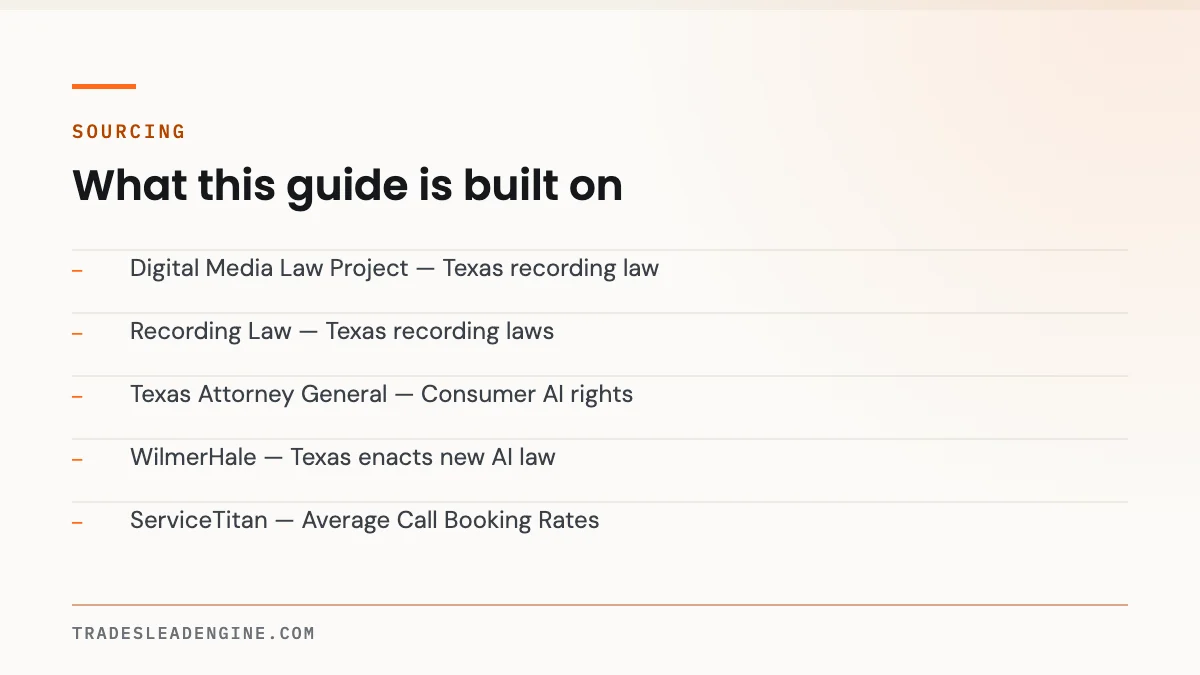
Sources
- Digital Media Law Project — Texas recording law (one-party consent; Tex. Penal Code § 16.02; Tex. Civ. Prac. & Rem. Code § 123.004)
- Recording Law — Texas recording laws (§ 16.02(c)(4)(A) participant exception; Tex. Code Crim. Proc. art. 18.20; penalty detail)
- Texas Attorney General — Consumer AI rights (TRAIGA scope and enforcement)
- WilmerHale — Texas enacts new AI law (effective date, covered entities, penalty tiers, 60-day cure period, no private right of action)
- ServiceTitan — Average Call Booking Rates (after-6 p.m. booking rates; data from June 2022)
- Invoca — Home Services Lead Conversion Benchmarks Report 2026 (inbound call answering and booking benchmarks used across this series)
- AnswerConnect — Consumers turning away from AI customer service (consumer trust data; note that AnswerConnect sells human answering services)
Statutory citations are given as reported by the legal-guide sources above and are current as of September 2026; we did not independently verify the current status of the FCC’s September 2024 notice of proposed rulemaking and make no claim about it. Nothing here is legal advice.