
It usually starts the same way. Somebody at a trade association lunch says their phone rang because ChatGPT recommended them, so you pull it up in the truck, type in your own company name, and get a polite non-answer. Then you ask it who the best HVAC company in your town is, and it lists three companies — one of which you’re fairly sure went out of business.
The explanation you’ll get from most of the internet is that you need an llms.txt file, “AI schema,” or a monthly retainer with the letters GEO in it. That explanation is wrong often enough to be expensive. Google’s own documentation on AI features states there are “no additional requirements to appear in AI Overviews or AI Mode, nor other special optimizations necessary,” and that you “don’t need to create new machine readable files, AI text files, or markup to appear in these features.”
The real reason is more mundane and more fixable. ChatGPT isn’t ranking the whole web the way Google does. It’s assembling an answer from a narrower set of things — pages its crawler is allowed to read, results from a third-party search index, and whatever it already knows about your brand from being mentioned in enough other places. If you fail at any one of those gates, you’re invisible, and each gate fails for a different reason with a different fix.
What follows is the diagnostic our team runs before we quote anyone for AI search work, and it starts with whether you are showing up in ChatGPT at all: how to test properly, how to check whether you’re accidentally blocking the crawlers, the likely causes in order of frequency, a 30-minute self-audit you can run yourself, and the one way to actually measure ChatGPT referrals in GA4 today. We’ll also tell you how much traffic is realistically at stake, which is smaller than the pitch decks suggest.
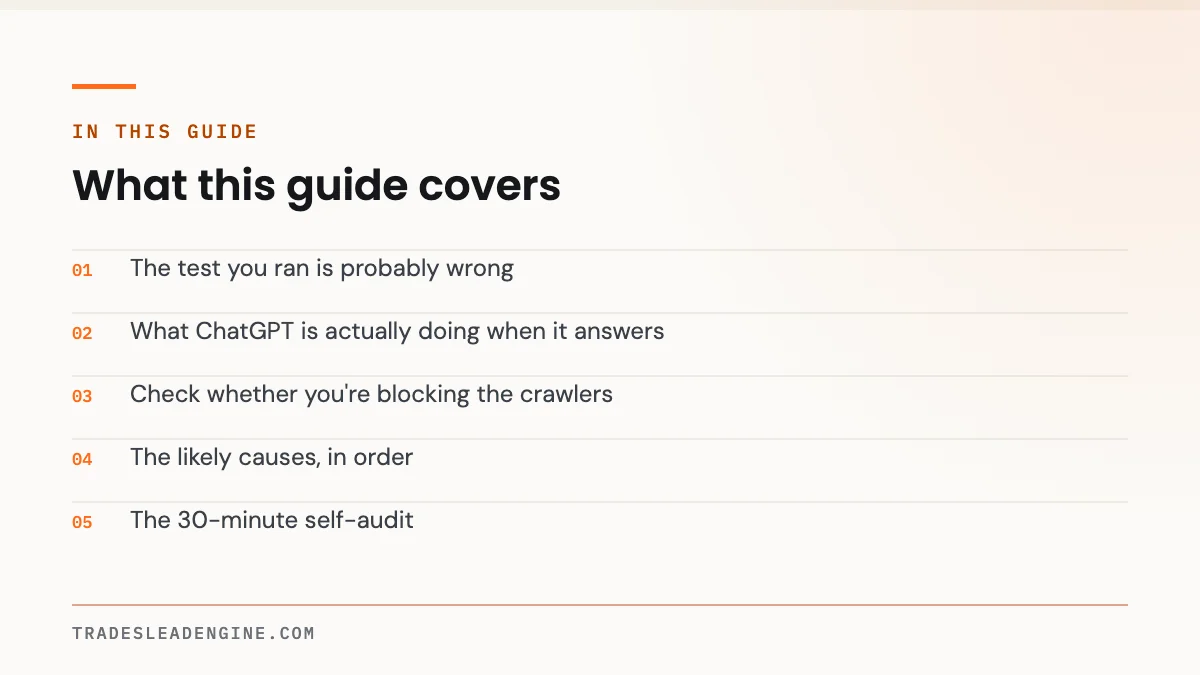
What’s in this diagnostic
- The test you ran is probably wrong
- What ChatGPT is actually doing when it answers
- Check whether you’re blocking the crawlers
- The likely causes, in order
- The 30-minute self-audit
- How to measure ChatGPT referrals in GA4
- What’s actually at stake — honest numbers
- What the evidence says actually moves it
- Questions contractors actually ask
The test you ran is probably wrong
Three things make a contractor’s self-test unreliable, and all three are easy to fix.
You were logged in. A logged-in ChatGPT account carries memory, chat history and custom instructions. If you’ve ever mentioned your own company in that account, the model has a reason to bring it up that has nothing to do with whether a homeowner in Corpus Christi would ever see it. Run every test in a logged-out session or a temporary chat.
You ran it once. Generative answers are not deterministic. The same prompt, in the same market, minutes apart, can return a different set of companies. The vendor study we found with the cleanest stated methodology — Mecha’s tracking of plumbing and HVAC recommendations — ran three runs per query per platform inside a 72-hour window, logged out, across ten US markets. That’s roughly the bar. One run in your truck is an anecdote.
You asked the wrong question. Typing your own company name is a recall test, not a visibility test. Homeowners don’t type company names. They type symptoms and constraints.
Most contractors stop at “it doesn’t know my name.” That is not analysis. The prompts worth testing look like the ones a panicked customer writes at 9pm:
- “My AC is blowing warm air and it’s 104 degrees, who can come out today in Katy?”
- “Do I need a licensed plumber to replace a water heater in Texas, and roughly what should it cost?”
- “Best rated roofing companies near Lubbock that handle hail damage insurance claims”
- “Which HVAC companies in the Hill Country offer financing?”
Run five of those, three times each, logged out. Write down every company named and every source cited. That list — not your own name — is your actual competitive set.
For a lot of local queries there is no stable answer to rank for. The model may decline to recommend anyone, may hand back a directory page instead of a company, or may name a different three companies on each run. If your results are unstable, that’s information: the category is contestable, and nobody in your market has locked it up either.
What ChatGPT is actually doing when it answers
OpenAI’s publisher documentation is short and unusually clear, and it settles several arguments at once. The first line worth knowing:
Any public website can appear in ChatGPT search.
OpenAI — Publishers and Developers FAQ
There is no application. No approval queue. No fee. If somebody has told you they can “get you listed in ChatGPT,” they are describing something that does not exist as a listing.
The second thing the documentation makes clear is that OpenAI runs two separate crawlers with two separate jobs, and contractors routinely block the wrong one — or both — without knowing it. And the third is that even a page you’ve disallowed can still show up in a limited way: OpenAI states that “if we obtain the URL of a disallowed page from a third-party search provider… we may surface just the link and page title.” That’s a useful clue. It means ChatGPT’s retrieval is partly riding on an outside search index, which is why your presence in ordinary search still matters here.
Five gates between your business and an AI answer
You have to clear all five. Most contractors who “aren’t in ChatGPT” are failing at gate 1 or gate 4.
Check whether you’re blocking the crawlers
This is the single most common technical cause we find, and it takes ninety seconds to check. Type your domain followed by /robots.txt into a browser. Read what comes back.
| User-agent | What it does | If you block it | Should a contractor block it? |
|---|---|---|---|
| OAI-SearchBot | The search crawler. It’s how pages become eligible to be surfaced in ChatGPT search results. | You remove yourself from the pool ChatGPT draws on. A link and page title may still appear if OpenAI gets the URL from a third-party search provider. | No. Blocking this is the self-inflicted version of the problem you’re trying to solve. |
| GPTBot | The training crawler. OpenAI states publishers “should disallow the GPTBot user-agent from sites and pages they wish to exclude from potential training.” | Your content is excluded from potential model training. It does not remove you from ChatGPT search. | Your call. It’s a separate decision from search visibility, and it has no downside for lead generation either way. |
The three ways this happens without anyone deciding it: a security or SEO plugin with a “block AI bots” toggle switched on during setup; a CDN or firewall bot-fighting mode that challenges any non-browser user agent; or a previous web developer who added a blanket disallow during the 2024 scraping panic and never revisited it. If you don’t control your own site files, that’s a bigger problem than AI visibility, and we wrote about it separately in do you actually own your contractor website.
If your robots.txt contains a line disallowing OAI-SearchBot, remove it today. It is the only item on this list that can be fixed in an afternoon, costs nothing, and has a mechanically certain effect on eligibility. Everything else in this guide is a months-long reputation project.
Not sure what your site is telling the crawlers?
The free Lead Engine Scorecard checks your robots.txt, your indexation, your Google Business Profile completeness and your third-party footprint — then shows you where you actually stand in AI answers for your trade and metro.
Get the free Scorecard
Or call (726) 224-4920 — same business day reply.
The likely causes, in order
Ranked by how often we find each one as the primary cause, with an honest note on how strong the evidence behind each is.
| Cause | How you confirm it | Evidence behind it |
|---|---|---|
| You’re blocking OAI-SearchBot, or a bot wall is challenging it | Read your robots.txt. Check whether your firewall challenges non-browser agents. | OpenAI docs |
| You have almost no third-party footprint | Search your exact business name in quotes. Count the pages that aren’t yours or your own social accounts. | Ahrefs, 75k brands |
| Directory profiles are missing or stale | Check Yelp, BBB, Angi and your chamber listing for accuracy. | Mecha, 10 markets |
| Your site never names the towns you serve in plain language | Search your own site for the town name. “Greater metro area” doesn’t count. | Practitioner inference |
| Your entity is ambiguous — two phone numbers, an old address, a DBA mismatch | Compare your Google Business Profile, your website footer and your Secretary of State filing. | Practitioner inference |
| Nothing is wrong; you tested logged in, or once | Re-run logged out, three times, with homeowner phrasing. | Mecha methodology |
One finding from the Mecha study is worth sitting with, because it inverts the usual assumption. Across ten markets, ChatGPT cited its sources roughly 40% of the time, and those sources were frequently Yelp or Angi rather than contractor websites. And in three of ten markets, Perplexity recommended a company with no website at all, pulling entirely from Yelp and BBB data.
That’s a vendor study on a small sample and we’d treat the percentages loosely. But the qualitative point stands on its own: for local trades, the assistants are often reading directories, not your homepage. Which means your Yelp and BBB profiles, and your Google Business Profile, are doing more work here than the website redesign you were quoted for.
The 30-minute self-audit
Run these in order. Set a timer. You do not need any software.
| # | Check | How to run it | A pass looks like | Time |
|---|---|---|---|---|
| 1 | Crawler access | Visit yourdomain.com/robots.txt | No Disallow line under OAI-SearchBot, and no blanket disallow for all agents. | 2 min |
| 2 | Indexation | Search site:yourdomain.com on Google | Your service pages and town pages are all listed. If you see three pages, that’s your problem. | 3 min |
| 3 | Entity consistency | Compare business name, address and phone on your website footer, GBP, Yelp and BBB | Identical, character for character. One phone number, one legal name. | 5 min |
| 4 | Third-party mentions | Google your exact business name in quotation marks | At least five pages that you don’t own and didn’t publish. | 4 min |
| 5 | Homeowner prompts | Five realistic prompts, three runs each, logged out | You’re named at least once, or the results are unstable enough that nobody owns the category. | 10 min |
| 6 | Competitive set | Write down every company and every source URL the assistant named | You know which directories and which competitors are actually being cited in your metro. | 4 min |
| 7 | Referral tracking | GA4 → Acquisition → Traffic acquisition, filter for chatgpt.com | Tracking is in place. A zero in month one is normal — see the next section. | 2 min |
How to measure ChatGPT referrals in GA4
This is the part almost nobody explains concretely, and it’s genuinely simple. ChatGPT appends utm_source=chatgpt.com to the links it sends you. That’s documented by OpenAI, it’s in the URL, and it means the traffic is measurable today without any special tool.
The five-minute setup
- In GA4, confirm your form submissions and your tel: link clicks are registered as key events. If they’re not, every channel report you look at is meaningless — including this one.
- Go to Reports → Acquisition → Traffic acquisition.
- Change the primary dimension to Session source / medium.
- Use the search box above the table and type chatgpt.
- Add key events and engagement time as columns, and compare that row against your organic row.
Three honest caveats about the number you’ll see
It’s a floor, not a count. Not every assistant passes a referrer or a UTM, and some browsers and privacy settings strip them.
You cannot separate Google AI Overview clicks at all. A click from inside an AI Overview arrives in GA4 as ordinary google / organic, with no parameter distinguishing it. Any vendor showing you a dashboard line labelled “AI Overview traffic” from GA4 alone is estimating, and should say so.
The number will be small. That’s not a failure of your setup. Semrush’s traffic channel mix study across 50,000-plus websites in 17 industries found AI traffic accounted for less than 0.15% of total web visits in 2025 — growing fast, at 66% year over year, but from a base that rounds to nothing. Google’s AI Mode specifically came in at 0.01% of total traffic.
If a vendor’s AI visibility report shows dozens of monthly “AI sessions” for a single-market contractor, ask exactly which parameter or referrer they’re counting. Given the measured base rates, a plausible number for a local trades business in its first year is single digits per month — sometimes zero. A big number usually means they’re counting something else.
What’s actually at stake — honest numbers
Here’s where most posts on this topic lose the plot. The pitch is usually “AI traffic is exploding, get in now.” The measured reality has two halves, and they point in different directions.
The volume is tiny, but the quality is exceptional. Invoca’s 2026 Home Services benchmarks found that ChatGPT and generative-AI search referrals produced a 45% lead rate — the highest of any channel — at 41% conversion, on what Invoca itself describes as currently minimal volume. Put next to the Semrush figure, that’s the honest whole picture: very few visitors, and the ones who arrive are unusually ready to buy. A handful of visits a month that convert at that rate is worth having. It is not worth reorganising your entire marketing budget around.
The real risk isn’t lost ChatGPT referrals. It’s suppressed clicks on Google. Pew Research Center’s July 2025 study tracked 900 US adults through 68,879 Google searches and found users clicked a traditional result on 8% of visits to pages with an AI summary, versus 15% without, and clicked a link inside the AI summary on just 1% of visits. Seer Interactive, working from 53 accounts and 5.47 million distinct queries through February 2026, measured organic CTR at 3.82% when no AI Overview appeared versus 2.36% when one did.
Google disputes the framing rather than the arithmetic, arguing in its own documentation that “when people click from search results pages with AI Overviews, these clicks are higher quality (meaning, users are more likely to spend more time on the site).” Both things can be true — fewer clicks, better clicks. We’d note that Google has an obvious interest in the second framing, and that Pew and Seer are measuring quantity, which is what shows up in your lead count.
Two caveats we’ll state rather than bury: Pew’s panel is a general-population sample, not a set of commercial or local-services queries, so don’t read it as “contractor traffic fell by half.” And Seer discloses that it “cannot track AIO in real time” and that one account represents 47% of impressions in one segment.
The local angle comes from Whitespark’s guide to Google’s AI Mode, which puts AI Overviews on roughly 68% of local searches in its Q1 2025 data. That’s the number that should set your priorities.
What the evidence says actually moves it
Ahrefs studied 75,000 domains against millions of AI responses across ChatGPT, AI Mode and AI Overviews, and measured which brand signals correlate with AI visibility. The results are inconvenient for the way most agencies sell this service.
YouTube mentions correlated most strongly of anything tested, at roughly 0.737. Branded web mentions came next at 0.656 to 0.709. Branded anchors, branded search volume and Domain Rating followed in descending order. And at the bottom, at approximately 0.194 — essentially no relationship — sat the number of pages on your site.
Ahrefs states the caveat plainly, and so will we: “Correlation isn’t causation.” But the direction is hard to ignore. Publishing more blog pages, which is what a great many AI optimization retainers actually consist of, is the input with the weakest measured relationship to the outcome. Being talked about somewhere other than your own website is the strongest.
For a contractor, that translates into a short and unglamorous list. Get reviews flowing steadily, because that’s third-party text about your brand at volume — the mechanics are in how many reviews you actually need. Keep your Google Business Profile accurate and correctly categorised, which we break down in do GBP categories actually affect ranking.
Fix your directory profiles. Put job footage on YouTube — a five-minute walkthrough of a condenser swap in Houston costs you a phone and twenty minutes. Name the towns you serve in real sentences on real pages, the same way you would for map pack and organic coverage across a service area.
None of that is an AI tactic. It’s the same reputation work that wins local search — and that’s the point. For the mechanism, read how AI Overviews and ChatGPT actually pick which contractor to recommend. For the money, we published real price bands and an explicit list of what isn’t proven.
Questions contractors actually ask
Can I pay to get my business listed in ChatGPT?
No. OpenAI’s publisher documentation states that any public website can appear in ChatGPT search — there’s no listing to buy and no submission process. OpenAI began testing ads in ChatGPT in the US on February 9, 2026, but its documentation is explicit that “ads do not influence ChatGPT’s answers,” that they run on separate systems, and that advertisers “have no ability to shape, rank, or alter ChatGPT’s responses.” Anyone selling paid placement inside the answer itself is selling something that doesn’t exist.
Do I need an llms.txt file or special AI schema?
Google’s documentation on AI features says no: “You don’t need to create new machine readable files, AI text files, or markup to appear in these features. There’s also no special schema.org structured data that you need to add.” Ordinary structured data is still worth having for other reasons, but a vendor selling an llms.txt file as the core deliverable is selling something Google has publicly said isn’t necessary.
Should I block GPTBot?
That’s a separate decision from search visibility. OpenAI states publishers “should disallow the GPTBot user-agent from sites and pages they wish to exclude from potential training.” Blocking GPTBot does not remove you from ChatGPT search — that’s OAI-SearchBot’s job. Blocking OAI-SearchBot is the one you don’t want to do by accident.
How do I know if ChatGPT is sending me any traffic at all?
ChatGPT appends utm_source=chatgpt.com to referral URLs. In GA4, go to Acquisition → Traffic acquisition, switch the dimension to Session source / medium, and search for “chatgpt”. Make sure your form submissions and phone-link clicks are set up as key events first, or the numbers tell you nothing. Expect a small figure: Semrush measured AI traffic at under 0.15% of total web visits in 2025.
My competitor shows up and I don’t. What do they have that I don’t?
Usually a larger third-party footprint rather than a better website. In Ahrefs’ study of 75,000 brands, YouTube mentions and branded web mentions showed the strongest correlations with AI visibility, while the number of pages on a site showed almost none. Check what sources the assistant actually cites when it names them — in local trades, it’s frequently a directory profile rather than the company’s own site.
Can I appear in AI answers without a website?
Apparently yes, at least sometimes. In Mecha’s tracking of ten US markets, Perplexity recommended a company with no website at all in three of the ten, pulling entirely from Yelp and BBB data. That’s a small vendor study, not proof of a rule — but it’s a strong argument for treating your directory profiles as real assets rather than an afterthought.
Is AI search worth spending money on yet for a local contractor?
As a separate line item, usually not. The volume is measurably tiny — under 0.15% of total web visits per Semrush — though Invoca found generative-AI referrals converted at the highest lead rate of any home services channel on that minimal volume. The work that improves AI visibility is largely the same work that improves local search, so buying it twice is the mistake. Buy the local search program and ask your provider to report AI visibility inside it.
What to do Monday
Open your robots.txt. If OAI-SearchBot is disallowed, fix it before lunch. That’s the only item here with a same-day payoff, and it’s the one that makes every other effort pointless if you skip it.
Then run the seven-step audit with a timer and write the results down, because the value is in the baseline, not the first reading. Three months from now you want to know whether the number of third-party pages mentioning your name went from four to fourteen — that’s the metric the correlation data actually supports, and it’s one you can verify yourself without buying a dashboard.
And set your expectations where the evidence puts them. A few highly qualified visits a month, arriving from a channel that converts better than anything else you run, sitting on top of a Google result page that now shows an AI summary on most local searches. The first is a bonus. The second is the thing to actually plan around.
See where you actually stand in AI answers
The free Lead Engine Scorecard runs the crawler check, the entity check and a set of real homeowner prompts for your trade and metro — then shows you which competitors and which directories are being cited instead of you.
Get the free Scorecard
Questions first? leads@tradesleadengine.com · (726) 224-4920
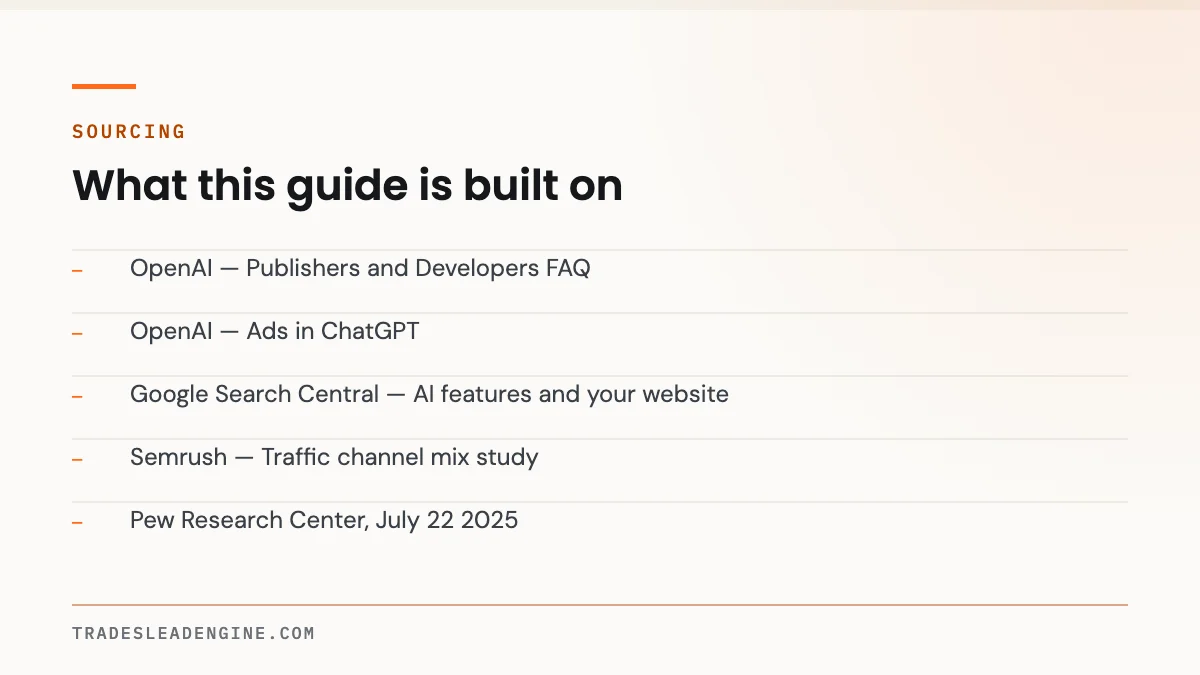
Sources
- OpenAI — Publishers and Developers FAQ (any public website can appear; OAI-SearchBot vs GPTBot; disallowed pages surfacing as link and title; utm_source=chatgpt.com)
- OpenAI — Ads in ChatGPT (US test began February 9, 2026; ads do not influence answers)
- Google Search Central — AI features and your website (no special optimizations necessary; no AI text files or special schema needed; click quality claim)
- Semrush — Traffic channel mix study (50,000+ websites, 17 industries, Jan–Dec 2025; AI traffic under 0.15% of total visits)
- Pew Research Center, July 22 2025 (900 US adults, 68,879 searches, March 2025; 8% vs 15% click rate)
- Seer Interactive — AIO impact on Google CTR, 2026 update (53 accounts, 5,471,127 queries through February 2026; 3.82% vs 2.36% organic CTR)
- Ahrefs — AI brand visibility correlations (75,000 domains; YouTube mentions ~0.737, site page count ~0.194)
- Invoca — Home Services Lead Conversion Benchmarks 2026 (generative-AI referrals: 45% lead rate, 41% conversion, minimal volume)
- Whitespark — Guide to Google’s AI Mode for local businesses (AI Overviews on ~68% of local searches, Whitespark Q1 2025)
- Mecha — Where AI chatbots send homeowners for plumbing and HVAC (vendor research; 10 markets, 3 runs per query, logged out)
Two limits worth naming. The Pew figures come from a general-population browsing panel rather than commercial or local-services queries, so they describe the direction of the effect, not its size for contractors. The Mecha study is vendor research on ten markets — useful for the behaviour it observed, too small to treat its percentages as stable.