
You’ve priced it out. The after-hours math works. And then your service manager says the thing that stops the whole conversation: “Mrs. Hernandez has been calling us for eleven years. She is going to hate this.”
That objection is the reason most trades businesses never get past the demo. It’s also the objection the category refuses to answer straight. ServiceTitan’s own guide to AI virtual agents in HVAC raises it — “Will customers feel brushed off? Will they resent not speaking to a human?” — and then treats it as anxiety to be managed rather than a question with an answer.
It has an answer. Yes, a measurable share of callers will hang up, and there’s survey data putting a number on it. But the number comes from an interested party, and the complaints that show up in verified buyer reviews of these products are not the ones the survey predicts. They’re much more specific, much more fixable, and much more useful to you.
So: the real figure with its conflict disclosed, what actual buyers say goes wrong, and the configuration decisions that change the outcome for an AI call agent on your line. If you’re still working out whether the economics justify any of this, start with what a missed call actually costs and come back.
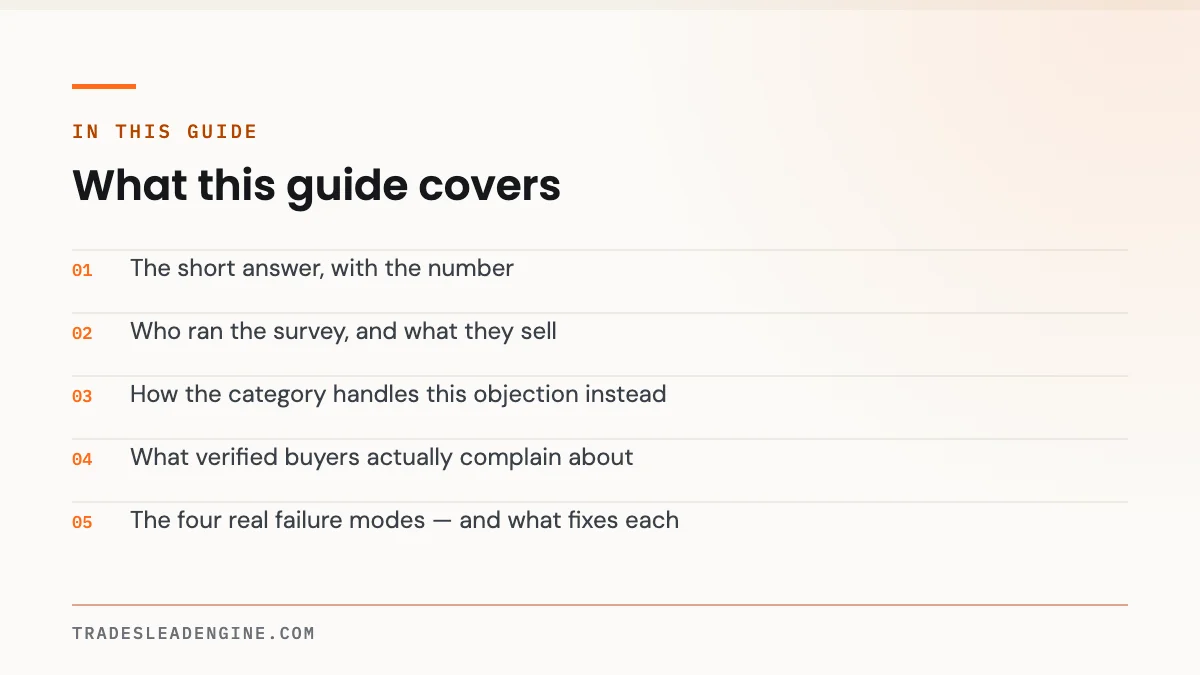
What’s in this guide
- The short answer, with the number
- Who ran the survey, and what they sell
- How the category handles this objection instead
- What verified buyers actually complain about
- The four real failure modes — and what fixes each
- The risk nobody puts in the demo
- What actually changes the outcome
- What this costs, and how to read vendor pricing
- Questions contractors actually ask
The short answer, with the number
About 31% of surveyed consumers say they would hang up if a business routed them to AI. That figure comes from a OnePoll survey of 6,000 consumers across the US, UK and Canada, fielded for AnswerConnect and compared against the same questions asked in October 2025. Sentiment moved in one direction over those six months, and it wasn’t toward AI.
Three things are true at once, and holding all three is the only honest position:
- A real minority of your callers dislike this and some will disconnect.
- The survey producing that number was commissioned by a business with a direct financial stake in AI looking bad.
- The specific things that go wrong in practice, according to people who’ve bought and used these products, are different from what the survey measures — and most of them are configuration failures, not the technology being detected.
The right comparison is not “AI agent versus your best CSR.” It’s “AI agent versus voicemail at 8:40 on a Sunday night.” If you have a person answering every call inside three rings, you don’t need this. If the alternative to the AI is nobody, then a caller who hangs up on the AI was a caller you were losing anyway — and the ones who don’t hang up are net new.
Who ran the survey, and what they sell
Here is the full set of findings, and here is the conflict, in the same breath. AnswerConnect published this OnePoll research in 2026. AnswerConnect sells human-staffed answering services. Every finding below makes their product look better and their competitors’ product look worse. That is not a reason to throw the data out — OnePoll is a real fieldwork provider and 6,000 respondents is a serious sample — but it is a reason to read it as advocacy, and to notice that no comparably sized survey has been published by anyone without a stake in the answer.
Consumer sentiment toward AI customer service, six months apart
OnePoll for AnswerConnect · 6,000 consumers, US / UK / Canada · October 2025 compared with April 2026.
Notice what the chart does not show. It doesn’t show what happened to those callers next, whether they called back, or how they behaved when the alternative was voicemail. A survey asks people to predict their own behaviour in a hypothetical, and people are famously bad at that — particularly when the hypothetical is “do you like robots” and the real situation is “it’s 110 degrees and my compressor just died.”
How the category handles this objection instead
ServiceTitan’s guide to AI virtual agents in HVAC puts the question in the reader’s mouth and then walks away from it:
Will customers feel brushed off? Will they resent not speaking to a human?
ServiceTitan — AI virtual agents in HVAC
The piece raises both questions and resolves them as misplaced anxiety rather than answering either. That is the standard move in this category, and it’s why contractors don’t trust the category. Most vendors stop at “modern AI sounds natural, your customers won’t even notice.” That is not an answer. It’s a bet that the reader won’t check.
Here’s what checking looks like.
What verified buyers actually complain about
We went through the verified G2 reviews of an established AI receptionist product — people who bought it, deployed it, and were asked what they disliked. The reviewer role shown on each review is given below.
Two of them do describe the objection everyone expects:
Some callers hate it that it’s not a real person.
Attorney, Small Business — G2 verified review
A small number of callers are put off when they realize an AI receptionist is handling their call.
President, Small Business — G2 verified review
Note the qualifiers those buyers chose on their own: “some,” “a small number.” That’s the lived version of the 31%, and it tracks.
But the complaints that repeat — the ones that show up again and again across different reviewers in different industries — are not about the voice at all.
Sometimes it’s impatient and will interrupt our customers.
Operations Manager, Mid-Market — G2 verified review
sometimes the AI get words or spelling wrong on customers
Owner, Small Business — G2 verified review
At times it will not transfer the calls to the office.
Law Practice, Small Business — G2 verified review
And one from a construction buyer specifically, which is the closest thing to a trades voice in the set:
I wish that the summary were consistent — some are very detailed and some are not.
Construction, Small Business — G2 verified review
That is a different list from the one the objection predicts. Nobody in it is complaining that the agent sounds like a machine. They’re complaining that it mis-hears names and emails, talks over people, fails to hand off, and files inconsistent notes.
That distinction matters more for your business than for the attorneys and agencies leaving most of those reviews. A law firm that mis-spells a caller’s email sends one message to the wrong address. A service business that mis-hears a street name sends a truck to the wrong side of town, on a Saturday, with a technician on overtime. Your calls are dense with exactly the material speech recognition handles worst: house numbers, gate codes, model and serial numbers, cross streets, and surnames that don’t look the way they sound.
So when you evaluate one of these, the question isn’t whether it passes for human. It’s whether it can take down “4412 Guadalupe, unit B, gate code 1174” and read it back correctly the first time. That’s a testable thing, and you can test it in ten minutes before anyone sends you a contract.
The four real failure modes — and what fixes each
Where an AI call actually breaks
The six stages of an answered call, with the failure verified buyers report at each one.
| What buyers report | What’s actually happening | What fixes it | Source |
|---|---|---|---|
| Mis-transcribed names, spellings and email addresses | Speech recognition on proper nouns and alphanumerics is the hardest part of the job, and Texas service areas are full of street and surname spellings a general model has never seen. | Read-back confirmation on every captured field. Spell-out prompts for email and last name. A custom vocabulary loaded with your street names, neighbourhoods, brands and part numbers. | G2 verified |
| Interrupting the caller | Turn-taking is tuned by a silence threshold. Set too short, the agent talks over anyone who pauses to think — or to read a serial number off a unit. | Lengthen the end-of-speech threshold, and test it with someone reading a model number aloud. This is a slider, not a limitation. | G2 verified |
| Failing to transfer to a human | No escalation path, or one that only triggers on an exact phrase. The caller asks for a person and gets handled instead. | A live-transfer rule on intent, not keywords, plus an unconditional fallback: any caller who asks twice goes to a ringing phone or a callback promise with a time on it. | G2 verified |
| Spam filtering blocking real customers | One reviewer reports the filter will “semi regularly block callers that actually need to speak with us.” An over-tuned filter costs you the exact calls you bought the system to catch. | Set filtering to flag rather than block, review the blocked log weekly for the first month, and whitelist anything that looks like a homeowner. | G2 verified |
| Inconsistent call summaries | Free-form summarisation produces whatever the model thinks is important. A construction buyer specifically flagged this. | Force a fixed schema — name, callsite address, trade, symptom, urgency, availability, source — so every summary has the same fields whether the call ran 40 seconds or six minutes. | G2 verified |
| “Some callers hate it that it’s not a real person” | The objection everyone expects. Real, and reported with qualifiers — “some,” “a small number.” | Nothing fixes this completely. What reduces it: an immediate path to a human, an honest greeting, and never deploying it on your daytime main line. | G2 verified |
See what your callers currently get after 6 p.m.
The free Lead Engine Scorecard includes a call-handling check — what happens to an inbound call outside your office hours, where those calls come from, and what share never reach a person.
Get the free Scorecard
Or call (726) 224-4920 — same business day reply.
The risk nobody puts in the demo
There’s a failure mode that doesn’t show up in reviews because the buyer never finds out it happened. TeleCloud’s analysis of AI receptionist risks names it precisely:
A sarcastic comment might be logged as positive, or a frustrated customer might be mistaken for calm.
TeleCloud — Risks of AI agents and receptionists answering calls
If you are using the agent’s own sentiment tagging to decide which calls to follow up on, you are trusting the system to flag its own bad calls. It won’t always. The same piece makes the point that matters more for a trades business than for almost anyone else:
a single negative interaction can damage long-term loyalty
TeleCloud
In a business where a homeowner’s next move after a bad experience is a one-star review on the profile you spent two years building, that’s not an abstract risk. It’s the same asset you’re protecting when you work on reviews and reputation — and one reason we tell clients to read the first month of transcripts themselves rather than the summaries.
For the first 30 days, have a human read every transcript from calls that didn’t book. Not the AI’s summary of them — the transcript. That’s where you’ll find the interruptions, the mis-heard addresses and the caller who asked three times for a person. Every vendor dashboard will tell you the agent performed well, because the agent is grading its own homework.
What actually changes the outcome
Most contractors stop at “does it sound human enough.” That is not the variable. These are.
Where you deploy it
The single biggest determinant of whether callers hate this is whether it answers calls your team would otherwise have answered. Overflow, after-hours and weekend coverage is a different proposition from replacing your daytime front desk, and the objection largely evaporates when the honest alternative is voicemail. ServiceTitan’s data shows businesses with fewer than five technicians booking 9% of calls after 6 p.m. — that’s the bar the AI has to clear, not your best CSR on a Tuesday morning.
How fast a human is reachable
Every complaint about transfer failure is really a complaint about being trapped. A caller who knows a person is one sentence away behaves differently from one who suspects there’s no exit. Build the escape hatch first and announce it in the greeting.
This is also the cheapest way to neutralise the 31%. A caller who was going to hang up on principle usually does it in the first ten seconds, before they’ve told you anything. If the greeting has already offered them a person, they have a reason not to. We can’t put a number on how many stay, because nobody has published one — but it costs you a single sentence to find out, and the ones who leave anyway were never going to sit through a voicemail prompt either.
Whether you tell them
You are not legally required to disclose in Texas — we walk through why in the legal guide to running an AI phone agent in Texas. But 57% of AnswerConnect’s respondents said their trust in a business would decrease if it used AI agents, and the version of that where they find out later is worse than the version where you said so up front. Disclosure is a trust decision, and we’d make it.
What it’s allowed to do
An agent that books straight into your dispatch board can make an expensive mistake. An agent that captures, qualifies and hands a structured job to a human who confirms it can’t. For roofing and remodeling work with long sales cycles, capture-and-qualify is usually the right scope; for plumbing and HVAC emergency calls in Dallas–Fort Worth or Austin, booking directly is where the value is.
Call the demo number yourself and do four things: give a hard-to-spell last name and an email address, pause for four seconds mid-sentence, ask for a human, then ask again. If it spells the name back wrong, talks over your pause, or won’t hand you off on the second ask, you’ve just reproduced four of the five most common buyer complaints in ten minutes. Do this before the pricing conversation, not after.
What this costs, and how to read vendor pricing
Pricing in this category is genuinely hard to pin down because published rates and quoted rates differ, and minute allowances vary wildly. The figures below come from a vendor-published pricing round-up quoting competitors’ list prices — which means every number is second-hand and should be confirmed on each vendor’s own page before you budget against it.
| Service | List price | Included volume | Source quality |
|---|---|---|---|
| Ruby (human) | $250–$1,725/mo | 50–500 minutes | Vendor round-up |
| AnswerConnect (human) | $325/mo + $1.95–$2.25/min | Overage billed per minute | Vendor round-up |
| PATLive (human) | $199/mo | 75 minutes | Vendor round-up |
| ReceptionHQ (human) | $175/mo | 100 minutes | Vendor round-up |
| Posh (human) | $137/mo | 50 minutes | Vendor round-up |
| Smith.ai — AI tier | $97.50–$300/mo | 30–90 calls | Vendor round-up |
| Budget AI tools | $25–$65/mo | Varies; usually thin integration | Vendor round-up |
| AI, per-minute pricing | $0.08–$0.50/min | Usage-based | Vendor round-up |
One thing we will not do is quote you a booking-rate improvement for this product category. No independent, non-vendor study of AI voice agent performance in the trades exists as of September 2026. Any number you’re shown is the vendor’s own. Decide on your own answer rate and your own ticket instead.
Questions contractors actually ask
What percentage of customers will hang up on an AI receptionist?
In a OnePoll survey of 6,000 consumers across the US, UK and Canada, 31% said they would hang up if routed to AI, up from 29% six months earlier. That survey was commissioned by AnswerConnect, which sells human answering services and has a direct commercial interest in the finding. It measures stated intent in a hypothetical, not observed behaviour when the alternative is voicemail.
What do people who actually use AI receptionists complain about?
Not the voice. In verified G2 reviews of an established AI receptionist product, the recurring complaints are mis-transcribed names and email addresses, the agent interrupting the caller, failure to transfer to a human when asked, over-aggressive spam filtering that blocks real customers, and inconsistent call summaries. Only a minority of reviews mention callers disliking that it isn’t a person, and those reviewers used qualifiers like “some” and “a small number.”
Should I tell callers they’re talking to an AI?
You are not required to in Texas — the Texas Responsible AI Governance Act’s disclosure duty applies to governmental agencies and healthcare providers, not private companies. But 57% of surveyed consumers said their trust in a business would decrease if it used AI agents, and finding out after the fact is worse than being told up front. We recommend disclosing as a trust decision, not a legal one.
Will an AI agent lose me a customer I already have?
That’s the real risk, and it’s why deployment scope matters more than voice quality. Existing customers calling your main line during business hours should reach your team. Put the agent on overflow, after-hours and weekends, where the alternative is voicemail. Published analysis of AI receptionist risks warns that a single negative interaction can damage long-term loyalty, which is a bigger threat to a trades business than a missed call.
Can an AI receptionist transfer a caller to a real person?
It should, and whether it reliably does is the single most important thing to test before you buy. Buyer reviews include “At times it will not transfer the calls to the office,” which is a configuration failure rather than a technical limit. Insist on an escalation rule that triggers on intent rather than an exact phrase, plus an unconditional handoff for any caller who asks twice.
Does an AI receptionist sound obviously robotic?
That’s the wrong question, and it’s the one most vendor content answers. Current systems are usually convincing enough that detection isn’t the main issue; the complaints from real buyers are about accuracy, turn-taking and handoff. Judge a demo on whether it spells a hard surname back correctly and lets you finish a sentence, not on how natural it sounds.
Is a human answering service a better choice than AI?
For some shops, yes — particularly if your call volume is low enough that a human service costs less than the revenue at risk from a bad AI interaction. Published list prices for human answering start around $137 a month for 50 minutes and rise steeply with volume, while AI tiers start lower and scale on usage. Confirm any pricing on the provider’s own site; the comparison figures in circulation are mostly second-hand.
How do I know if the AI agent is actually performing well?
Read transcripts, not dashboards. For the first 30 days, have a person read the full transcript of every call that didn’t result in a booking. Vendor analytics and the agent’s own sentiment tagging are unreliable for exactly this purpose — published risk analysis notes that a sarcastic comment can be logged as positive and a frustrated customer mistaken for calm.
How to decide
The objection is legitimate and the number behind it is roughly real. Around a third of people say they’d hang up, the survey that measured it was paid for by a competitor to the technology, and no neutral party has published anything comparable. That’s the state of the evidence, and anyone telling you otherwise hasn’t looked.
What the evidence also says is that the fear is aimed at the wrong thing. The buyers who live with these systems aren’t losing calls because the voice sounds synthetic. They’re losing them to mis-heard email addresses, agents that talk over people, transfers that don’t fire, and spam filters that eat real homeowners. Every one of those is a setting.
So make the decision the way you’d make any other operational one. Put it where the alternative is nobody. Build the exit to a human first. Test the demo with a hard name and a long pause. Read the transcripts yourself for a month. And if it turns out that a third of your after-hours callers hang up on it — you were losing all of them before.
Find out what your after-hours calls are doing now
The Lead Engine Scorecard checks your call handling alongside your search and AI visibility, so you can see the real baseline before you change anything. Free, no obligation, no sales call required.
Get the free Scorecard
Questions first? leads@tradesleadengine.com · (726) 224-4920
Sources
- AnswerConnect — Consumers turning away from AI customer service (OnePoll, 6,000 consumers, US/UK/Canada, October 2025 vs April 2026). AnswerConnect sells human answering services and has a direct commercial interest in this finding.
- G2 — verified reviews of Smith.ai AI Receptionist (all quoted complaint language and reviewer roles)
- TeleCloud — Risks of AI agents and receptionists answering calls (sentiment misclassification; loyalty risk)
- ServiceTitan — AI virtual agents in HVAC (the objection as the category frames it)
- ServiceTitan — Average Call Booking Rates (3,000+ trade businesses; after-6 p.m. booking rates; data from June 2022)
- NextPhone — AI receptionist pricing guide (a vendor page quoting competitors’ list prices; confirm every figure on the provider’s own site)
- Invoca — Home Services Lead Conversion Benchmarks Report 2026 (call answering and booking benchmarks referenced throughout this series)
The only sizeable consumer survey available on this question was commissioned by a company selling the competing product, and we have flagged that everywhere it appears. The buyer complaints are drawn from verified reviews of a single product and describe the shape of the problem rather than measuring any particular vendor. No independent study of AI voice agent booking performance in the trades exists, and we make no performance claim for the product.