
The job closed out fine. Two weeks later the text arrives: I want the full $2,400 back or I’m putting a one-star review on Google and telling everyone what you did. No fault identified, no callback requested, no chance to look at the work. Just the number and the threat, in that order. It lands hardest on remodeling and electrical jobs where the ticket is big enough to be worth someone’s trouble.
Every contractor who’s been in business more than a few years has had this message. The standard advice splits two ways, and both ways are wrong. One camp says pay it — two grand is cheaper than a one-star review. The other camp says get a lawyer to send a letter that scares them off. The first is a payment you’ll make again. The second, in 2026, can create a liability you didn’t have.
The structural problem is that this isn’t one situation, it’s two that look identical from the outside. Sometimes it’s a genuinely dissatisfied customer who has reached for the only leverage they think they have, and who would be fully satisfied by a callback and a fix. Sometimes the refund is the point, and the complaint was reverse-engineered to support it. You cannot respond correctly until you’ve worked out which one you’re in, and almost everybody skips that step because the message makes them angry.
What follows is the protocol for a bad review threat: how to tell the two apart, what to document and when, exactly how to answer in writing, what Google’s policy does and doesn’t cover here, and the one legal point — 16 CFR §465.7 — that turns the most popular piece of contractor-forum advice into a real risk. Nothing here is legal advice, and section seven explains precisely why you want a Texas attorney rather than a template.
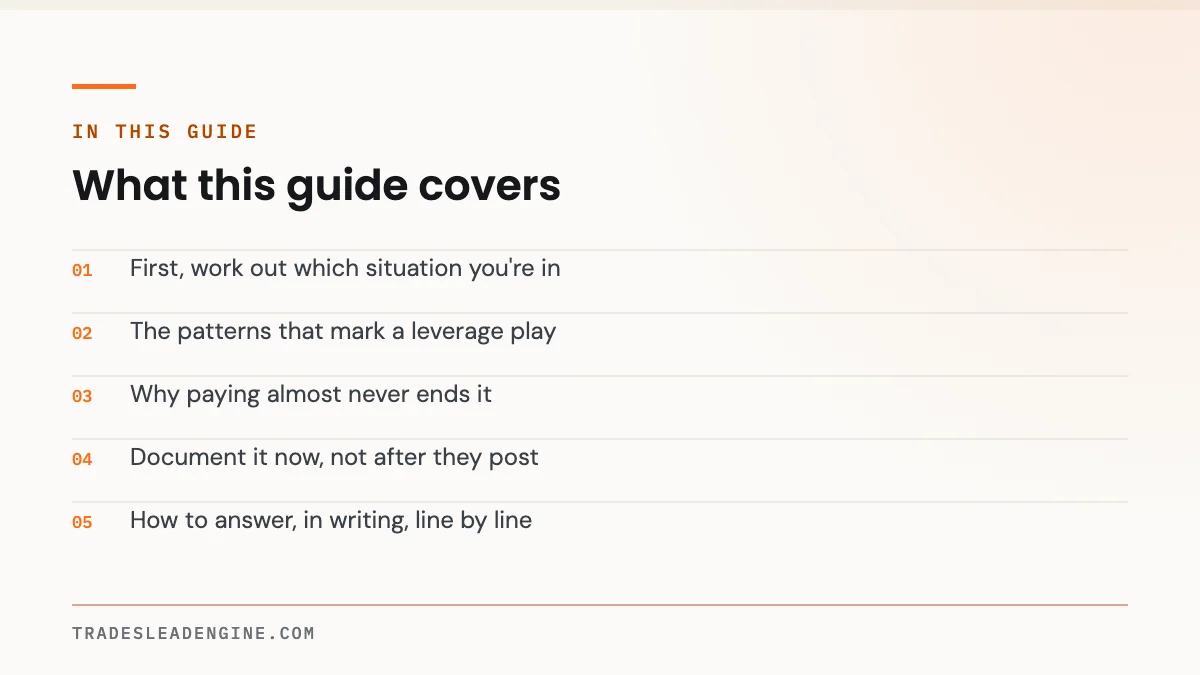
What’s in this guide
- First, work out which situation you’re in
- The patterns that mark a leverage play
- Why paying almost never ends it
- Document it now, not after they post
- How to answer, in writing, line by line
- What Google’s policy actually covers here
- The lawyer-letter trap: 16 CFR §465.7
- If they post it anyway
- Questions contractors actually ask
First, work out which situation you’re in
Before you write a word, answer one question with your file open rather than from memory: is there a real, specific, documented service problem behind this?
Not “were they happy.” Not “did they seem difficult.” Is there something in the job — a callback that never got scheduled, a part that failed, a permit that didn’t get pulled, a crew that left a mess — that a reasonable person would be upset about? Pull the work order, the photos, the invoice and the call log before you decide.
The fork that decides everything else
Same message, two entirely different situations — and two responses that share almost nothing.
If the answer is yes, you have a service failure with an ugly wrapper. Fix the service failure. The threat is the part you ignore — not out of strategy, but because the remedy is the same whether they threatened you or not, and because a customer whose problem gets solved almost never posts the review anyway.
The most common root cause we find behind a threat like this isn’t bad workmanship at all — it’s a callback nobody answered for four days, which is its own expensive habit and one we’ve put numbers on in what a missed call actually costs a Texas contractor.
If the answer is no — there is no identified defect, no callback request, no description of what actually went wrong, and the first communication after the job was a demand for money — you’re in the second situation, and the rest of this guide is about that one.
This is general information about published platform policy and published federal rules. It is not legal advice, and nothing here characterises any particular person’s conduct as a crime. Whether a specific demand crosses a legal line in Texas depends on facts, wording and intent that only a lawyer reviewing your actual messages can assess. Before you send a formal response, involve an attorney, or contact law enforcement, talk to a Texas attorney about your specific situation.
The patterns that mark a leverage play
None of these on its own proves anything. Several together tell you what you’re looking at.
| Signal | Genuine dissatisfied customer | Leverage play |
|---|---|---|
| What they complain about | Specific: a part, a date, a room, a person, a line on the invoice | General and shifting: “the whole job was a disaster,” details change between messages |
| What they ask for | The problem fixed — money only if a fix isn’t possible | A number, immediately, usually the full invoice regardless of what was delivered |
| When the review comes up | Late, if at all, usually after they feel ignored | In the first message, before you’ve been given a chance to respond |
| Willingness to let you look | Wants you back on site to see it | Refuses access, or keeps rescheduling, or says it’s “too late for that” |
| Timing relative to payment | Any time, often right after completion | Frequently right after final payment clears, or right before a warranty window closes |
| Language | Frustrated, sometimes angry, but about the work | Transactional about the review itself — naming the star rating, the platform, or how many people they’ll tell |
| Their history | Nothing notable | A public review profile showing similar one-star reviews of other contractors, often in the same trade |
| Response to a partial remedy | Engages with it | Escalates the number, or adds a deadline |
One thing worth doing in the first ten minutes: click the person’s Google profile and look at their other reviews. Contractors on the Mike Holt forum describe exactly what a pattern looks like when they find one:
I’ve been doing some digging on them, they probably put these things out there to extort money.
JoeyD74, Mike Holt’s Forum
That’s one electrician’s read of one situation, not a finding — but the underlying move is right. Look at the pattern before you decide anything, and screenshot it while it’s visible.
Why paying almost never ends it
The case for paying is that $2,400 is less than a one-star review costs you. Hold that number up against what actually follows.
First, the refund doesn’t buy silence. There is no enforceable agreement in most of these exchanges — you send the money, and they retain every ability to post anyway. Contractors discover this constantly. Second, if you condition the refund on the review being withdrawn, you have now done something prohibited: Google’s policy bars merchants from offering incentives “in exchange for posting any review or revision or removal of a negative review.” The refund-for-silence deal is a policy violation on your side of the table, and we lay out the full rulebook in what Google and the FTC actually allow around reviews.
Third — and this is the one shop owners underrate — it is repeatable. A person who has learned that this particular contractor pays will use it again, and the trades talk — in a market like Austin the same handful of names come up on every job site. Fourth, you’ve now got an accounting problem: a full refund on a completed job, with no documented defect, is a hole in your records that your bookkeeper and, potentially, a future dispute will both ask about.
None of which means never refund. It means: refund because the work justifies it, document why, and never because of the review. If those two happen to coincide, write the file so it shows the first reason.
Decide the remedy as though the review threat had never been sent. If the work warrants a partial credit, issue the partial credit. If it warrants nothing, offer nothing. Then communicate that decision in a tone so flat and so procedural that it would look completely unremarkable if they screenshot it and post it — because they will.
Every difficult part of this becomes simple once you stop letting the threat set the price.
Document it now, not after they post
Do this in the first hour, before you reply. It takes twenty minutes and it’s the difference between a strong report later and a story nobody can verify.
- Preserve the messages in their original form. Screenshots with visible sender details, timestamps and full thread context. Voicemails exported, not just left on the phone. Emails forwarded to an archive address rather than flagged.
- Write a dated file note the same day: what was done, what was paid, what they said, what you offered. Contemporaneous notes carry weight that reconstructed memory does not.
- Pull the job file together in one place: signed scope, change orders, before-and-after photos, inspection or permit records, delivery tickets, technician notes, the invoice and the payment record.
- Screenshot their public review profile — their other reviews, the dates, the businesses. If there’s a pattern, that’s the single most useful piece of evidence you will have later, and it can disappear.
- Move everything to written channels. Reply by email or text rather than by phone. If you do speak to them, follow it with a short written summary of what was discussed — and note that Texas call-recording rules have their own requirements, which is a separate question for your attorney.
Most contractors start documenting after the review lands. That is not analysis, it’s archaeology — and by then the threatening message has often been deleted from their side, the review profile has been cleaned up, and what you have left is your word.
How to answer, in writing, line by line
One reply. Short. Written as though it will be read by a stranger, because it probably will be.
Acknowledge receipt without conceding anything. “Thanks for getting in touch — I’ve reviewed the file for the work we completed on [date].”
Offer the inspection. “I’d like to come out and look at the work myself, at no charge, at a time that suits you.” This is the most important sentence in the message. It is a genuine offer, it costs you a truck roll, and the response to it tells you more than anything else in the exchange.
State your position on the money in one sentence, without justifying it at length. “Based on the completed scope and the inspection records, a full refund isn’t something we’re able to do.” No paragraph of reasons. Reasons invite a rebuttal.
Say nothing about the review. Don’t acknowledge the threat, don’t ask them not to post, don’t say you’re disappointed they’d threaten you. Any sentence referencing the review can be read as an attempt to influence whether it gets posted, which is territory you don’t want to be standing in.
Close with a real door open. “If there’s something specific that isn’t right, tell me what it is and I’ll take care of it.” Then stop replying. One reply, not six. Repeated exchanges produce a sentence you’d rather not have written.
What never goes in the message: the word “lawyer.” Any reference to legal action. Any suggestion about what will happen to them if they post. Any sarcasm. Any mention of their other reviews. Any accusation of extortion or fraud — that’s a characterisation with legal weight and it is not yours to make in a text message.
What Google’s policy actually covers here
A common hope is that Google will simply remove a review that came attached to a demand. Be realistic about what the policy does and doesn’t reach.
What it does cover: reviews from people who were never customers, which is fake engagement; reviews posted “from multiple accounts by or at the request of one person”; content “based on a conflict of interest,” which Google says “may include current or former employment, a contractual or consultory relationship”; and harassment, personal information or obscenity, which are separate restricted-content categories.
What it does not cover: a real customer posting a harsh, one-sided, even wildly unfair account of a real job. Google removes policy violations, not inaccuracy. A review is not removable simply because the person demanded money first — Google has no published category for that, and no route to submit the text messages as evidence.
Where the demand does matter is if the reviewer never actually hired you. That happens more than you’d think: a person who called for a quote, never proceeded, and posts anyway. That’s a genuine fake-engagement report, and your records are the proof. The report and appeal process — including the fact that you only get one appeal — is documented in full in how to remove a fake Google review and what to do when Google says no.
Find out how much one bad review would actually cost you
The free Lead Engine Scorecard shows your review count, rating and recency against the contractors ranking above you — and how far a single one-star would move your average. Most shops are more exposed than they think.
Get the free Scorecard
Or call (726) 224-4920 — same business day reply.
The lawyer-letter trap: 16 CFR §465.7
Here is the advice you’ll get within three posts on any contractor forum where this comes up. On a Mike Holt thread about a bad review, it arrived almost immediately:
Sounds like you might have to pay a lawyer to send a threatening letter
Coppersmith, Mike Holt’s Forum
It’s the intuitive move, it feels like taking control, and in 2026 it is the single riskiest thing in this entire guide.
The FTC’s Rule on the Use of Consumer Reviews and Testimonials, 16 CFR Part 465, took effect October 21, 2024. Section §465.7 addresses review suppression, and it prohibits using “unfounded or groundless legal threats, physical threats, intimidation” or false accusations to get a review removed or prevented.
Read the first three words again: unfounded or groundless. The Rule is not aimed at businesses with real claims defending themselves. It is aimed at exactly the thing the forum advice describes — a letter whose purpose is to be threatening rather than to be correct. If there’s no viable claim behind it and its function is to frighten someone out of posting, that is the conduct the section names. And the maximum civil penalty under FTC Act §5(m)(1)(A) is $53,088 per violation, subject to annual inflation adjustment.
So the calculus inverts. The scary letter was supposed to be the cheap way out of a $2,400 problem. It can instead be the expensive way into a federal one, on top of the near-certainty that the letter gets photographed and posted, which is a far worse story than the review would have been.
| Move | Standing | Why |
|---|---|---|
| A lawyer reviews your draft reply before you send it | Sensible | Costs an hour of time, catches the sentence you’d regret, and creates no threat at all. |
| A demand letter backed by a genuine, evidenced claim | Depends | Not what §465.7 targets — it addresses threats that are “unfounded or groundless.” Whether yours is founded is a question for a lawyer, in advance, not after. |
| A letter sent mainly to frighten, with no real claim behind it | Serious risk | The conduct §465.7 describes. Civil penalties up to $53,088 per violation, plus the near-certainty that the letter is published. |
| Telling them in writing what will happen to them if they post | Don’t | Reads as intimidation, creates a document you can’t take back, and hands them the better story. |
| Publicly accusing them of extortion in your review response | Don’t | A legal characterisation you’re not positioned to make, published to everyone who reads your profile. It can also create exposure of its own. |
| Reporting the matter to law enforcement | Fact-specific | Some demand conduct may be criminal under Texas law; whether a particular message qualifies is not something to self-diagnose. Talk to an attorney first and let them advise on whether and how. |
The useful version of “get a lawyer” is not “get a lawyer to threaten them.” It’s “get a lawyer to read what you’re about to send, tell you whether you have a claim, and tell you what Texas law actually says about the message you received.” That is a defensible hour of legal spend. The other thing is a gamble with a federal downside.
If they post it anyway
Assume they will, because it costs you nothing to be ready and everything to be surprised.
Report it only if it fits a policy category — they were never a customer, it contains personal information, it’s abusive, or it was posted from multiple accounts. Don’t report it because it’s untrue; that fails, and the appeal you burn is the only one you get.
Then respond publicly, and write it for the next reader rather than the reviewer. Keep it to four sentences. Say you’ve reviewed the file, say you offered to come out and inspect the work at no charge, and repeat the offer. Do not mention the refund demand, do not mention the threat, do not characterise their behaviour. The restraint reads as credibility, and the offer to inspect is the sentence that does the persuading.
This matters more than the review itself does. BrightLocal’s 2026 Local Consumer Review Survey of 1,002 US adults found 89% of consumers expect owners to respond, 80% are more likely to use a business that responds to all reviews, and 50% are put off by templated or generic responses. A short, human, specific reply to a hostile review does more for you than the review does against you.
Then go back to the only durable defence, which is depth. BrightLocal found 47% of consumers won’t use a business with fewer than 20 reviews and 74% want reviews from the last three months. Whitespark’s 2026 Local Search Ranking Factors survey puts review signals at roughly 17% of local pack weight and lists “sustained influx of reviews over time (rather than bursts)” as a factor in its own right.
A shop in the Hill Country with 140 current reviews absorbs this. A shop in El Paso with eleven does not — and that gap is the actual vulnerability, not the customer. The competitive version of that number, market by market, is in how many Google reviews you actually need to rank, and the profile side of it sits with Google Business Profile management.
Questions contractors actually ask
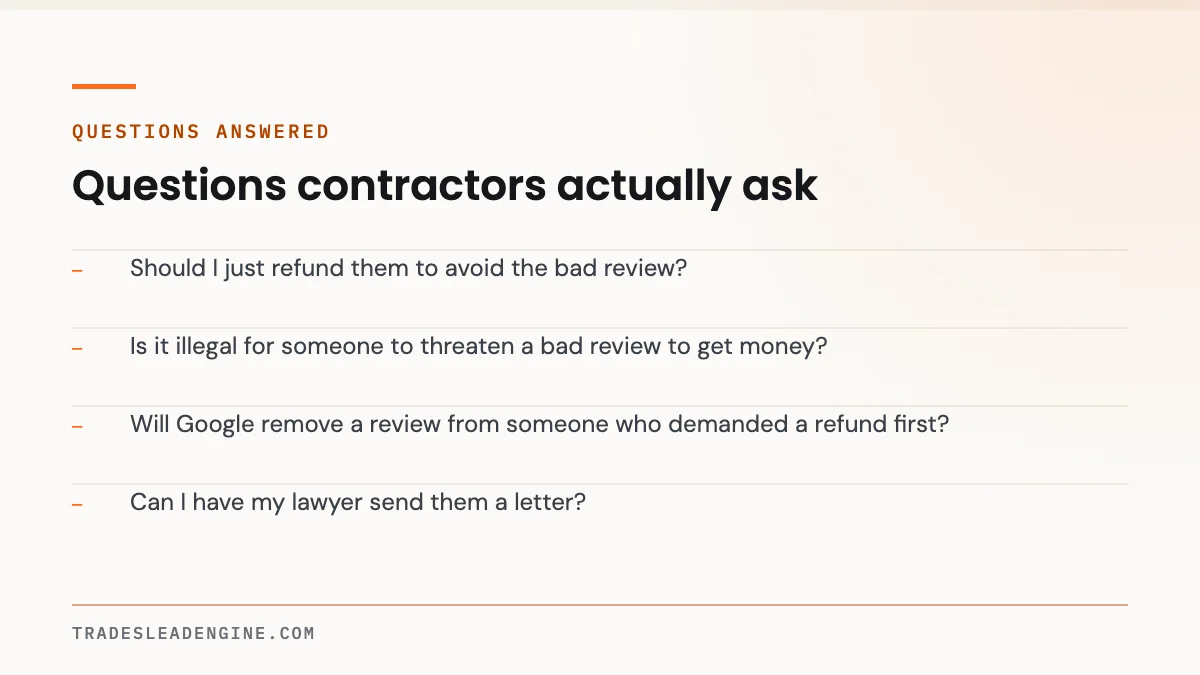
Should I just refund them to avoid the bad review?
Decide the refund on the merits of the work, not on the threat. There’s usually nothing binding them to stay quiet once they’re paid, so you may end up with both the refund gone and the review posted. Worse, conditioning a refund on the review being withdrawn is itself prohibited by Google’s policy, which bars offering incentives “in exchange for posting any review or revision or removal of a negative review.” If the work justifies a credit, issue it and document why — and the reason on file should be the work.
Is it illegal for someone to threaten a bad review to get money?
It depends entirely on the facts and the wording, and it’s not something to self-diagnose. Some demand conduct may cross legal lines under Texas law; plenty of aggressive messages don’t. Save every message in its original form with timestamps, write a dated file note, and have a Texas attorney read the actual text before you describe it as anything — including in your own public response.
Will Google remove a review from someone who demanded a refund first?
Not on those grounds. Google removes content that violates a published policy, and there’s no category for “the reviewer asked for money first,” nor any route to submit your text messages as evidence. If the person was never actually a customer, that’s different — that’s fake engagement, and your records are the proof. Report the specific violation, not the unfairness.
Can I have my lawyer send them a letter?
Be careful with this one. FTC Rule §465.7, effective October 21, 2024, prohibits using “unfounded or groundless legal threats, physical threats, intimidation” or false accusations to suppress a review, with civil penalties up to $53,088 per violation subject to annual inflation adjustment. A letter backed by a genuine, evidenced claim is a different thing from a letter whose purpose is to frighten. Have a Texas attorney tell you which one you’d be sending before anything goes out — and expect any letter to be published by the recipient.
What if the customer actually has a legitimate complaint?
Then the threat is noise and the defect is your real problem. Go look at the work in person, fix what’s wrong at your cost, and confirm the remedy in writing. Don’t mention the review at any point — you’re fixing it because it needs fixing. Customers whose problem gets genuinely solved rarely post the review they threatened.
Should I mention the review threat in my public response?
No. It reads as defensive to everyone who wasn’t in the exchange, it’s a characterisation of someone’s conduct published to the world, and it can create exposure of its own. Write four calm sentences about the work, repeat your offer to inspect it at no charge, and let the restraint make the point.
Can I refuse to work for that customer again?
Generally yes — you choose your customers, subject to anti-discrimination law and anything in your existing contract or warranty obligations. If there’s a live warranty on the completed work, that obligation doesn’t disappear because the relationship soured, so handle the warranty properly and decline the new work separately. Check both with your attorney if the job is large or the contract is unusual.
How do I stop a single bad review from mattering so much?
Volume and recency. A one-star on a profile with a dozen reviews moves your average by a third of a star and sits at the top of the page for months; on a profile with 150 current reviews it’s a rounding error nobody scrolls to. Ask every customer, every job, with no incentives and no filtering, and respond to all of them. That’s the only defence that works before you need it, and the scripts for it are in our contractor marketing playbooks.
What to do in the next hour
Screenshot everything, including their public review profile, before you reply to anything. Open the job file and answer the one question that matters — is there a real, documented problem here. Let that answer, and nothing about the threat, decide what you offer.
Then send one short written reply: you’ve reviewed the file, you’ll come out and look at the work at no charge, and here’s your position on the money in a single sentence. Nothing about the review. Nothing about lawyers. Then stop typing.
If it posts, report it only if it fits an actual policy category, answer it publicly in four calm sentences, and get back to work. The contractors who handle this well aren’t the ones with the best comeback — they’re the ones whose profile is deep enough that a single hostile review is visibly an outlier, which is a problem you solve months before it happens.
That’s the whole argument for treating reviews and reputation as an operating system rather than a fire drill, and it’s the first thing we look at when a shop calls us after a bad week. If you want a second set of eyes on your situation, get in touch — we’ll tell you honestly whether it’s a real problem or a survivable one.
Build the profile that makes this a non-event
The free Lead Engine Scorecard benchmarks your reviews against local competitors, shows how exposed a single one-star would leave you, and lays out a compliant review system that runs without you chasing it.
Get the free Scorecard
Questions first? leads@tradesleadengine.com · (726) 224-4920
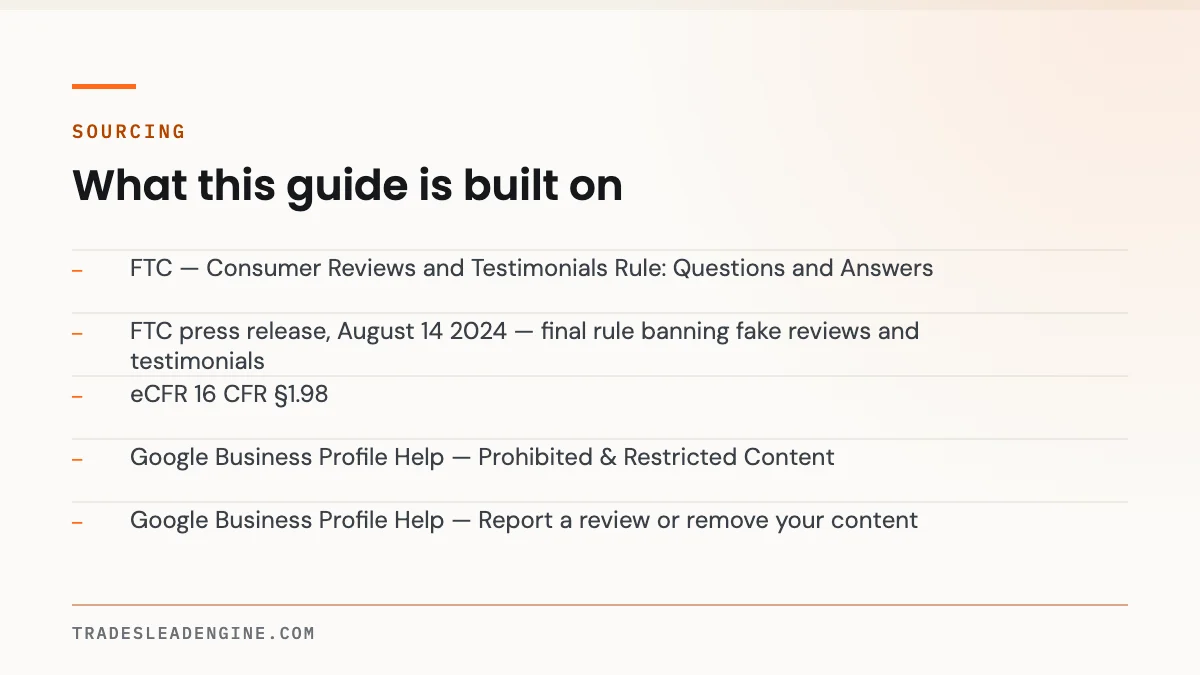
Sources
- FTC — Consumer Reviews and Testimonials Rule: Questions and Answers (16 CFR Part 465; §465.7 review suppression via “unfounded or groundless legal threats, physical threats, intimidation”)
- FTC press release, August 14 2024 — final rule banning fake reviews and testimonials (effective October 21, 2024)
- eCFR 16 CFR §1.98 — $53,088 maximum civil penalty per violation for penalties assessed after January 17, 2025, subject to annual inflation adjustment
- Google Business Profile Help — Prohibited & Restricted Content (fake engagement; incentives for “revision or removal of a negative review”; conflict of interest)
- Google Business Profile Help — Report a review or remove your content (reporting path; one-time appeal)
- BrightLocal — Local Consumer Review Survey 2026 (n=1,002 US adults, published February 2026)
- Whitespark — Local Search Ranking Factors 2026 (47 practitioners; review signals ~17% of local pack weight)
- Mike Holt’s Forum — Online reviews, bad one
This guide is general information about published platform policy and published federal rules, not legal advice, and it does not characterise any individual’s conduct as criminal. Whether a particular demand crosses a legal line in Texas depends on facts only an attorney reviewing your actual messages can assess. Forum quotes are individual opinions, reproduced as posted.