
A one-star review lands on a Friday afternoon. The name doesn’t match any customer in your system. The complaint describes a job you didn’t do, in a city you don’t work, with a price you’d never quote — the kind of thing roofing companies see every storm season and plumbers see year-round. You report it, you get an automated acknowledgement, and eleven days later you get an email saying the review doesn’t violate Google’s policies.
The advice you’ll find at this point is a wall of identical blog posts that all stop in the same place: report it, appeal once, “be patient,” and if that fails, “focus on getting more positive reviews.” That last line is not a plan. It’s what you write when you’ve run out of things to say.
The structural reason those posts stop there is that the removal process genuinely does end. Google’s documented path is report, wait, and one appeal — and then there is no further published route. Everything after that is either a workaround, a different channel, or a decision about whether to live with it. That’s uncomfortable to write, so most people don’t.
This piece covers the full path for getting a fake Google review taken down. What actually qualifies for removal under policy versus what merely feels unfair. How to report it properly so you don’t waste your one appeal. Real timelines. Then sections five through eight — what to do when the appeal fails, how to respond publicly to a review you can’t remove, the arithmetic of burying it, and the narrow set of circumstances where a lawyer is the right call rather than an expensive reflex.
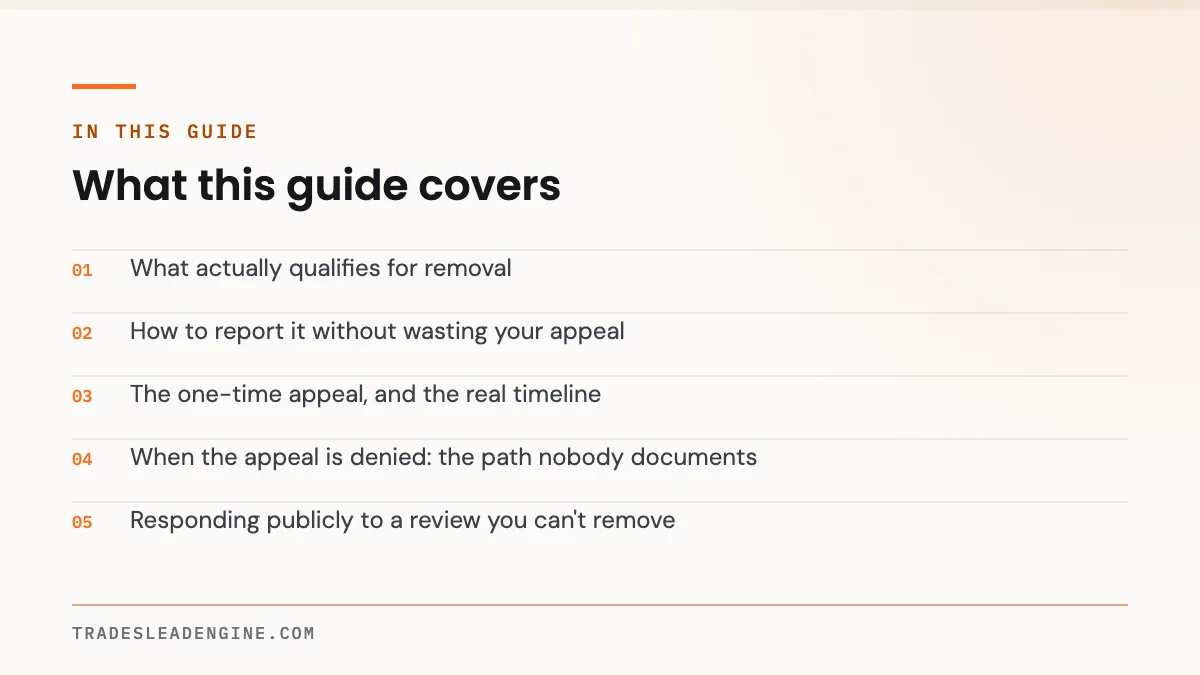
What’s in this guide
- What actually qualifies for removal
- How to report it without wasting your appeal
- The one-time appeal, and the real timeline
- When the appeal is denied: the path nobody documents
- Responding publicly to a review you can’t remove
- The arithmetic of burying one bad review
- When legal action makes sense, and when it doesn’t
- Questions contractors actually ask
What actually qualifies for removal
Google does not remove reviews for being untrue. It removes reviews for violating a published content policy. Those are completely different tests, and the gap between them is where almost every failed report lives.
A customer who says your tech was rude when he wasn’t, who claims you charged $1,400 when the invoice says $600, who is furious about a warranty term he agreed to in writing — none of that is a policy violation. It’s a disputed account of a real transaction, and Google’s position is that the disputed account is exactly what a review platform is for.
What is a policy violation, under the Maps user-generated content policy:
| The review | Removable? | Policy basis, or why not |
|---|---|---|
| Left by someone who was never your customer | Yes | Fake engagement — content that doesn’t reflect a genuine experience. This is the strongest report you can file, and it’s the one to document hardest. |
| Posted by a competitor, or by an ex-employee | Yes | Conflict of interest: “current or former employment, a contractual or consultory relationship.” Competitor reviews fall under the same prohibition. |
| Same complaint posted from several accounts | Yes | “Content that has been posted from multiple accounts by or at the request of one person.” |
| Contains slurs, obscenity, threats or harassment | Yes | Restricted and prohibited content. Usually the fastest category to get actioned. |
| Publishes your home address, a phone number, or a customer’s private details | Yes | Personal information. Report this one immediately regardless of anything else in it. |
| Advertises another business or links out | Yes | Advertising and solicitation, plus spam. |
| About a different company with a similar name | Yes | Off-topic. Strong report if you can show the other company exists and matches the description. |
| Factually wrong about the price, the timeline or what was said | No | Not a policy category. A disputed account of a real job is protected opinion as far as the platform is concerned. |
| One star with no text at all | No | Ratings without text are permitted content. Frustrating, common, and not removable. |
| From a real customer who is being unreasonable | No | Genuine experience. Nothing in the policy requires a reviewer to be fair or proportionate. |
| About a subcontractor, a supplier or a manufacturer’s product | Sometimes | Arguably off-topic if it’s genuinely about a third party, but Google usually treats the whole job as your experience. Weak report; better answered publicly. |
Before you file anything, pick your category and write one sentence explaining how the review fits it. If you can’t write that sentence, the report will fail, and it will burn your appeal on the way.
This guide covers published platform policy and general principles. It is not legal advice. Defamation, business disparagement and related claims in Texas turn on specific facts, deadlines and elements that a non-lawyer will get wrong — including limitations periods that are shorter than people expect. Before you send anything that could be read as a legal threat, or file anything in court, have a Texas attorney review it.
How to report it without wasting your appeal
Two things to do before you touch the report button, both of which take fifteen minutes and both of which most contractors skip.
Screenshot everything. The review, the reviewer’s profile, their other reviews, the date, the star rating. Google’s removal process is opaque and reviews do vanish and reappear without notice — as one contractor put it on ContractorTalk, “google randomly removes reviews that were once posted are now gone.” If you end up escalating, the evidence you didn’t capture on day one is gone.
Search your own records. Run the reviewer’s name against your CRM, your invoicing system, your call log and your dispatch history. Include misspellings and the spouse’s surname. You need to be able to say, without hedging, “this person does not appear anywhere in six years of records,” because that sentence is the entire basis of a fake-review report.
The report itself
From your Business Profile on desktop: open Reviews, find the review, click the three-dot menu, choose Report review, and select the single category that fits best. Pick one and pick the strongest one. Reports that select “off topic” for a review that’s really a competitor attack get evaluated against the off-topic standard, and fail. If you can’t see a Reviews panel at all, your profile may not be verified or may be in a restricted state — that’s a different problem, and it’s covered in our guide to Google Business Profile suspensions.
Do not have six people report the same review from six accounts. It does not increase the weight of the report, and coordinated reporting behaviour is exactly the pattern Google’s own systems are built to detect.
The one-time appeal, and the real timeline
Google’s help documentation states plainly that “review evaluation typically takes several days.” In practice, contractors report anything from 48 hours to several weeks, and no acknowledgement in between. There is no status page and no case number for the initial report.
If the review isn’t removed, you get one more move. Google’s process allows a business to submit a one-time appeal through the Reviews Management Tool. One. Not one per week, not one per escalation — one, for that review, permanently.
The documented path, end to end
Google publishes four stages. Most guides cover the first three. Stage four is where the Help Community threads start.
Because you only get one, the appeal has to be written differently from the report. The report is a category selection. The appeal is an argument. Name the specific policy clause, state the factual basis in one or two sentences, and attach what you have. “This is unfair and it’s hurting my business” is not an argument under any policy Google publishes. “This reviewer does not appear in our customer records for the six years we have operated, and their profile shows four one-star reviews of plumbing companies in three different states posted the same week” is.
When the appeal is denied: the path nobody documents
Here’s the part that gets skipped. Look at the thread titles in Google’s own Business Profile Help Community and the pattern is impossible to miss:
“False review not removed after report, appeal, and escalation”
Google Business Profile Help Community, thread 425151662
“Fake review not removed after appeal”
Google Business Profile Help Community, thread 425823297
Those are titles, posted by business owners who had already done everything the standard advice tells you to do. “Fake review reported but not removed — why?” is another. “How long does it take for a Google review to be removed after submission?” is a fourth. This outcome is common enough to be a genre.
Most contractors stop at the denial email and conclude nothing else exists. That is not analysis. There are four remaining moves, they have genuinely different odds, and knowing which is which stops you from burning weeks on the worst one.
| Move | What it is | Realistic odds | Effort |
|---|---|---|---|
| Post in the Business Profile Help Community | Google’s public forum, staffed by volunteer Product Experts, some of whom can escalate genuinely strong cases to Google staff. The only free route with a human on the other end. | Low to moderate — better with hard evidence, near zero with “it’s untrue” | An hour to write it properly |
| New material change of facts | Not a second appeal — a new report on new grounds. If the reviewer edits the review to add a slur, links to a competitor, or posts your address, that’s a fresh violation in a new category. | Moderate, when the facts genuinely changed | Minutes, but you have to be watching |
| Legal route | Defamation or business disparagement against the author, not Google. Platforms generally aren’t liable for user content, so a court order runs at the reviewer. Fact-dependent and slow. | Situation-specific — see section 7 | Significant, with real cost |
| Stop trying and dilute it | Accept the review, respond to it well, and drive the volume and recency of genuine reviews high enough that one outlier stops mattering. This is what actually works most of the time. | High, over 60–90 days | Ongoing, but it’s work you should be doing regardless |
If you post in the Help Community, write it like a case file
Lead with the policy category, not the emotion. State what you checked and found — CRM, invoices, dispatch, call logs, the years covered. Give the reviewer’s public pattern if there is one. Include the dates you reported and appealed. Say explicitly that the appeal was denied. Do not paste the reviewer’s personal information, which will get your post removed and helps nobody.
Responding publicly to a review you can’t remove
This is the highest-return action available to you, and it’s the one contractors do worst, usually because they write it while angry.
The numbers make the case. BrightLocal’s 2026 Local Consumer Review Survey of 1,002 US adults found 89% of consumers expect owners to respond to reviews and 80% are more likely to use a business that responds to all of them. And the trap: 50% are put off by templated or generic responses. The copy-paste reply your software offers is measurably worse than a real one.
What consumers expect from your review responses
BrightLocal Local Consumer Review Survey 2026, n=1,002 US adults, published February 2026.
Write the response for the reader, not the reviewer. That single reframe fixes most bad responses. The reviewer has already decided. The person deciding is the homeowner in Corpus Christi scrolling your profile at 9pm — or in Houston, where a single one-star in a crowded market costs you more than it would in a thin one.
What a good response to a fake review does
- States calmly that you have no record of the job. “We’ve searched our records back to 2019 and can’t locate a customer, invoice or service call matching this name or address.” Factual, not accusatory.
- Invites correction. “If we’ve made an error, please email us or call the office and we’ll make it right immediately.” This is the line that convinces readers, because a fake reviewer never takes it up.
- Stays under four sentences. Length reads as defensiveness.
- Never names the reviewer, never speculates about who they really are, and never mentions a competitor.
- Never references a lawyer. More on why in section seven — this is the mistake with the most downside.
For a review that’s genuinely from a customer and just harsh, the structure is different: acknowledge, state what you did, state what you’d do, and move it offline. Don’t relitigate the invoice in public. Nobody reads a paragraph of point-by-point rebuttal and concludes the business was in the right.
Offer the remedy in public, hold the argument in private. A response that says “call the office and ask for me directly, I’ll take it from there” reads as confidence to every future reader, costs you nothing, and gives a genuinely unhappy customer a path that doesn’t involve escalating in public. It also means that when a review really is fabricated, your silence in the thread afterwards is the reviewer’s, not yours.
The arithmetic of burying one bad review
Dilution sounds like giving up. It isn’t — it’s the only one of the four remaining moves with high odds, and the arithmetic is more forgiving than most contractors assume.
The reason is that a star average is a mean, and means move fast when the denominator is small and slowly when it’s large. A profile sitting at 5.0 with twelve reviews drops to 4.67 when one one-star lands. Add twenty more five-star reviews and it’s back to 4.88. The same one-star on a profile with 200 reviews moves the average by two hundredths.
Which is why the honest answer to “how do I stop this happening again” is volume, not vigilance. An electrician on the Mike Holt forum put it about as well as it can be put:
If that’s the only review you have online I could see it deterring people… Just make sure you get reviews elsewhere so that looks like an outlier
Valewoodelectric, Mike Holt’s Forum
Two constraints on how you do it. First, it has to be compliant — no incentives, no gating, no staff quotas. Every one of those is a policy violation in its own right and we’ve documented the exact rules in what Google and the FTC actually allow when you ask for reviews. Second, it has to be steady rather than a burst: Whitespark’s 2026 Local Search Ranking Factors survey lists “sustained influx of reviews over time (rather than bursts)” as its own ranking factor, separate from raw count, alongside recency at #11 and review signals at roughly 17% of local pack weight overall.
Consumers apply the same filter. BrightLocal found 74% want reviews from the last three months, 68% require a minimum four-star rating, and 47% won’t use a business with fewer than 20 reviews. A single old one-star on a thin profile is a real problem. On a deep, current one it reads as what it is — an outlier. If you want the competitive version of that math for your own market, we work through it in how many Google reviews you actually need to rank, and the profile hygiene side sits with our Google Business Profile management.
Find out how exposed your profile actually is
The free Lead Engine Scorecard shows your review count, rating, recency and response rate next to the contractors ranking above you — so you can see whether one bad review is a crisis or a rounding error.
Get the free Scorecard
Or call (726) 224-4920 — same business day reply.
When legal action makes sense, and when it doesn’t
Contractor forums reach for a lawyer fast. On a Mike Holt thread about a bad review, the suggestion arrived within a few posts:
Sounds like you might have to pay a lawyer to send a threatening letter
Coppersmith, Mike Holt’s Forum
Understand what changed in 2024 before you act on that instinct. The FTC’s Rule on the Use of Consumer Reviews and Testimonials, effective October 21, 2024, includes §465.7, which prohibits review suppression through “unfounded or groundless legal threats, physical threats, intimidation” or false accusations. A demand letter backed by a real, well-founded claim is one thing. A letter sent purely to frighten someone into deleting a review, with nothing behind it, is the conduct that section describes — and the maximum civil penalty under FTC Act §5(m)(1)(A) is $53,088 per violation, subject to annual inflation adjustment.
So the lawyer question isn’t “can I scare them.” It’s “do I have a claim.”
When it can be sensible
- The review states a verifiable false fact — not an opinion — that you can disprove with documents. “They were never licensed” when you hold a current Texas license is a fact. “They were unprofessional” is not.
- You can show identifiable harm, and you have something better than a feeling to show it with.
- The author is identifiable, and worth pursuing. An anonymous account routed through a burner email may require a subpoena to unmask before anything else can happen.
- A pattern exists — the same person or business attacking you repeatedly, which changes the character of the case.
When it’s a mistake
- The review is a real customer’s honest opinion of a real job, however unfair it feels.
- You want the letter to be scary rather than correct. That’s the §465.7 problem, and it can convert a reputation annoyance into a regulatory one.
- The cost of the action exceeds the cost of the review, which for a single one-star on a healthy profile it almost always does.
- You haven’t thought about what happens when the reviewer posts the letter. That is the standard outcome now, and it is a far bigger story than the review was.
Note also that suing Google is generally not the route — federal law broadly shields platforms from liability for content their users post, so any claim runs at the author. If someone threatened a bad review to extract a refund in the first place, that’s a related but distinct problem with its own protocol, covered in what to do when a customer threatens a bad review unless you refund them.
Questions contractors actually ask
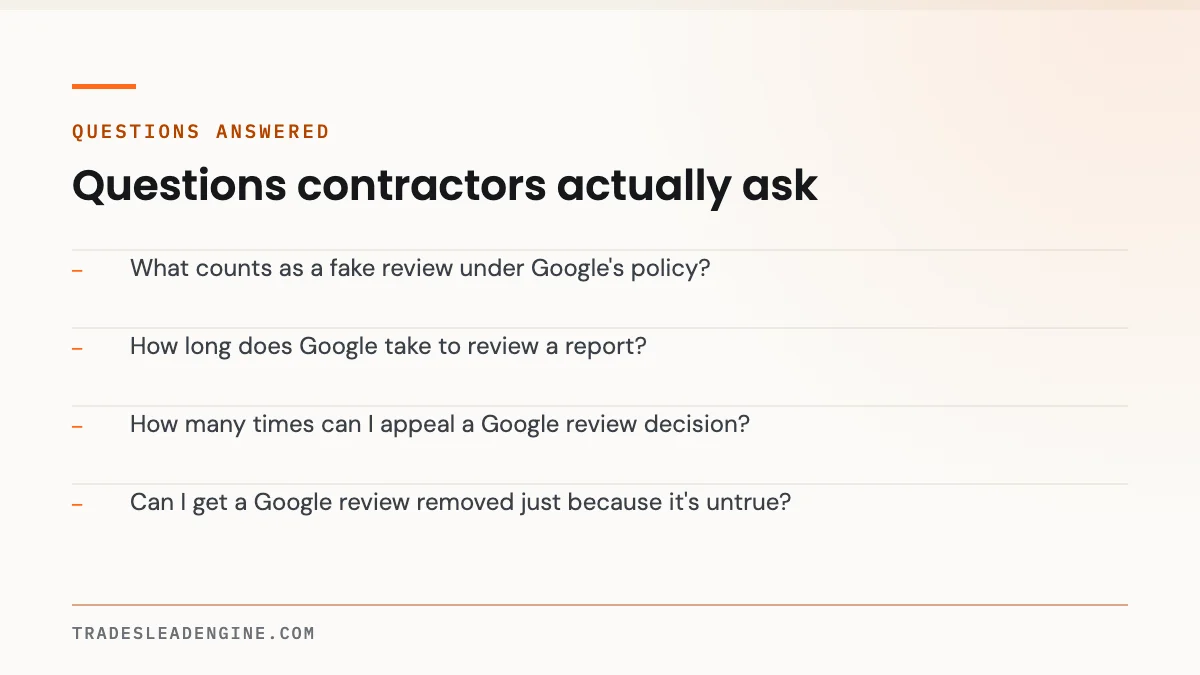
What counts as a fake review under Google’s policy?
Content that doesn’t reflect a genuine experience — a review from someone who was never a customer, reviews posted “from multiple accounts by or at the request of one person,” and content “based on a conflict of interest,” which Google says “may include current or former employment, a contractual or consultory relationship.” A review that’s simply wrong about the price or the timeline is not fake under the policy; it’s a disputed account of a real transaction, and Google won’t remove it on those grounds.
How long does Google take to review a report?
Google’s documentation says “review evaluation typically takes several days.” There’s no status page, no case number and no service-level commitment. Contractors report anything from two days to several weeks. If nothing has happened after two weeks, that’s normal rather than a sign your report failed.
How many times can I appeal a Google review decision?
Once. Google’s process provides a one-time appeal per review, submitted through the Reviews Management Tool. That’s why the report and the appeal should be written differently — the report selects a category, the appeal has to make an evidenced argument naming the specific policy clause. Spend real time on it, because there is no second one.
Can I get a Google review removed just because it’s untrue?
No. Google removes content that violates a published policy, not content that’s inaccurate. A customer’s mistaken or exaggerated account of a real job doesn’t fit any policy category. Your remedies there are a good public response and enough genuine recent reviews that the outlier reads as one.
What if the reviewer was never my customer at all?
That’s the strongest report available, so build it properly. Search your CRM, invoicing, dispatch and call records for the name, common misspellings and any related surname, and note the span of years covered. Screenshot the review and the reviewer’s profile, including any pattern of similar one-star reviews of other businesses. Then report under fake engagement and keep the same evidence ready for the appeal.
Should I respond publicly while I’m trying to get a review removed?
Yes. Responding doesn’t affect the report, and most reviews aren’t removed, so silence is the higher-risk choice. Keep it short and factual: you have no record of the job, and you’d like the chance to fix it if you’re wrong. Around 89% of consumers expect owners to respond, and half are put off by replies that read as templated, so write it yourself.
Can I sue someone over a fake review in Texas?
Sometimes, and it depends on facts a lawyer needs to assess. Claims generally require a false statement of fact rather than an opinion, an identifiable author, and demonstrable harm — and Texas has procedural mechanisms that can end weak claims early and shift costs. Since the FTC’s rule took effect in October 2024, §465.7 also makes unfounded or groundless legal threats aimed at suppressing a review a violation in their own right. Talk to a Texas attorney before sending anything.
Do paid review-removal services work?
Treat them with suspicion. The legitimate part of what they do — report under the right category, write an evidenced appeal — you can do yourself in an afternoon, and it’s described in this guide. The illegitimate part involves mass reporting, fake counter-reviews or spam tactics that put your profile at risk of action. Nobody has a private channel into Google’s review-removal queue, and anyone claiming a guaranteed removal is describing something that doesn’t exist.
What to do this week
If the review is live right now, the order matters. Screenshot it and the reviewer’s profile today, because that evidence disappears. Search your records and write the one sentence that explains which policy category it falls under. Report it under that category and nothing else. Then write your public response — four sentences, factual, offering the remedy — and post it while you wait.
If the appeal has already failed, stop spending time on removal. Take one hour to write a proper Help Community post if the evidence is genuinely strong, and otherwise move your energy to the thing with high odds: a steady, compliant, unfiltered flow of new reviews that pushes the outlier down the page and the average back up.
And build the system that means this matters less next time. A contractor in Dallas–Fort Worth with 180 current reviews and a habit of responding to every one of them can absorb a fabricated one-star without noticing. A contractor with nine reviews cannot. That gap isn’t luck, and it isn’t Google’s decision — it’s the one part of this whole process you fully control, which is why our reviews and reputation work starts there rather than with removal requests.
Stop being one review away from a bad month
The free Lead Engine Scorecard shows exactly how thin or how deep your review profile is against local competitors, and what a compliant, steady review flow would need to look like for your shop.
Get the free Scorecard
Questions first? leads@tradesleadengine.com · (726) 224-4920
Sources
- Google Business Profile Help — Report a review or remove your content (“review evaluation typically takes several days”; one-time appeal via the Reviews Management Tool)
- Google — Prohibited & Restricted Content, Maps user-generated content policy (fake engagement, conflict of interest, multiple accounts, restricted content)
- Google Business Profile Help Community — “False review not removed after report, appeal, and escalation”
- Google Business Profile Help Community — “Fake review not removed after appeal”
- Also in the same forum, cited by title only: “Fake review reported but not removed – why?” and “How long does it take for a Google review to be removed after submission?”
- FTC — Consumer Reviews and Testimonials Rule: Questions and Answers (§465.7, review suppression; effective October 21, 2024)
- eCFR 16 CFR §1.98 — $53,088 maximum civil penalty per violation for penalties assessed after January 17, 2025
- BrightLocal — Local Consumer Review Survey 2026 (n=1,002 US adults, published February 2026)
- Whitespark — Local Search Ranking Factors 2026 (review signals ~17% of local pack weight; recency and sustained-influx factors)
- Mike Holt’s Forum — Online reviews, bad one
- ContractorTalk — Getting customers to write reviews
Help Community threads are cited by title only; they are user-generated posts, not Google statements, and are included as evidence of how frequently the appeal-denied outcome occurs. Google publishes no removal statistics and no service-level commitment for review evaluation. Nothing here is legal advice.